Medical City · Simulation 04 of 12
Medical Device Mastery
Master device families through challenges.
What you do
Device Mastery
Each Device Mastery track takes one family of devices apart: what is inside, the physics that makes the clinical number, what the screen and alarms mean, the limits, how it fails, how it is kept safe and how to explain it.
Clinical engineers are trusted when they can say why a device shows what it shows. That is what turns an alarm, an odd reading or an incident into the right action instead of a swapped device and a repeat of the same harm.
43 challenges, each at Foundation, Practitioner and Expert level.
How it works
Step by step.
Inside the machine
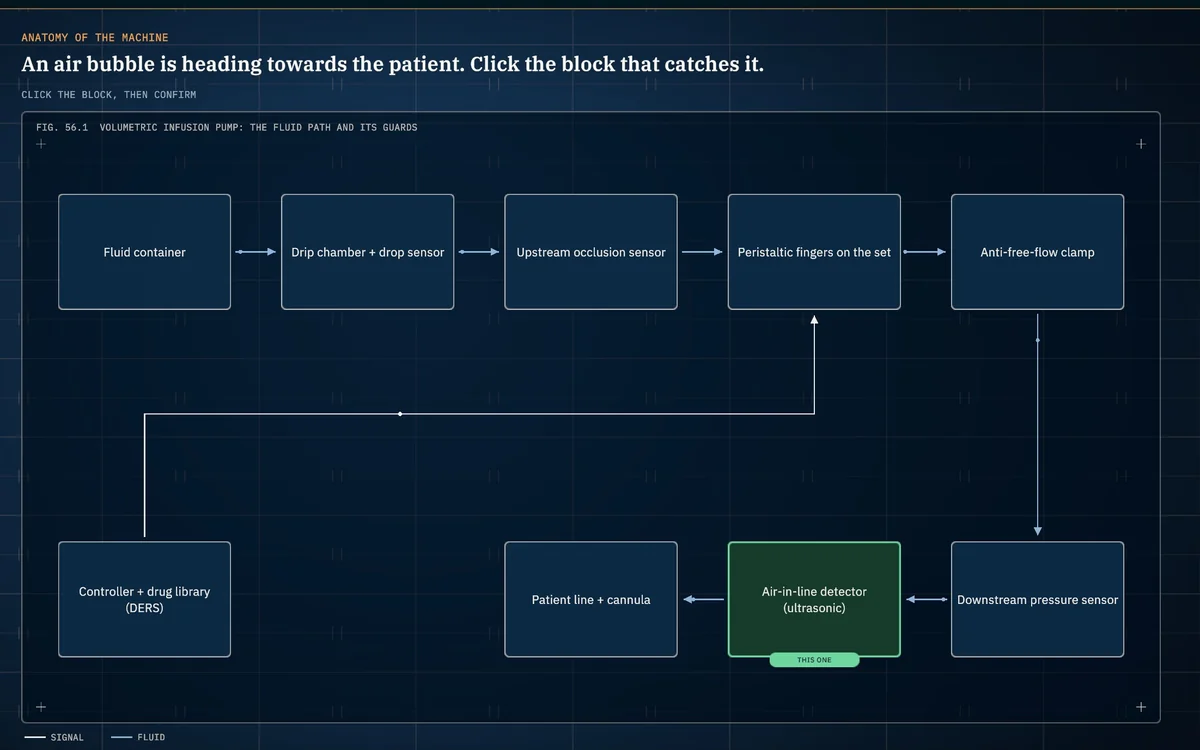
You find the part of a drawn schematic that does one job: the block that senses, filters, pumps, stores energy or stops a hazard. Every device is a chain of blocks: find the block, and you know where to look when it fails.
From physics to number
You put in order, or choose, how the device turns physics into the number or the therapy the clinician sees. Know how a number is made and you know when not to trust it.
Reading the screen
You read a drawn monitor, pump or ventilator screen and its alarm, and decide what is really happening. Check the patient and a second channel before you believe one alarm.
Numbers and limits
You estimate a specification or work out a value the device depends on. Always check the unit and the order of size before you trust a number.
How it fails
You trace a failure from the broken part to the symptom staff would see. A symptom points back to the part whose job has stopped.
Keeping it safe
You answer a safety question: classes, standards, protections and the rules that go with the device. Every safety rule exists because someone was once harmed without it.
Explain it to a clinician
You choose the best plain explanation of the device for a nurse, doctor or patient. Say what the device does, why it matters to this patient and what to do.
Same physics elsewhere
You find the same physics at work in a different device in the city. Learn the physics once and you understand every device that uses it.
Debrief
Your score, stars, the mastery of each device and a review of every challenge with its explanation. Study the concept you missed in the Device Lab, then try again one level harder.
What it trains
Skills and competencies.
- Name the parts that carry a device's signal, energy or fluid
- Explain the physics from sensor to clinical number
- Read alarms and screens as evidence
- Reason from a failed part to the symptom
In the BMEssentia competency framework, this simulation builds 8 competencies across Patient & Electrical Safety, Maintenance & Performance Testing, Device Technology & Fault Finding, Leadership & Professional Practice.
- Patient & Electrical Safety
Alarm safety and configuration
Understand alarm priorities, limits, latency and alarm fatigue, and verify that alarms reach the people who must act on them.
- Patient & Electrical Safety
MRI, radiation and laser safety
Work safely in MRI zones, ionising radiation and nuclear medicine areas and laser rooms, following IRR17, IR(ME)R and local rules.
- Maintenance & Performance Testing
Performance verification and calibration
Prove a device does what its specification says using analysers and simulators, and judge results against tolerance.
- Device Technology & Fault Finding
Device operating principles
Explain how a device turns physics and physiology into a clinical number or therapy, and where its limits come from.
- Device Technology & Fault Finding
Systematic fault diagnosis
Separate device faults from user, accessory, consumable and environmental causes, then test one hypothesis at a time.
- Device Technology & Fault Finding
Sensors, signals and instrumentation
Use multimeters, oscilloscopes and analysers to follow sensors and signal chains and find drift, noise and calibration errors.
- Leadership & Professional Practice
Communicating with clinicians and patients
Explain engineering findings in plain words, respect clinical boundaries and communicate openly with patients.
- Leadership & Professional Practice
Training, mentoring and reflective practice
Develop yourself and others: reflect on performance, train users, mentor juniors and transfer knowledge.
The takeaways
- Know how a number is made and you know when not to trust it.
- A symptom points back to the part whose job has stopped.
- Every safety rule exists because someone was once harmed without it.
The challenges
43 training cases.
- 01 Patient Monitoring
The bedside numbers everyone trusts: ECG, SpO2, blood pressure, temperature and the stethoscope.
- 02 Infusion & Medication Delivery
Pumps that put drugs into patients: volumetric, syringe and insulin pumps, glucose meters and nebulisers.
- 03 Respiratory & Anaesthesia
Ventilators, anaesthesia workstations, spirometers and the laryngoscope.
- 04 Cardiac Support & Resuscitation
Defibrillators, pacemakers, the balloon pump, EP mapping and IVUS.
- 05 Imaging: X-ray, CT, MRI, Ultrasound & Nuclear
How each modality makes contrast, and how each one fails: X-ray, CT, MRI, ultrasound, PET, SPECT, PEM, DEXA and TEE.
- 06 Neurophysiology & Neuromonitoring
EEG, EMG and nerve conduction, intraoperative neuromonitoring and transcranial Doppler.
- 07 Surgery & Energy Devices
Electrosurgery, lasers, hyperthermia, cryotherapy, the cranial drill, the stapler and the autoclave.
- 08 Endoscopy & Minimally Invasive
Endoscopes, colonoscopes, magnetic capsules, surgical robots, PCNL, lithotripsy and vitrectomy.
- 09 Renal & Extracorporeal
Haemodialysis, peritoneal dialysis, cardiopulmonary bypass, ECMO and urodynamics.
- 10 Neonatal & Maternal
Incubators, phototherapy and fetal monitoring, with the oximeters and pumps neonates depend on.
- 11 Diagnostics & Laboratory
Blood gas analysers, centrifuges, oesophageal manometry and the examination scopes.
- 12 Implants & Neuromodulation
Cochlear implants, hearing aids, VNS, CSF shunts, orthopaedic implants, prostheses and TENS.
- 13 Defibrillation, Cardioversion & External Pacing
Biphasic shocks, impedance, rhythm analysis, synchronised cardioversion and transcutaneous pacing, in depth.
- 14 Mechanical Ventilation in Depth
Modes, waveforms, time constants, sensors, alarms, NIV and transport ventilators.
- 15 The Anaesthesia Workstation
Gas supply, flowmeters, vaporisers, the circle, scavenging, pre-use checks and the laryngoscope, in depth.
- 16 Infusion Safety in Depth
Volumetric and syringe pumps, insulin pumps: accuracy, occlusion, siphonage, air and the drug library.
- 17 The ECG and Rhythm Monitoring
The 12-lead ECG, the Holter and the bedside monitor: leads, filters, interference, pacing and ST.
- 18 Pulse Oximetry and Capnography
Light through a finger and infrared through exhaled gas: how SpO2 and EtCO2 are made, and when they mislead.
- 19 Blood Pressure Measurement in Depth
Cuffs, Korotkoff sounds, oscillometric envelopes and the arterial line: where every pressure number comes from.
- 20 CT in Depth: Gantry, Dose and Artefacts
The CT scanner from slip ring to Hounsfield unit: tube heat, helical pitch, kernels, daily QA, dose metrics, artefacts and dose reduction.
- 21 MRI Physics & Safety: The Field Never Sleeps
5 mT line, ASTM labelling, zoning, quench, projectiles and burns.
- 22 Ultrasound Physics, Doppler & Probe Safety
Transducers, impedance, attenuation, artefacts, the Doppler equation, aliasing, output indices, TEE probe safety and TCD windows.
- 23 Radiography, Fluoroscopy & Bone Densitometry
Generator to detector in depth: focal spot, filtration and HVL, grids, AEC, DR and CR, exposure index, fluoroscopy dose and staff protection, IRR17, and DEXA.
- 24 Nuclear Medicine: PET, SPECT & PEM
Radiopharmaceuticals, annihilation and coincidence, collimators, scintillators, CT attenuation correction, SUV, dead time, QC and radiation protection.
- 25 Haemodialysis & Peritoneal Dialysis in Depth
Diffusion, convection and ultrafiltration, water treatment, circuit pressures, adequacy, HDF and the PD cycler.
- 26 ECMO & Cardiopulmonary Bypass in Depth
Pumps, membrane lungs, circuit pressures, anticoagulation, heat exchange, and the emergencies of extracorporeal support.
- 27 Intra-Aortic Balloon Counterpulsation
Timing, triggers, helium and alarms: running a balloon pump from the console and the waveform.
- 28 Electrosurgery in Depth
RF physics, cut and coagulation waveforms, return electrodes, stray energy in laparoscopy, smoke, implants, vessel sealing and the powered stapler.
- 29 Lasers and Thermal Therapies
Stimulated emission, wavelength and chromophore, laser classes, NOHD and eyewear, airway fire, hyperthermia SAR and cryoablation.
- 30 Sterilisation and Decontamination Engineering
Saturated steam, air removal, F0 and SAL, leak and steam-quality tests, validation, endoscope reprocessing and the centrifuge.
- 31 Flexible Endoscopy and Capsules in Depth
Video chips and fibre bundles, light sources, angulation, insufflation, damage patterns, narrow-band imaging and the magnetically steered capsule.
- 32 Surgical Robotics and Powered Surgical Tools
Teleoperation, the remote centre of motion, scaling and tremor filtering, 3D vision, instrument life, collisions, PCNL access and lithotripsy, and the cranial perforator.
- 33 Neonatal Intensive Care Devices in Depth
Thermal control, humidity, transport and radiant warmers, phototherapy dosimetry and neonatal oximetry, in depth.
- 34 Fetal Monitoring: the CTG in Depth
Doppler and autocorrelation, maternal heart rate confusion, toco and IUPC, the scalp electrode, CTG features and categories, telemetry and signal loss.
- 35 Point-of-Care and Laboratory Analysers in Depth
Glucose strip chemistries and interferences, ISO 15197, quality control, blood gas electrodes, calibration, temperature correction and centrifuge safety.
- 36 Neurophysiology and Intraoperative Neuromonitoring in Depth
The 10-20 system, montages, impedance and filters, EEG artefacts, EMG and nerve conduction, MEPs, SSEPs, anaesthesia and alarms, and TCD.
- 37 Implantable Cardiac Devices and Electrophysiology
Pacemakers, ICDs, electroanatomic mapping and IVUS: sensing, capture, interference and imaging inside the heart.
- 38 Hearing Devices and Neuromodulation in Depth
Cochlear implant coding, electrode telemetry and MRI; hearing aid gain, compression and feedback; VNS programming; TENS waveforms.
- 39 Diagnostic Optics: Eye, Ear and Skin
Direct and indirect ophthalmoscopy, light hazard, pneumatic otoscopy, dermoscopy modes, vitrectomy fluidics and retinal laser.
- 40 Orthopaedic Implants, Prosthetics and Surgical Power
Implant materials and wear, stress shielding, MRI of metal, sockets and myoelectric control, microprocessor knees, bone drilling heat and stapler firing.
- 41 Respiratory Diagnostics & Therapy Devices
Spirometry in depth, nebuliser technologies and particle size, high-flow nasal oxygen, NIV interfaces and leaks.
- 42 Urology and GI Function Testing
Urodynamics, high-resolution oesophageal manometry and shock-wave lithotripsy, with the stone decisions that link them to PCNL.
- 43 Grand Rounds
A mixed round across the whole city: the hardest cases, and the physics one device teaches about another.
Devices
Devices in this simulation.
- Cardiac Monitor
- ECG
- Pulse Oximeter
- Blood Pressure Monitor
- Holter
- Thermometer
- Stethoscope
- Infusion Pump
- Insulin Pump
- Glucometer
- Nebulizer
- Ventilator
- Anaesthesia Machine
- Spirometer
- Laryngoscope
- Defibrillator
- Intra-aortic Balloon Pump
- EP Mapping System
- Pacemaker
- IVUS
- X-ray
- CT Scanner
- MRI
- Ultrasound
- PET/CT
- SPECT
- PEM
- DEXA Scanner
- TEE Probe
- EEG
- EMG
- IONM
- Transcranial Doppler
- Electrosurgical Unit
- Skin Resurfacing Laser
- Retinal Laser
- Hyperthermia System
- Cryotherapy System
- Cranial Drill
- Surgical Stapler
- Autoclave
- Endoscope
- Colonoscope
- MCCE
- Surgical Robot
- PCNL System
- Lithotripter (ESWL)
- Vitrectomy System
- Haemodialysis Machine
- Peritoneal Dialysis
- Cardiopulmonary Bypass
- ECMO
- Urodynamics System
- Infant Incubator
- Phototherapy Unit
- Fetal Monitor
- Blood Gas Analyser
- Centrifuge
- Oesophageal Manometry
- Ophthalmoscope
- Otoscope
- Dermatoscope
- VNS
- Cochlear Implant
- CSF Shunt
- Orthopedic Implants
- Prosthetic Limbs
- Auditory Amplifiers
- TENS
Standards