Medical City · Device Lab 9 of 69
Intra-aortic Balloon Pump
A three-electrode ECG into the console, an R wave detector with a pacing-pulse rejection stage in front of it, and a timing controller that places inflation a learned interval after the R wave and fires deflation on the next R wave. The gas is helium and the balloon is the one the patient’s height indexes.
- 10 parts
- 2 configurations in the Device Lab
- Also called: Balloon Pump
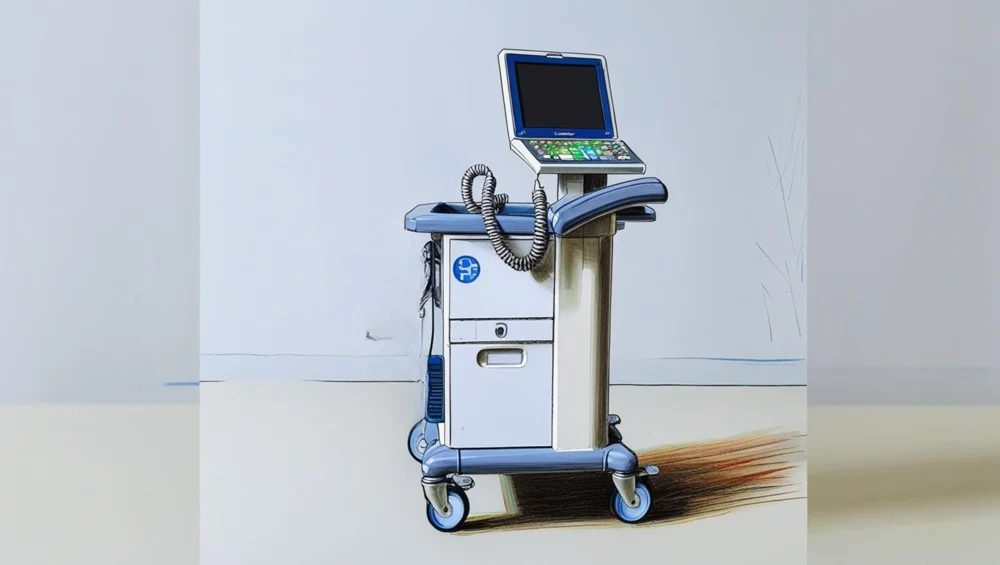
Configurations
The versions in the Device Lab.
ECG-triggered timing
A three-electrode ECG into the console, an R wave detector with a pacing-pulse rejection stage in front of it, and a timing controller that places inflation a learned interval after the R wave and fires deflation on the next R wave. The gas is helium and the balloon is the one the patient’s height indexes.
Pressure-triggered timing
The arterial pressure waveform from a transducer at the balloon tip into the console, a dicrotic notch detector with an amplitude threshold, a square-wave damping test that decides whether the channel can carry the notch at all, and a timing controller that fires inflation on the detected notch and places deflation a learned interval before the expected upstroke.
How it works
Explore it in the Device Lab.
The one number this device has
Leave both instants where they are and change only the arterial compliance. Then change only the balloon volume. Watch what happens to the augmented diastolic pressure and to the afterload reduction, and notice that only one quantity is moving underneath both of them.
Where the sign changes
Put the balloon volume and the patient where they are and move only the deflation instant, a few milliseconds at a time, from well before the next ejection to well after it. Watch the aortic pressure at the onset of that ejection.
Why the cylinder contains helium
Change only the gas. Keep the volume, the lumen, the drive pressure and the vacuum exactly where they are, and read off the fill time, the vent time and the rate at which one-to-one assist stops fitting inside a diastole.
Which instant is guessed
Set the current heart rate and leave it. Then change only the PREVIOUS beat’s rate, and watch which of the two instants moves. Do it on both configurations.
What the index cannot see
Inject a late deflation and then read the supply-and-demand ratio. It is still well above its unassisted value. Now read the end-diastolic pressure of the following beat and notice that it is higher than it would have been with no balloon at all.
The parts
Part by part.
Balloon membrane and its fold
A sleeve of polyurethane about a tenth of a millimetre thick, a couple of hundred millimetres long and sixteen or so across when it is open, wrapped tightly round the end of a catheter so that it goes down a hole a few millimetres wide. It is the only part of this machine that touches blood and the only part that moves.
Dual-lumen catheter shaft
A slim tube about two and a half millimetres across and something over seven hundred millimetres long, stiff enough to be pushed up an artery and flexible enough to follow an aortic arch. It carries printed depth markings along it and ends in a moulded Y hub with two arms, and it is the object the entire device is delivered through.
Helium shuttle lumen
A ring-shaped passage a fraction of a millimetre across, running the whole length of the catheter between the outer wall and the central tube. It is invisible, it has no moving parts, and it is the single component that decides whether this machine can work at the heart rate the patient happens to have.
Central lumen and tip pressure port
A tube under a millimetre across running down the middle of the catheter, opening at a port just beyond the distal end of the membrane. On the way in it carries a guidewire.
Radiopaque tip marker and the aortic window
A short dense band at the tip of the catheter, visible on a radiograph when nothing else useful is, plus the two anatomical limits it has to sit between. This component is not really an object: it is a constraint, and the marker exists so that somebody can check the constraint is being met.
Introducer sheath and haemostasis valve
A short tube through the wall of a femoral artery with a valve on the outside end, a small side arm with a tap on it, and a flat wing with two sutures through it. It is the hole this device is delivered through and the reason the leg beyond it has to be looked at every hour.
Helium cylinder, regulator and contents
A small aluminium cylinder in a cradle at the back of the console with a coloured collar, a valve, a regulator and a round contents gauge. It holds the only consumable the machine cannot work without, and the only thing that says how much of it is left is a dial somebody has to walk round the back and look at.
Gas isolator and volume-limited safety chamber
A clear chamber inside the cabinet with a flexible diaphragm across the middle of it and a graduated scale etched on the outside. On one side of the diaphragm is the gas that goes to the patient; on the other is the gas the console pushes.
Shuttle drive: bellows, compressor and vacuum
A bellows with a stack of rings on it, a small compressor, a vacuum reservoir the size of a large can and a motor to work them. This is the only assembly in the cabinet that moves, and its stroke is one balloon volume.
Solenoid valve manifold
A small machined block with three solenoids standing on it, each with a coil, a stem and a cap. One admits pressurised gas, one vents, and one connects the vacuum.
Next
Learn it, then ask about it.
- BMEssentia PlatformThe Intra-aortic Balloon Pump on the PlatformThe Device Library course: 13 sections from physics to maintenance.
- EssentiaAsk Essentia about the Intra-aortic Balloon PumpAnswers from named sources, with every claim cited.
- Device LabAll 69 devicesEvery Device Lab device, part by part.