References and editorial standards
One standard for every device.
Every device follows the same 13-section structure, from physics to ethics. Every page is written against published references and held to one editorial standard, so every learner and every teacher works from the same material.
The Reference Book
Every source, in one book.
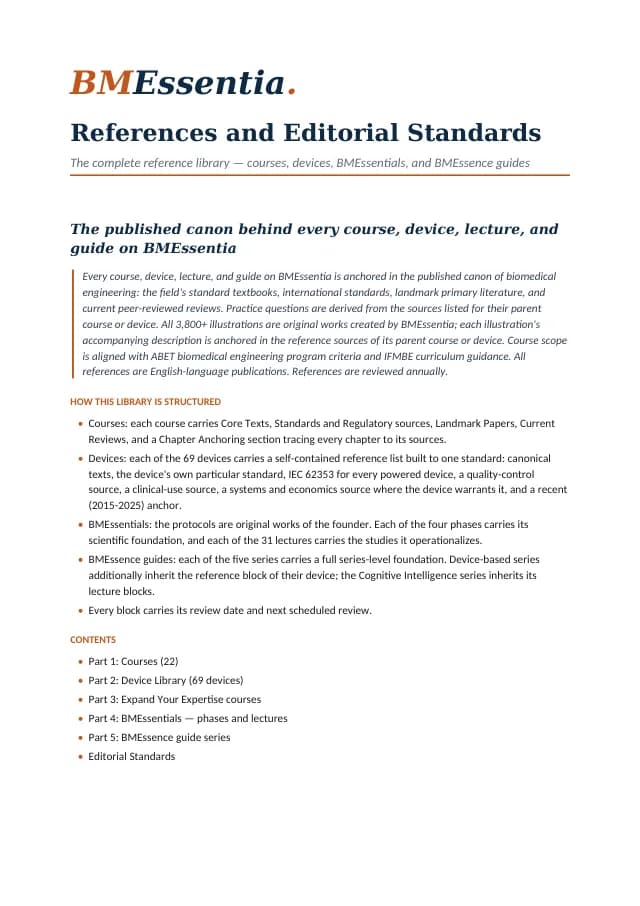
The Reference Book lists the published sources behind all 22 courses, all 69 devices, the BMEssentials lectures and the BMEssence guides, and closes with our editorial standards. Read it here, or download it and keep it.
Contents
Structure
The same 13 sections for all 69 devices.
Learn to read one device page in the Device Library and you can read them all. Each section answers one question, in the same order, every time.
- 01
Overview
What the device is, what it is for and where you meet it.
- 02
Operations
How it is set up, run and monitored in clinical use.
- 03
Importance
Why it matters to the patient, the clinician and the hospital.
- 04
Physics
The physical principles the device depends on.
- 05
Features
The main parts, controls and configurations, and what each one does.
- 06
Applications
The clinical uses, and the limits of each.
- 07
Physiology
The part of the body the device measures, supports or treats.
- 08
Safety
The hazards, the alarms and the protections built in against them.
- 09
Advancements
How the technology has developed and where it stands now.
- 10
In Research
What current research is exploring, described as research, not as settled practice.
- 11
Logistics
Procurement, installation, maintenance and the life of the device in a hospital.
- 12
Alternatives
Other devices or approaches that do a similar job, and how they compare.
- 13
Ethical
The ethical questions the device raises for patients, clinicians and engineers.
Sourcing policy
Written against published references.
Every page is written from published, checkable sources. We prefer primary and authoritative sources, and we use the most recent edition we can reach. The kinds of source we rely on:
- International standards for medical electrical equipment, risk management and healthcare facilities, such as the IEC 60601 series, IEC 60364-7-710 and ISO 14971
- Healthcare building and technical guidance, such as HBN and HTM documents
- Guidance from medical device regulators
- Peer-reviewed journals and review articles
- Established textbooks in biomedical engineering, physiology and medical physics
- Clinical guidelines published by professional bodies
- Manufacturers' published technical documentation, where it is publicly available
What we do not do
- Copy text or images from textbooks or manufacturers
- Present research findings as settled practice
- Rely on unsourced web pages or forums
- Invent values, figures or case details and present them as real
Sample data, such as the institutional dashboard on this site, is always labelled as sample data.
Review process
How a page is checked before you read it.
- 01
Written to one structure
Every device page is written to the same 13 sections, so nothing is skipped and every page can be compared with every other.
- 02
Checked against the sources
Facts, values and descriptions are checked against the references listed for that page before it is released.
- 03
Illustrations checked against the text
Every illustration is drawn for its page and checked so that what it shows matches what the text says.
- 04
Edited for clarity
Each page is edited for plain language, consistent terms and British spelling, so the material reads the same everywhere.
- 05
Reviewed over time
Pages are reviewed again when standards, guidance or the technology change, and whenever a reader reports a problem.
The same standard applies in Medical City. Scenarios are built against the standards the job uses, including HBN and HTM guidance, IEC 60364-7-710 and ISO 14971.
Corrections policy
When we are wrong, we fix it.
If you find an error, an out-of-date value or a missing reference, tell us. Use the contact page and choose Content and corrections as the topic. Name the device or course, the section and what you think is wrong, with a source if you have one.
Every report is read and checked against the sources. When a correction is confirmed:
- the page is corrected
- any illustration or question that depends on it is corrected too
- a significant correction is noted on the page it changed
We would rather be told than stay wrong.
For learning, not for clinical use
BMEssentia teaches how medical devices work. It does not replace the manufacturer's instructions for use, your organisation's procedures, local regulations or professional judgement. Always follow those when you work on real equipment or with patients.