Medical City · Device Lab 22 of 69
Haemodialysis Machine
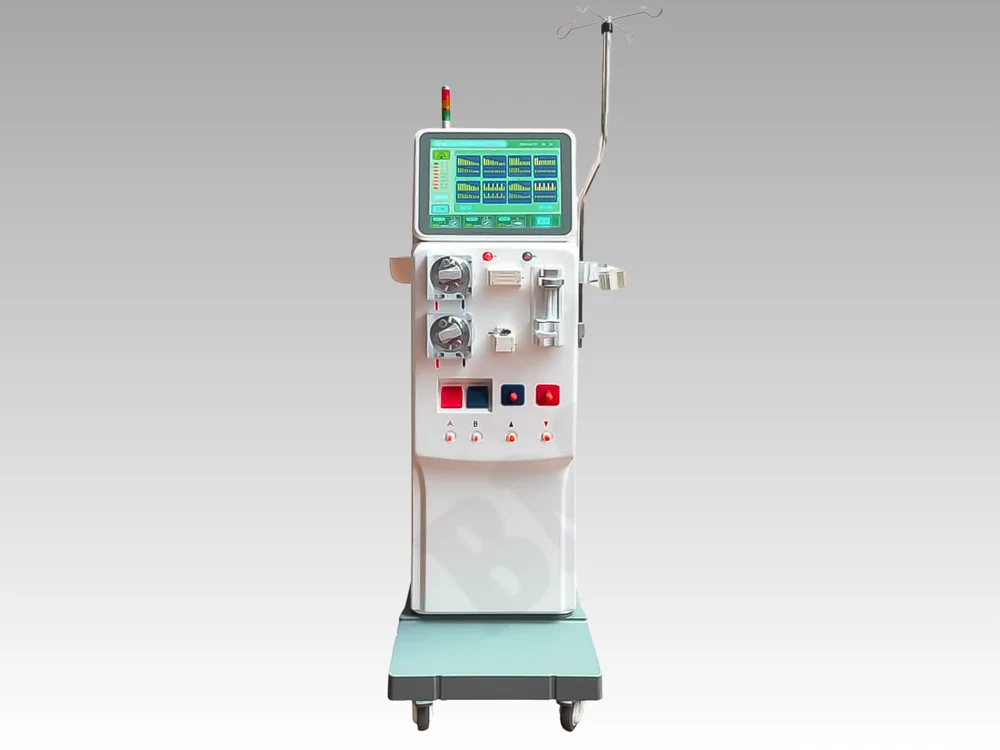
An extracorporeal blood circuit exchanges across a hollow-fibre membrane against a separate prepared dialysate stream. Access, blood handling, fluid preparation and protective sensing are different parts of the same treatment system.
- 10 parts
- Also called: Dialysis Machine, Hemodialysis Machine, Hemodialysis, Haemodialysis, Kidney Machine
Configurations
The versions in the Device Lab.
Hemodialysis
An extracorporeal blood circuit exchanges across a hollow-fibre membrane against a separate prepared dialysate stream. Access, blood handling, fluid preparation and protective sensing are different parts of the same treatment system.
Automated peritoneal dialysis
A pneumatic cycler moves dialysis solution through a disposable cassette and a single patient catheter. Fill, dwell and drain are separate phases; the peritoneum provides the exchange surface and blood remains inside the body.
Manual peritoneal dialysis
A gravity exchange set connects fresh solution, a patient transfer set and a drain bag. There is no powered cycler. The patient connection, bag heights, clamp states and clean connection workflow determine what can happen.
The parts
Part by part.
Housing
It is a box. That is the point, and it is why people stop looking at it.
Display
You will be tempted to call this the brain. It is not.
Blood pump
The machine never touches the blood. Read that again, because almost every wrong mental model of this pump starts by forgetting it.
Heparin
Blood that meets a plastic surface tries to clot. The entire extracorporeal circuit is one long plastic surface, so without anticoagulation the dialyzer would progressively clot off during treatment.
Dialyzer
Everything else in this room exists to get two liquids to this cartridge under the right conditions. The dialyzer is where the treatment actually happens, and it happens across a membrane you will never see.
Venous safety
Air in the venous line is one of the few failures in this circuit that can injure a patient in seconds. Everything in this assembly exists for that single scenario.
Pressure
These two thin branches are not delivering anything. They are the machine's only direct sense of what is happening inside a circuit it otherwise cannot see.
Saline
A clear bag of clear fluid hanging beside a machine full of other clear fluids. This is the single easiest component in the room to misidentify, and misidentifying it is not harmless.
Concentrates
Dialysate is not delivered to this machine. It is manufactured by this machine, continuously, during treatment, out of treated water and concentrated salt solutions.
Hydraulics
Open the lower cabinet and you are looking at the half of the machine nobody talks about. It prepares the dialysate, holds it at temperature, pushes it through the dialyzer, takes it away again, and controls the one thing in this treatment with no independent check: how much fluid is removed from the patient.
Simulations
Where it appears in the simulations.
Next