Medical City · Device Lab 48 of 69
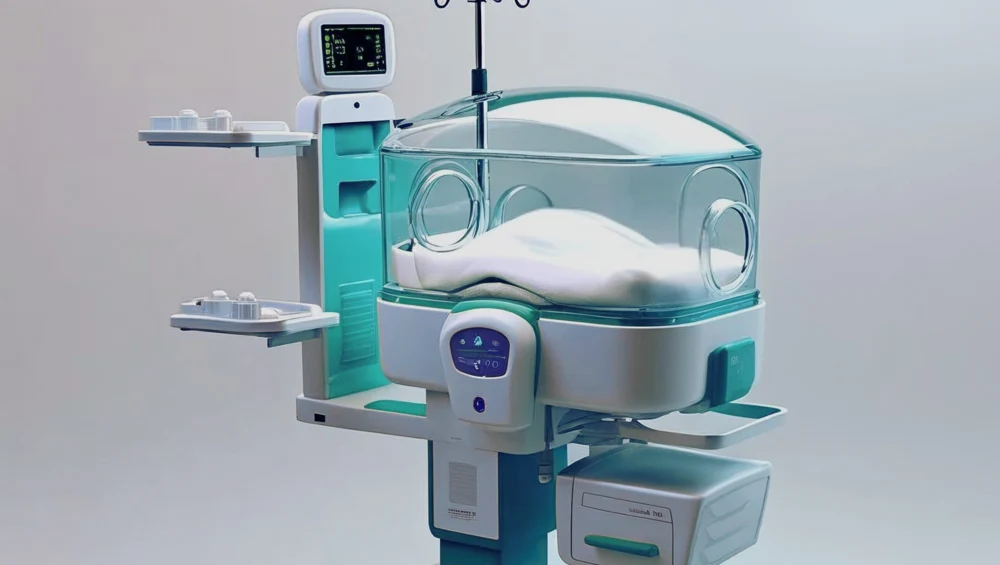
Infant Incubator
The loop closes on an air temperature sensor sitting at the defined reference point above the centre of the mattress. The controller compares that reading with a setpoint and modulates a heating element until they agree, which they do within about half a minute. Nothing in this configuration measures the baby, nothing touches the baby, and the baby’s temperature is whatever the resulting environment gives it.
- 10 parts
- 2 configurations in the Device Lab
- Also called: Neonatal Incubator
Configurations
The versions in the Device Lab.
Air control
The loop closes on an air temperature sensor sitting at the defined reference point above the centre of the mattress. The controller compares that reading with a setpoint and modulates a heating element until they agree, which they do within about half a minute. Nothing in this configuration measures the baby, nothing touches the baby, and the baby’s temperature is whatever the resulting environment gives it.
Skin-servo control
The same fan, the same element and the same hood, with the loop closed on a thermistor taped to the baby’s abdomen instead of on the air sensor. The controller drives the heater until the PROBE reads the setpoint, and the air temperature is no longer held at anything, it becomes the manipulated variable and goes wherever the baby’s losses require.
How it works
Explore it in the Device Lab.
The four routes, and which one the loop can reach
Set an infant and a compartment, then read the four heat-loss routes side by side against the infant’s total metabolic heat production.
What the second pane actually buys
Compute the hood’s resistance as the series chain it physically is, the film on the inside, a pane, an air gap, a pane, the film on the outside, and then compute the inner surface temperature from the fraction of that chain lying on the inside of it.
The one lever that is larger than the heater
Set a very preterm infant, then change only the humidity and watch the evaporative loss, the insensible water loss and the air temperature the loop demands.
Three time constants, and the display shows the fastest
Compute the thermal capacity of the compartment air, of the inner hood pane and of the infant, and divide each by its conductance to its surroundings.
Two loops, one hardware, opposite failures
Run the same infant, the same bay and the same humidity on both configurations, and change only which variable is being held.
The parts
Part by part.
Mains inlet, isolation and alarm battery
An inlet, a fuse, a switch and an earth stud on the service face, and behind them two things worth separating: a transformer that isolates the patient from the supply, and a sealed battery whose only job is to keep the alarm alive after the supply has gone.
Stand, column and castors
A wheeled base, a single telescoping column with a clamp collar and a foot pedal, a drawer slung under the machine and an intravenous pole on one corner. It looks like furniture and three of its properties are engineering ones.
Double-walled hood
Two panes of clear acrylic three millimetres thick with a ten-millimetre air gap between them, bonded into moulded edges, lifting off in one piece. It is what makes this machine recognisable across a room, and its inner surface is the single most consequential temperature in the device.
Iris portholes and front access panel
Four circular ports with soft silicone cuffs and hinged clear doors, and a front wall that is entirely a drop-down access panel. Everything that is ever done to this patient is done through one of them, and each one is a hole in the boundary the machine is maintaining.
Cable and tube access grommets
Slotted rubber discs in both end walls, four of them, through which a ventilator circuit, three infusion lines, a probe lead and a set of monitoring leads all pass at once. They cost almost nothing and they are the largest continuous leak in the compartment.
Mattress tray, tilt and slide
A moulded tray with a raised lip, running on steel rails so that it slides out over the dropped front panel, with a lever at the head end that tilts it about twelve degrees either way and a cassette slot underneath.
Mattress
A foam slab in a welded wipe-clean cover, with a fitted sheet over it and a rolled nesting support along one side. It is the route everybody names first when asked how a baby loses heat in an incubator, and it is under one per cent of the answer.
Air intake filter
A pleated cartridge behind a grille low on the back of the base unit, with a latch and a date window. Everything this patient breathes for however many weeks they are in here came through it.
Recirculating fan
A centrifugal impeller in a scroll housing, turning continuously for the whole of an infant’s stay. It is inside the compartment’s air circuit with the patient, which is not true of the cooling fan of anything else in this library.
Heating element
A sheathed resistance element wound as a helix between two ceramic terminals, in a stainless chamber in the air stream. A few hundred watts, and it is the only thing in this machine that adds energy to anything.
Simulations
Where it appears in the simulations.
Standards
The standards for this device.
Next