Medical City · Device Lab 3 of 69
PET/CT
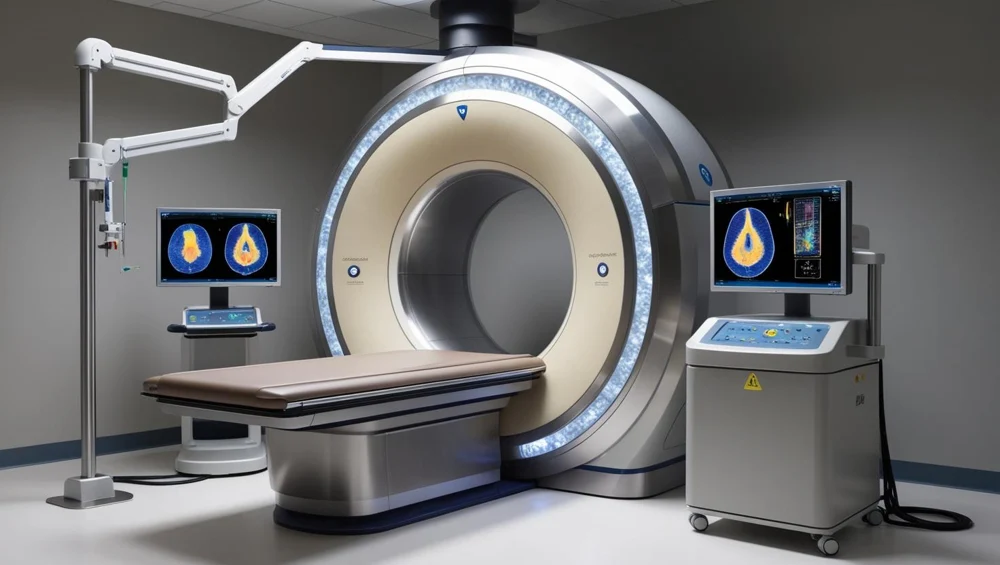
The scanner housing joins two measurement systems around one patient pathway. The front station contains CT; the PET ring sits behind it.
- 10 parts
- 2 configurations in the Device Lab
- Also called: Pet Scanner, Positron Emission Tomography
How it works
Explore it in the Device Lab.
When do two detections become a pair?
The exercise compares a fixed teaching event set under two timing windows. Widening the window admits more pairs, including unrelated ones. Predict the trade-off, change the window, then run and pause the illustration.
A detector sector loses response
A synthetic uniform object should produce a consistent response under controlled conditions. Reduce a detector sector response and watch the illustrative image develop a deficit. This is a teaching response model, not a reconstruction algorithm or a calibrated scanner.
Two datasets, one patient position
The synthetic emission pattern and anatomical outline start aligned. Move the reference outline and observe where the overlay no longer agrees. Real CT-based attenuation correction also depends on the relationship between these datasets.
Axial coverage changes the sampling
Compare a shorter axial ring with the longer architecture. The latter surrounds more of the patient axis at once. The mechanism displays a coverage band whose length follows the selected architecture.
The parts
Part by part.
Scanner housing
The scanner housing joins two measurement systems around one patient pathway. The front station contains CT; the PET ring sits behind it.
CT acquisition assembly
CT measures how an external X-ray beam is attenuated through the patient. Its source and opposing detector array rotate around the bore.
PET detector ring
The PET ring surrounds the patient with many detector modules. Each module contributes measurements; no single block produces the final image.
Scintillator crystals
The scintillator is where deposited gamma energy becomes light. A PET photon can interact in the crystal and produce a short flash too small and fast to see directly.
Silicon photomultipliers
The silicon photomultiplier converts the scintillator flash into an electrical signal. It contains many tiny avalanche cells that respond to incoming light.
Timing and energy readout
Readout electronics turn a pulse into estimates of energy, arrival time and channel location. Those estimates decide whether an event is useful.
Coincidence processor
The coincidence processor compares detections and accepts pairs that satisfy the acquisition conditions. A pair can be consistent with one annihilation, but timing agreement alone cannot prove that both photons came from the same event.
Patient support and drive
The patient support establishes the moving coordinate system shared by PET and CT. The narrow top, drive and position feedback work together.
Positioning controls
The gantry controls let the technologist position the support while watching the patient. Their location matters: a control is useful only when the operator can see the movement and reach the relevant stop or adjustment.
Acquisition console
The acquisition console is where examination intent meets machine state. It brings together identity, protocol, positioning and acquisition information.
Training cases
Guided training cases.
A repeatable detector-sector deficit
A uniform-phantom result shows a sector deficit. A patient examination is waiting.
The PET and CT maps disagree
The fused synthetic phantom has a spatial mismatch.
Cooling hold during acquisition
A cooling condition stops the teaching acquisition.
Local image, missing archive study
Local reconstruction is complete, but archive transfer failed.
Training cases written by BMEssentia for teaching.
Model notes