Medical City · Device Lab 19 of 69
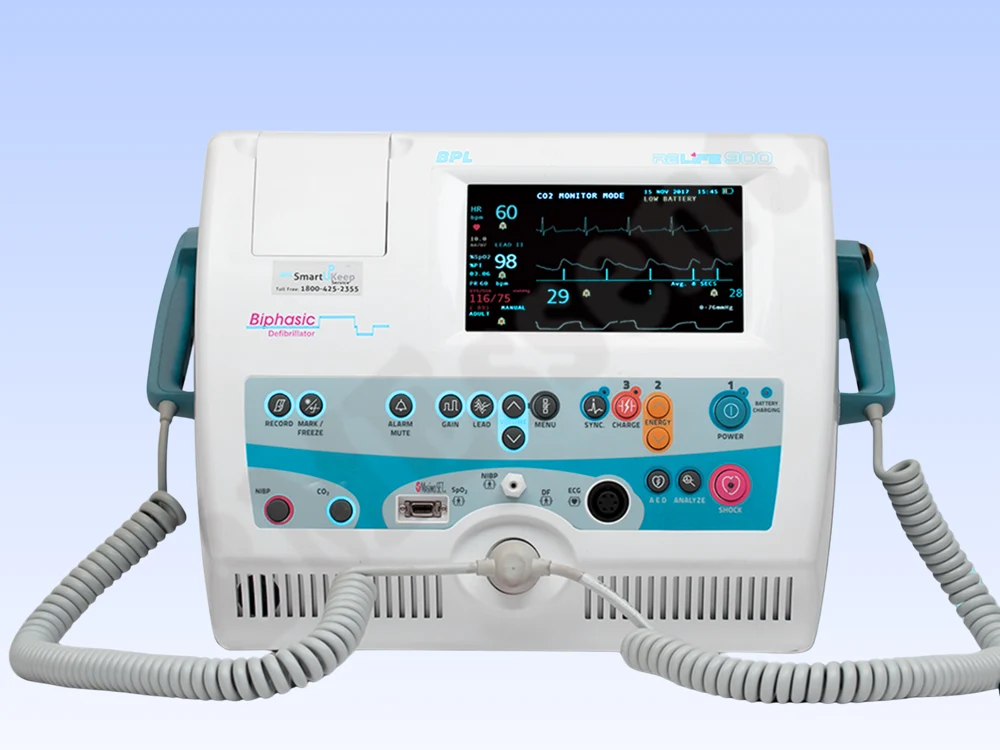
Defibrillator
This device spends years in a box on a wall, doing nothing, and then has to work perfectly in the hands of a frightened stranger. That combination, years of nothing followed by one attempt with no second chance, shapes everything about how it is built, tested and stored.
- 10 parts
- 6 configurations in the Device Lab
- Also called: Defib, Aed, Automated External Defibrillator
The parts
Part by part.
Housing
This device spends years in a box on a wall, doing nothing, and then has to work perfectly in the hands of a frightened stranger. That combination, years of nothing followed by one attempt with no second chance, shapes everything about how it is built, tested and stored.
Display
There is no ECG trace here and that is deliberate. A manual defibrillator shows a clinician a waveform because a clinician can interpret one.
Controls
Count the controls. There are almost none, and that is the single most important design decision in this device.
Battery
This battery will sit unused for years and must then supply a full resuscitation without warning. No other battery in this device family has that duty.
Therapy
On this device the therapy cable is usually already connected, and that is a decision about users rather than about engineering. A cable a bystander has to plug in correctly, under stress, is a step that can be got wrong.
Right Pad
This pad has to be placed correctly by somebody who has never done it, is not being supervised, and is reading a picture. Everything about it, its size, its backing, the diagram printed on it, exists to make a correct placement the obvious one.
Left Pad
The second pad completes the circuit, and where it goes decides what the shock reaches. Two electrodes do not deliver therapy to a place; they deliver it along a path between them.
Capacitor
This store holds enough energy to stop a heart, inside a device that a member of the public opens on a wall. That it can be operated safely by an untrained person is a claim resting entirely on the fact that they can never reach this component, and that the device decides when it is charged.
Charger
This converter has to take a standby battery to defibrillation voltage in the seconds after the device decides to treat, having done almost nothing for years beforehand. It is the least exercised assembly in the device and one of the most critical, which is why the self-test runs it deliberately.
Output
This assembly delivers a defined energy into a patient whose electrical properties nobody has measured, applied by someone with no training, through pads they placed from a picture. It compensates for almost all of that, automatically, in the moment.
Simulations
Where it appears in the simulations.
Next