Medical City · Device Lab 45 of 69
Blood Gas Analyser
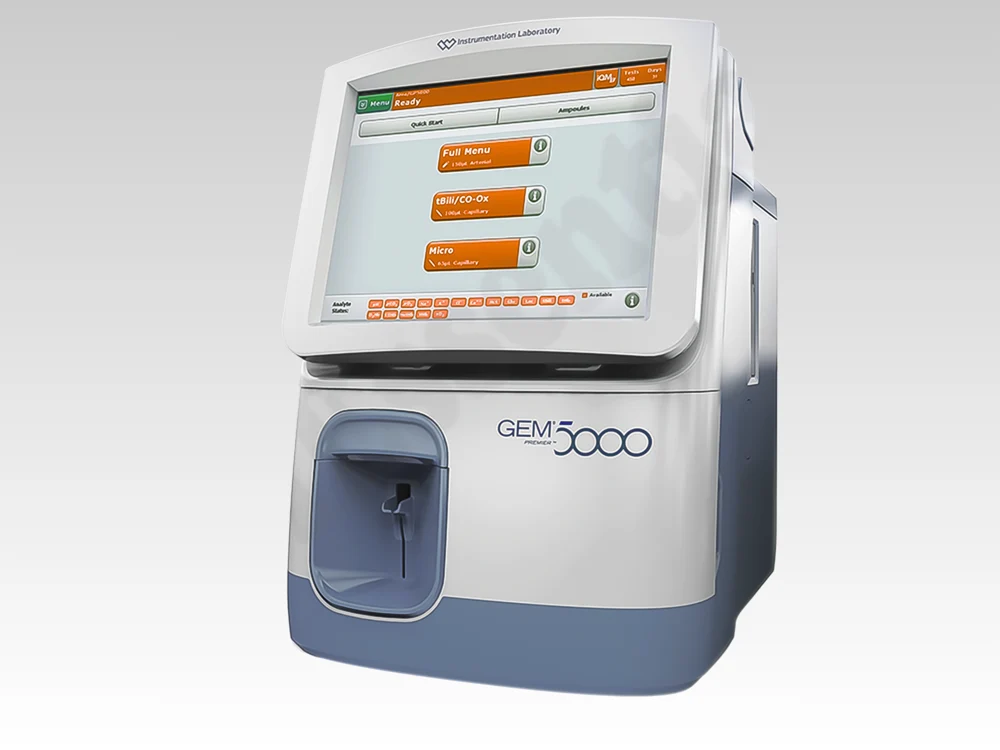
A bench instrument about the size of a small printer, with a tilt-out front carrying a single fluid pack that holds both calibrant buffers, both gas-equilibrated solutions, the rinse and the waste. A peristaltic pump draws ninety-five microlitres of sample up an aspirating probe and through a one-millimetre capillary that passes four electrodes in series inside a block held at thirty-seven degrees. A co-oximeter sits in the same path and measures haemoglobin and its species spectrophotometrically.
- 10 parts
- 2 configurations in the Device Lab
- Also called: Blood Gas Analyzer, Abg Analyser
Configurations
The versions in the Device Lab.
Benchtop laboratory analyser, fluid-pack reagents
A bench instrument about the size of a small printer, with a tilt-out front carrying a single fluid pack that holds both calibrant buffers, both gas-equilibrated solutions, the rinse and the waste. A peristaltic pump draws ninety-five microlitres of sample up an aspirating probe and through a one-millimetre capillary that passes four electrodes in series inside a block held at thirty-seven degrees. A co-oximeter sits in the same path and measures haemoglobin and its species spectrophotometrically.
Cartridge point-of-care analyser, one calibration per cartridge
A handheld instrument the length of a hand, with a slot in the end. The sensors are thin films printed on a silicon or polymer chip inside a single-use cartridge together with a foil pouch of calibrant fluid. Inserting the cartridge closes twelve contacts; the instrument punctures the pouch, floods the sensors with calibrant, reads one point, then displaces the calibrant with sixty-five microlitres of blood and reads the sample.
How it works
Explore it in the Device Lab.
The exchange rate between millivolts and the report
Put an offset on the pH electrode, one millivolt at a time, and watch what a millivolt is worth.
What bicarbonate inherits
Put two millivolts of INDEPENDENT error on the two potentiometric channels and read four numbers in order: the pH error, the carbon dioxide error, the bicarbonate error, and whether either of the first two failed a limit. Then put the same shift on the REFERENCE instead and read them again, because the second experiment is the surprising one.
Where the calibration lives
Set the true electrode slope away from the assumed one, then read the error at each of the samples on the bench and at each control level.
Why the oxygen channel behaves differently
Double the oxygen tension and watch the current double. Then double it again. Then compare that behaviour with what the pH channel does.
The half cell both channels are measured against
Put an offset on the reference electrode and watch which channels move. Then fault the pH glass alone and watch again.
What thirty-seven degrees is for
Move the measuring block away from thirty-seven and watch two separate things happen.
The parts
Part by part.
Sample inlet and preanalytical path
A steel needle on a swing-out arm, a drip tray under it, and a syringe held against it for four seconds. That is the entire interface between this instrument and the patient, and it is the last link in a chain that started in an artery somewhere else in the building.
Thermostatted measuring block at 37 °C
An aluminium jacket around the measuring chamber, a heater foil under it, a thermistor in the side of it, and a blanket of insulation around the lot. It holds thirty-seven degrees to within about a tenth, and it is not doing that for the patient comfort of a hundred microlitres of blood.
Reference electrode and its junction
A silver wire coated in silver chloride, sitting in saturated potassium chloride, with a porous plug where that solution meets the sample. It produces a potential that is supposed to depend on nothing at all, and it is half of every potentiometric reading this instrument makes.
pH glass membrane electrode
A bulb or a capillary of a special glass, fifty micrometres thick, with a buffer of known pH sealed inside it and a wire in that buffer. A difference in hydrogen ion activity across that glass produces a potential, and that is the whole of what it does.
Severinghaus carbon dioxide electrode
A pH electrode with a twenty-five-micrometre silicone rubber membrane stretched over it and a ten-micrometre film of bicarbonate solution trapped in between. It measures carbon dioxide, and there is nothing in it that is sensitive to carbon dioxide.
Clark oxygen electrode
A platinum disc a fraction of a millimetre across, held at about six hundred and fifty millivolts negative to a silver anode, behind a twenty-micrometre polypropylene membrane. It is the only channel on this instrument that is not a voltage, and it is the only one whose errors do not get amplified.
Electrometer and picoammeter front end
A screened can the size of a matchbox as close to the electrodes as it can physically be, with a gold guard ring round its input and the shortest lead in the instrument going to it. It exists because the pH electrode is very nearly an open circuit.
Digitiser and channel multiplexer
A multiplexer, a converter and a settling delay. It is the least interesting board in the instrument and it sets the finest change in pH the machine is capable of reporting.
Derived-quantity calculator
The cheapest component in the instrument, and the one that produces more than half the numbers on the report. It takes three measurements and returns a dozen results, and nothing in the way they are printed distinguishes the three from the nine.
Report display and printout
A screen and a strip of thermal paper. Between them they carry every number this instrument produces, measured and calculated, in the same font, to the same number of decimal places, in one column.
Simulations
Where it appears in the simulations.
Model notes
Real models, reviewed.
Next