Medical City · Device Lab 28 of 69
CSF Shunt
A ball held on a seat by a compression spring, in a rigid sealed housing. It opens when the pressure difference across it exceeds the spring preload divided by the seat area, and it has no path to ambient pressure anywhere.
- 10 parts
- 2 configurations in the Device Lab
- Also called: Vp Shunt, Ventriculoperitoneal Shunt
Configurations
The versions in the Device Lab.
Fixed differential-pressure valve
A ball held on a seat by a compression spring, in a rigid sealed housing. It opens when the pressure difference across it exceeds the spring preload divided by the seat area, and it has no path to ambient pressure anywhere.
Anti-siphon arrangement, ambient-referenced at the body surface
The same ball, spring and seat, with a second stage whose flexible diaphragm is open on one face to the pressure at the patient’s own body surface at the valve site. When the pressure inside falls below that reference, the diaphragm is pushed onto a throttle seat and restricts the flow.
The parts
Part by part.
Flanged ventricular inlet tip
This is the only part of the device that faces the fluid it is there to move, and it is a closed-ended silicone tube with holes in its side wall. It has no moving part, no coating that does anything, and no way of telling you whether fluid is passing through it or not.
Ventricular (proximal) catheter
3 mm of bore over 70 mm of implanted run. It is the proximal limb, and its whole job is to carry fluid from the tip to the connector with as little loss as possible.
Right-angle burr-hole connector
A small rigid moulded elbow that turns the proximal limb through ninety degrees and joins it to the rest of the device. It is the only place on the implant where two separate lengths of tubing are made into one path by a mechanical joint, which makes it the only place that can come apart without anything breaking.
Reservoir dome
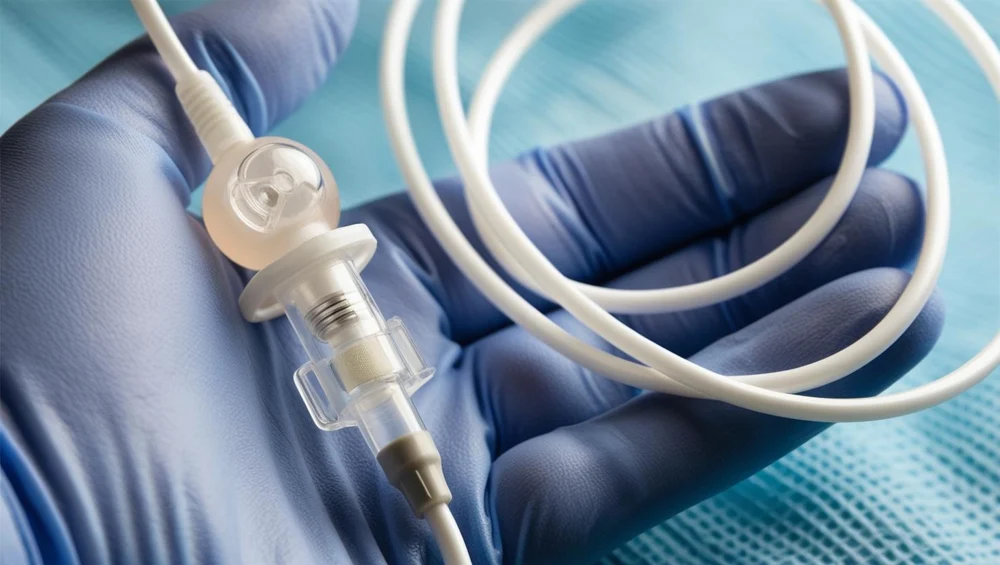
A small self-sealing silicone dome sitting on a rigid base, in line with the flow. It is the only part of the implant a person can interact with from outside, and it is therefore the part most often mistaken for an instrument.
Inlet seat and aperture
A machined conical land with a small circular aperture at its throat. This is where a force becomes a pressure, and the number that does the converting is the area of that aperture.
Occluder ball
0 mm sphere of hard polished material, held against the seat by the spring behind it. It is the only part of the implant that moves in normal use, and it moves through a distance far too small to see.
Compression spring
A helical compression spring wound from wire forty micrometres thick. It is the only source of stored energy in the entire device, and it is the reason the thing works at all without a battery.
Valve housing
The rigid shell that holds the seat, the ball and the spring in fixed relation to each other and seals the whole assembly from everything around it. On this configuration it is completely closed, and the fact that it has no opening to its surroundings is not a detail of manufacture.
Outlet nipple
A short metal spigot at the downstream end of the valve body, with two raised barbs, over which the distal catheter is pushed and ligatured. It is where the device stops being a mechanism and becomes a plumbing problem, and that transition is worth naming explicitly.
Strain-relief sleeve
A short ribbed silicone sleeve over the joint between the rigid nipple and the flexible catheter. It carries no fluid function whatever.
Next