Medical City · Device Lab 30 of 69
Prosthetic Limbs
The anatomical knee is intact, so the whole argument is the socket: 510 square centimetres of wall carrying a body weight that arrives with an offset, and a carbon keel that gives back some of what the step put into it.
- 10 parts
- 6 configurations in the Device Lab
- Also called: Prosthetic Limb, Artificial Limb
Configurations
The versions in the Device Lab.
Transtibial prosthesis, total-surface-bearing socket and energy-storing foot
The anatomical knee is intact, so the whole argument is the socket: 510 square centimetres of wall carrying a body weight that arrives with an offset, and a carbon keel that gives back some of what the step put into it.
Transfemoral prosthesis, ischial-containment socket and polycentric four-bar knee
Everything the transtibial has, plus a knee with no muscle across it. Stance stability is bought with geometry alone: the four-bar puts its instantaneous centre 40 mm behind the load line and that offset is the entire safety margin.
Transfemoral prosthesis, microprocessor-controlled hydraulic knee
The same socket and the same load path, with the knee resistance modulated from sensed shank moment and knee angle rather than set at the bench. Damping goes as the inverse square of the valve orifice, so the controller has a very large authority over a very small aperture.
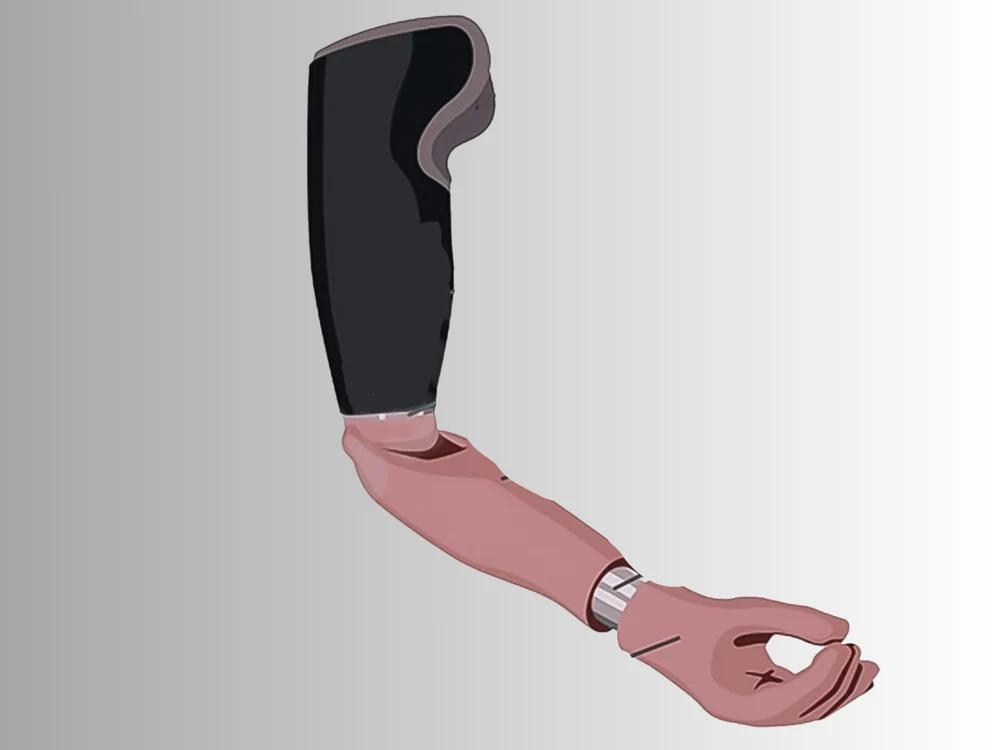
Transradial prosthesis, figure-of-nine harness and voluntary-opening hook
A stainless cable from a harness across the opposite shoulder to a voluntary-opening hook. Prehension is stored in rubber bands and the user pulls against them to open, so the command and the reaction travel the same wire.
The parts
Part by part.
Roll-on interface liner
The liner is the only part of this device that touches skin, and it is the reason the rest of the load path is possible at all. It is a roll-on sleeve of silicone or a thermoplastic elastomer, a few millimetres thick, turned inside out and rolled on so that no air is trapped and no shear is dragged along ahead of it.
Hypobaric seal ring and expulsion valve
The seal ring and the one-way expulsion valve together are the suspension. Between them they turn the socket into a closed volume that atmospheric pressure holds on, and they are physically small out of all proportion to what they do.
Distal attachment collar and end pad
The distal attachment is where the socket stops being a shell and becomes part of a machine. It is a collar bonded or laminated into the closed end of the socket, carrying a standard four-screw interface on one face and, on the other, an end pad that decides whether the closed end touches at all.
Bench alignment and load jig
The alignment jig is a levelled bench with a slotted top, two uprights carrying reference lines, a clamp head and a dial gauge. It is the only instrument in the workshop that can hold a limb still enough for a measurement to mean anything, and it is a component of this family rather than furniture because alignment is not a property a limb has on its own.
Interface pressure-mapping array
The interface pressure-mapping array is a thin sensor film that lies between liner and socket wall, carrying a grid of sensing pads and a ribbon that leaves over the brim. It is the only instrument in this family that can see the quantity the whole device is about, and it is the only one that can show that a peak is somewhere other than where it was expected.
Modular pylon
The pylon is the tube between the socket and whatever meets the ground. It is a plain cylinder of aluminium alloy, titanium or carbon composite, thirty millimetres across, with a clamp at each end and a scale etched along it.
Four-screw pyramid adapter
The pyramid adapter is a truncated four-sided boss sitting in a matching receiver, held by four set screws at ninety degrees. It is the joint that lets a limb be angled, and it is the reason two identical sets of components can be assembled into two limbs that stand quite differently.
Energy-storing carbon keel
The energy-storing keel is a carbon-fibre leaf that runs from a clamp near the ankle forward to the forefoot and back to the heel. It is a spring, and it is the only component in a passive lower limb that gives anything back.
Foot shell and toe spring
The foot shell is the soft cover around the keel: a moulded foam or elastomer body with a tread on the sole, a split at the front and a lifted forefoot. It looks cosmetic and it is not.
Total-surface-bearing transtibial socket
The transtibial socket is a tapered shell 150 millimetres long and 340 millimetres around, closed at the bottom and open at the top, and it is the whole of the load path between a body and the ground. It is the shortest of the three lower-limb walls in this family and it carries the same body weight the longest one does.
Model notes
Real models, reviewed.
Next