Medical City · Device Lab 26 of 69
Cochlear Implant
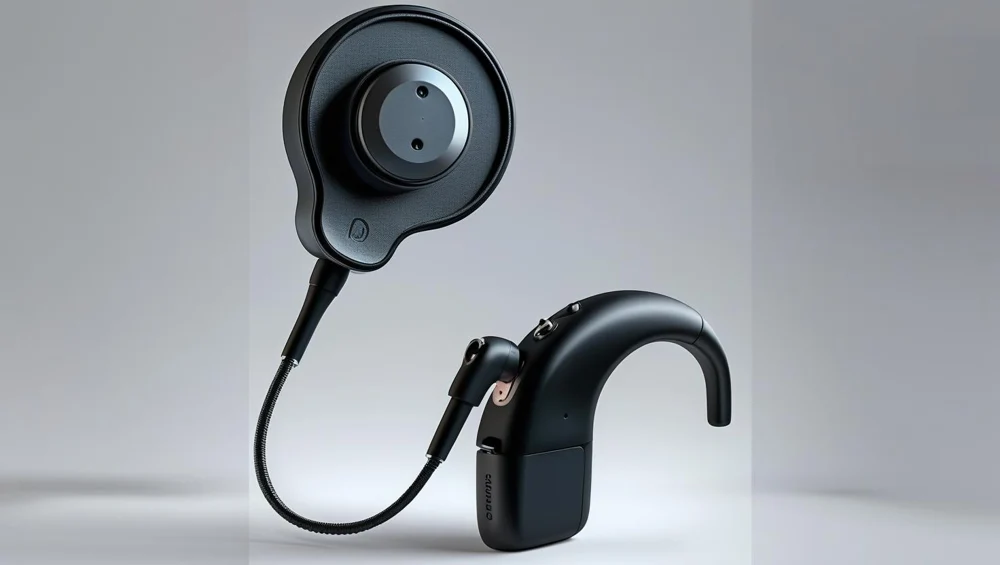
The processor sits behind the ear on a hook and a coiled cable runs up to a coil held over the implant by a magnet. Microphones sit at the top of the processor, where an ear would have collected sound.
- 10 parts
- 2 configurations in the Device Lab
Configurations
The versions in the Device Lab.
Behind-the-ear sound processor
The processor sits behind the ear on a hook and a coiled cable runs up to a coil held over the implant by a magnet. Microphones sit at the top of the processor, where an ear would have collected sound.
Single-unit off-the-ear processor
Everything is inside the coil: processor, battery and microphones all sit in one disc held on the head by the same magnet. There is no cable and nothing behind the ear at all.
The parts
Part by part.
Sound processor
The body behind the ear. It holds the microphones, the processing, the controls and the battery, and it is the part a recipient owns, charges, drops and replaces every few years.
Microphones and inlets
Two small inlets on the upper edge of the processor. Everything this system will ever deliver enters through them, and they are open to weather, sweat and hairspray.
Power source
A module that clips onto the bottom of the processor. It powers the external half and, through the link, the implanted half as well.
Earhook and retention
The moulded hook over the top of the ear. It carries the weight of the processor and decides whether it stays on a running child.
Coil cable
The coiled lead between the processor and the coil. It is the single most replaced part of this whole system, and the only external part whose failure reliably looks like something else.
Transmitting coil
The disc on the side of the head. It holds the transmitting antenna and the magnet, and it is the last external part before the signal leaves the outside world.
Retention magnets
Two magnets, one in the coil and one in the centre of the implant, holding the coil over the receiver through the scalp. It is the only thing keeping the external half attached to the person, and it is the only purely mechanical link in a chain that is otherwise electrical from end to end.
Receiver-stimulator
A sealed electronic package the thickness of a coin, sitting in a recess in the skull under the skin. It receives an instruction through the scalp, and produces current at particular contacts on the array.
Electrode array
A tapering silicone carrier finer than the wire in a paperclip, curled into the spiral of the cochlea, carrying about twenty-two contacts along its length. It is the part of this system that makes the whole idea work, and it is the part that nothing can be done about: it is placed once, by a surgeon, and it stays where it was put.
Where it sits
The placement view: an implant under the skin behind and above the ear, a coil on the outside directly over it, and the array in the cochlea a few centimetres away through bone. It is the only picture in this lab where you can see both halves of one device at the same time, and the only one that makes the separation between them into a distance rather than a description.
Model notes
Real models, reviewed.
Next