Medical City · Device Lab 36 of 69
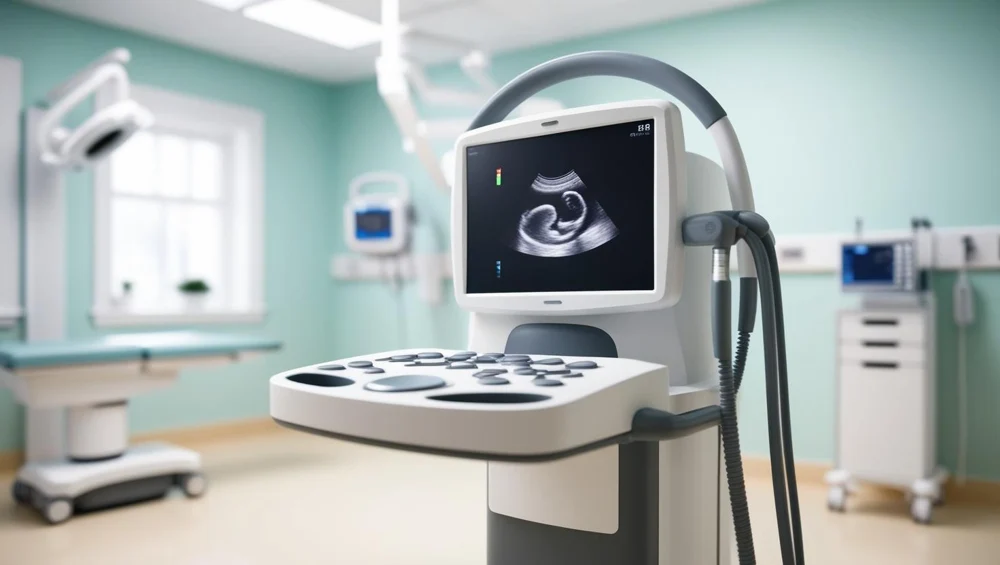
Ultrasound
A flat array of a hundred and twenty-eight elements diced at about three tenths of a millimetre, running at ten megahertz. It does not steer. It fires a group of adjacent elements straight down, forms one line, then slides the active group one element along and does it again, which is why the image is a rectangle exactly as wide as the probe.
- 10 parts
- 2 configurations in the Device Lab
- Also called: Ultrasound Machine, Ultrasound Scanner, Sonography
Configurations
The versions in the Device Lab.
Linear array, vascular and superficial
A flat array of a hundred and twenty-eight elements diced at about three tenths of a millimetre, running at ten megahertz. It does not steer. It fires a group of adjacent elements straight down, forms one line, then slides the active group one element along and does it again, which is why the image is a rectangle exactly as wide as the probe.
Phased array, cardiac and deep
Sixty-four elements diced at almost exactly the same physical pitch as the linear probe, in a footprint a third of the width, running at two and a half megahertz. Every element fires on every line, with a delay across the array that tilts the wavefront, so the beam sweeps out a sector from what is very nearly a point.
How it works
Explore it in the Device Lab.
The account everything is bought from
Change the frequency and watch four numbers at once: axial resolution, lateral resolution, penetration and the mechanical index.
The number that decides whether a probe can steer
Set the steering angle to zero and step it outwards, watching for the angle at which a grating lobe appears. Do it on both probes.
One number that is three things
Change the depth and watch the pulse repetition frequency, the frame rate and the Nyquist velocity all move together.
Why bone is white and air is a wall
Compute the reflection coefficient at three boundaries: tissue against fat, tissue against bone and tissue against air.
What 1540 metres per second costs
Set a speed-of-sound error and watch the reported depth against the real one.
The parts
Part by part.
Mains inlet, isolation and protective earth
An inlet, a fuse and an earth stud on the back of the tower, and behind them something most equipment in the building does not have: a transformer whose only job is to make sure the patient is not connected to the mains by any route at all.
Transmit pulser
A bank of high-voltage switches, one per channel, that slam a hundred volts or so across a piezoelectric element for a fraction of a microsecond and then stop. It is the loudest thing in the machine electrically and it does nothing at all for the other ninety-nine per cent of the time.
Transmit and receive beamformer
The board with the largest chip on it and the most channels running to it. Nothing about it moves and nothing about it is acoustic, and it is where the beam actually comes from.
Preamplifier and time-gain compensation
A row of small amplifiers immediately behind the connector, one per channel, and a gain that climbs while it is listening. It is the first thing the echo meets and the last chance to amplify it before noise is added.
Digitiser
A row of converters turning each channel into numbers, tens of millions of times a second. Everything before it is analogue and fragile; everything after it is arithmetic and can be copied without loss.
Envelope detection, compression and scan conversion
The stage that turns a line of radiofrequency signal into a line of grey pixels, and then turns a fan of such lines into a rectangle a screen can display. Three operations, each of which throws information away on purpose.
Upper display
The large screen on the articulated arm, angled towards whoever is reading rather than whoever is scanning. In a room with the lights down it is the brightest object in the space.
Touchscreen control display
The smaller angled screen above the keys, raked back so a seated operator can reach it without looking away from the patient for long. Its content changes with the mode, which is the whole reason it exists.
Key panel and trackball
A field of keys around a trackball, with two large encoders either side. The trackball is the single most used control on the machine and it is in the middle for that reason.
Mechanical and thermal index display
Two small numbers in a corner of the screen that most operators never look at, and which are there because a regulator required them rather than because a designer wanted them.
Simulations
Where it appears in the simulations.
Next