Medical City · Device Lab 60 of 69
Ophthalmoscope
513 mm from the cornea with the brow rest against the examiner's forehead. 293243 mm is unvignetted.
- 10 parts
- 2 configurations in the Device Lab
- Also called: Fundoscope
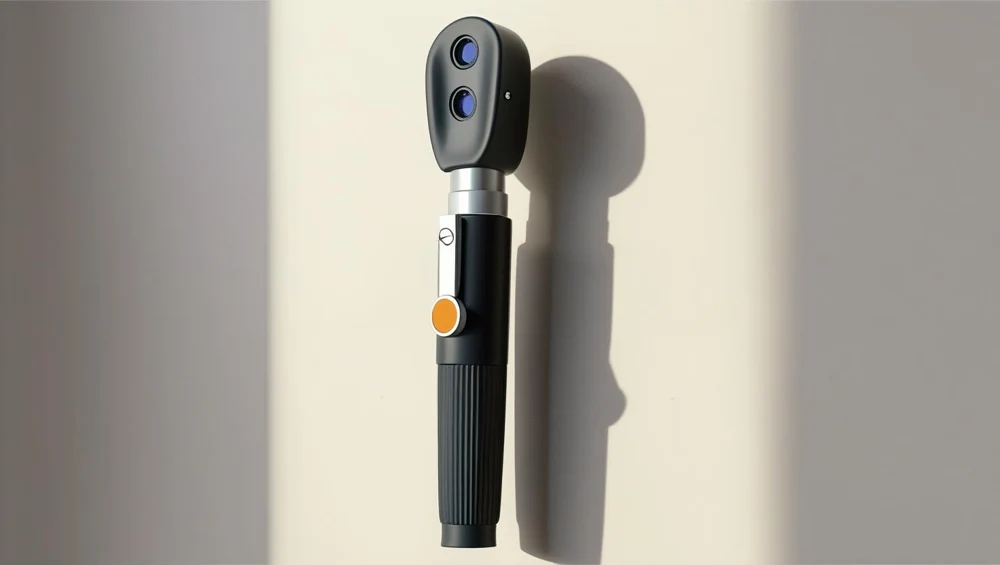
Configurations
The versions in the Device Lab.
Direct ophthalmoscope, hand-held head at the brow
513 mm from the cornea with the brow rest against the examiner's forehead. 293243 mm is unvignetted.
Head-mounted binocular indirect with a +20 D condensing lens
000 mm from the cornea. 90919 mm inside the pupil.
The parts
Part by part.
Charger base and transformer well
A moulded block on the instrument rail with two cylindrical wells, a brass contact disc at the bottom of each, and a small lit lamp on the front face per well. It is the only part of this device that is never in the darkened part of the examination, and that is not an accident: it lives on the rail by the door, where its own indicator lamps cannot reach the patient.
Coiled mains supply cable
5 mm rubber-jacketed cable running from the outlet on the back of the charger base, down behind the instrument rail, across to a wall socket. It is the least interesting part of the device to look at and the easiest to get wrong in a model, because a cable drawn between two correct endpoints will happily pass through the floor in the middle.
Rechargeable power handle
A 30 mm metal barrel 148 mm long, slightly tapered, holding a lithium cell, a brass terminal at the top and a chromed base disc at the bottom that is the charging contact. In the direct configuration it is what the examiner holds; in the indirect one an equivalent cell sits in the lamp house on the headband.
Rheostat collar and brightness index
A knurled collar 33 mm across between handle and head, carrying eighteen raised knurls and one lit amber index mark. Turning it changes the current to the source.
White LED source and its reflector
A 6 mm white emitter 9 mm long sitting in a polished conical reflector 11 mm across, with brass contacts behind it. In the direct head it sits 8 mm off the optical axis; in the indirect headset it sits in a house above the viewing tubes.
Collimating condenser
5 mm thick in a metal mount, immediately in front of the source. Its job is to turn the source’s diverging output into a beam of a definite width, because the next three elements all work on a beam of a definite width and none of them can work on a cone.
Aperture wheel
A 26 mm blackened disc with five real openings in it, indexed by detents, sitting in the illumination path. Large, small, pinhole, slit and a fixation target.
Filter wheel
A 24 mm blackened disc carrying four glass elements: clear, a green red-free, a cobalt blue, and a neutral density. It sits after the aperture wheel, and unlike the aperture wheel it changes nothing geometrical at all.
Illumination fold mirror
A small mirror 11 by 9 mm at forty-five degrees on a thin post, sitting between the illumination train and the observation path. It is the smallest optical element in the instrument and the one the whole architecture is arranged around, because it is the part that makes illumination and observation two paths instead of one.
Blackened baffle stack
5 mm down. They are matte black rather than merely dark, and they do nothing at all for the image.
Model notes
Real models, reviewed.
Next