Medical City · Device Lab 40 of 69
Holter
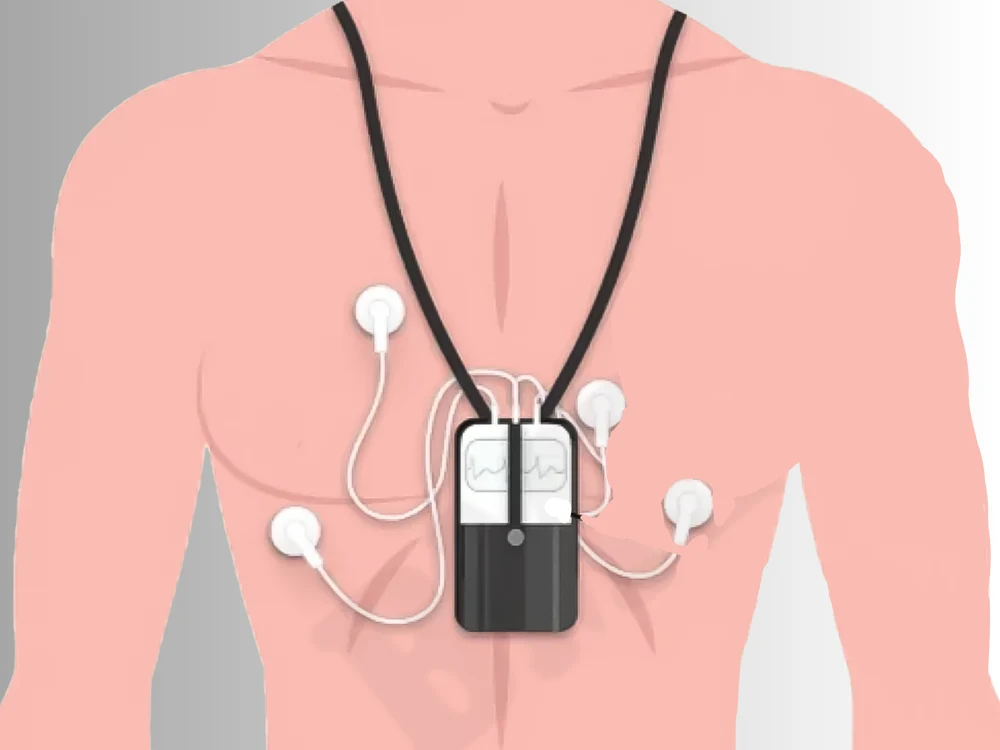
Writes every sample of every channel for the whole ordered duration into a linear log. Nothing is selected, so nothing is discarded, and every later decision can be re-argued from the record itself.
- 10 parts
- 2 configurations in the Device Lab
- Also called: Holter Monitor, Ambulatory Ecg
Configurations
The versions in the Device Lab.
Continuous full-disclosure recorder
Writes every sample of every channel for the whole ordered duration into a linear log. Nothing is selected, so nothing is discarded, and every later decision can be re-argued from the record itself.
Event-triggered loop recorder
Acquires continuously into a short ring buffer and writes only a window either side of a trigger, whether the trigger came from the on-board analyser or from the patient pressing the button. Between events the samples are overwritten.
The parts
Part by part.
Pre-gelled disposable electrode patch
A disc of closed-cell foam forty millimetres across with a twenty-millimetre window of wet gel in the middle of it, stuck to the chest and expected to stay there for two to fourteen days. Five of them are applied in the fitting room in about four minutes, and then nobody touches them again until the recorder comes back.
Conductive hydrogel column
A column of conductive hydrogel one millimetre thick and twenty millimetres across, sitting between the sintered pellet and the outer skin. It is mostly water with mobile ions in it, and it is the part of this device with a shelf life measured in the same units as the recording.
Sintered silver / silver-chloride pellet
A sintered disc of silver and silver chloride, eight millimetres across and just over a millimetre thick, recessed into the foam above the gel. It is the point at which the recording stops being ionic and starts being electronic, and it is chosen for what it does not do.
Stud and socket lead attachment
A four-millimetre stud pressed into the back of the pellet and a sprung socket on the end of the lead wire that clicks onto it. It is the only joint in the signal path that a patient can undo, and it is the only one they can accidentally undo.
Shielded patient lead wire
A shielded wire seven tenths of a millimetre in radius and a metre long, running from the snap on the chest to the yoke on the recorder. There are five of them and they spend two to fourteen days being bent by a person who is asleep for a third of it.
Patient cable yoke and recorder plug
A small moulded block where five lead wires meet one keyed plug, sitting on the top edge of the recorder. It is the single point through which every channel passes, and the only part of the patient side a patient is told they may unplug.
Input protection and defibrillation network
A set of series resistors, one per input, and two clamp arrays, sitting on the board within a few millimetres of the patient socket. It is there so that an energy the recorder was not designed for does not reach the amplifier, and so that the recorder does not become a path it should not be.
Instrumentation amplifier stage
The differential front end, a small package inside a soldered shield can, with its gain resistor beside it. It takes the difference between two electrodes and makes it large enough for a converter to see.
AC coupling network
Three capacitors and a bleed resistor forming the network that stops a steady offset reaching the converter. On this device the interesting property is not what it removes.
Anti-alias low-pass filter
A filter amplifier and two capacitors placed immediately before the converter, set at the declared forty hertz. Its job is to make sure that nothing arriving at the converter is faster than the converter can represent, and its value has to be chosen together with the sample rate rather than after it.
Simulations
Where it appears in the simulations.
Model notes