Medical City · Device Lab 15 of 69
MCCE
A 100 mm by 100 mm N42 block on a six-axis manipulator. m squared of dipole moment and dissipates nothing at all.
- 10 parts
- 2 configurations in the Device Lab
- Also called: Capsule Endoscopy, Magnetically Controlled Capsule
Configurations
The versions in the Device Lab.
Permanent-magnet manipulator
A 100 mm by 100 mm N42 block on a six-axis manipulator. m squared of dipole moment and dissipates nothing at all.
Electromagnet coil array
Eight water-cooled coils on a non-ferrous former around a 700 mm bore: two coaxial pairs and four saddle coils, 420 mm mean winding radius, driven by current amplifiers. The field can be commanded to zero and it goes.
How it works
Explore it in the Device Lab.
Torque follows the field, force follows its gradient
Write the two relations down and then write their distance laws beside them. Turning moment is the cross product of the capsule moment with the field; force is the gradient of their dot product. For a dipole source the field is 2k·M/r³ and its axial gradient is exactly three times the field divided by the separation.
Two envelopes, 231.50 mm and 724.91 mm
Set each authority equal to what it has to beat. 91 micronewton metre righting torque produced by the capsule’s own centre-of-mass offset. Solve each for separation.
Stable in orientation, unstable in translation
57 hertz undamped at the reference geometry. Being drawn up a gradient is not restoring at all.
The control gain goes as the fifth power of closeness
Differentiate the attraction with respect to separation. Since it goes as the inverse fourth power, its derivative is minus four times itself over the separation, so the sensitivity of the control to a millimetre of source motion follows the inverse fifth power.
What a source can and cannot be asked to stop doing
One of these sources answers a zero command in a switching interval. 91 to release the aim, at 100 millimetres per second.
The parts
Part by part.
Field command console
The console is where a person asks this machine for something, and the first honest thing to notice about it is what it will not accept. There is no control here that asks for a pull of so many millinewtons.
Field solution and pose estimator
This unit is the one that answers the question nobody can measure: where is the capsule and what is it experiencing. It takes the commanded source geometry, the image, and the reference field reading, and produces a pose.
External permanent-magnet head
890 kilograms and consumes nothing. It produces its field the moment it exists and it will still be producing it when the building loses power, when the software crashes, and when everyone has gone home.
Six-axis manipulator
The manipulator is the only actuator in this configuration. The field source cannot be turned up or down, so every command the operator gives becomes a motion of six joints, and the quality of the control is the quality of the arm.
Keeper and parking enclosure
The keeper is the closest thing this configuration has to an off switch, and it is a steel can. Parked inside it, the head still produces its field; the difference is that the steel offers the flux a much easier path than the air outside, so what escapes into the room collapses.
Gravity-independent retract accumulator
An unswitchable source needs a way to leave the patient when the electricity does not. This cylinder is that way: a charged gas accumulator on the fore link whose only job is to drive the head clear without any power at all.
Capsule internal magnet
This is the smallest component in the device and everything else exists to talk to it. A cylinder of neodymium iron boron eight millimetres across and five long, sitting off-centre inside a swallowed shell, and its dipole moment is the entire interface between a person and a machine standing outside them.
Capsule shell
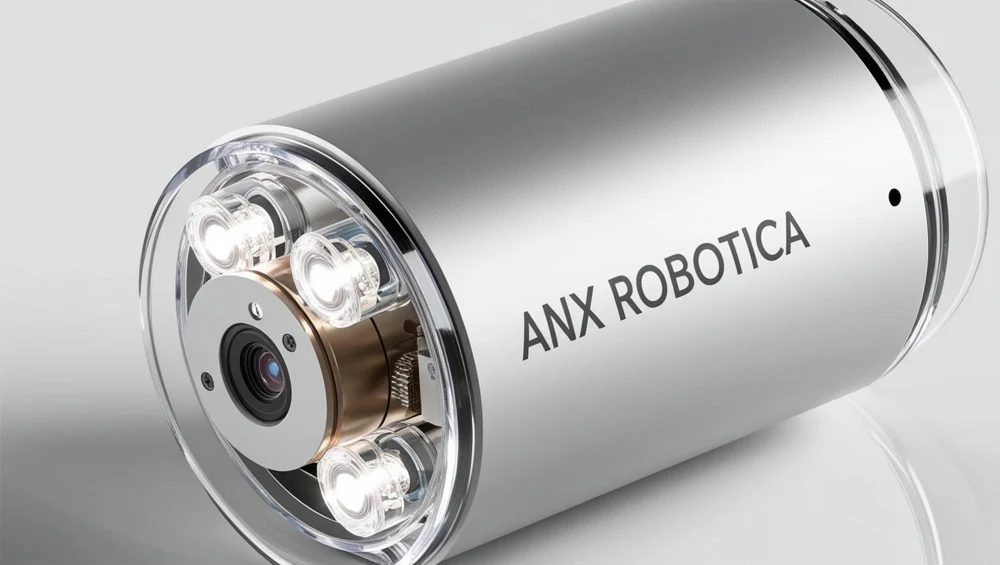
The shell is the boundary between a person and a machine, and it is the only part of this device that goes inside anybody. Eleven millimetres across, twenty-six long, and it has to hold a magnet, an optical head, two cells and a radio while being swallowable.
Capsule optical head
The optical head is here because the capsule has one, and because in this device it is doing a job it was not built for: it is the only sensor that says anything about where the capsule actually is. The image chain itself belongs to device 34 and is not modelled here.
Capsule cell and power budget
Two cells and a small power board, and between them they decide how long the operator has. Everything else on this machine can be switched on again; the capsule cannot.
Model notes