Medical City · Simulation 05 of 12
Equipment Procurement
Run a tender: specification, bids, whole-life cost, evaluation and award.
What you do
Equipment Procurement
A clinical team needs equipment. You run the tender the way a clinical engineer would: a specification from real needs, a fair compliance check, an honest whole-life cost, a scored award and a report that defends it.
Equipment bought on price alone fails patients for years: consumables that lock you in, software that loses support, service that never arrives. A good tender buys a device that is safe, supportable and affordable for its whole life.
Your role: the clinical engineer running a tender.
45 challenges, each at Foundation, Practitioner and Expert level.
How it works
Step by step.
Write the specification
Hear the people at the table and turn what they ask for into specification lines: MUST, DESIRABLE or LEAVE OUT. If a bid without it would still be safe and do the clinical job, the line is not a MUST.
Check the bids
The bids are back. Check each one against your mandatory lines and shortlist or exclude it. Exclude on a true MUST only, and never guess at compliance: ask when a bid does not say.
Audit the whole-life cost
Finance's draft prices every shortlisted bid over the device's life. Some figures are wrong. The trap is rarely a wrong number: it is a missing year, a missing unit or a line nobody remembered.
Score the bids and award
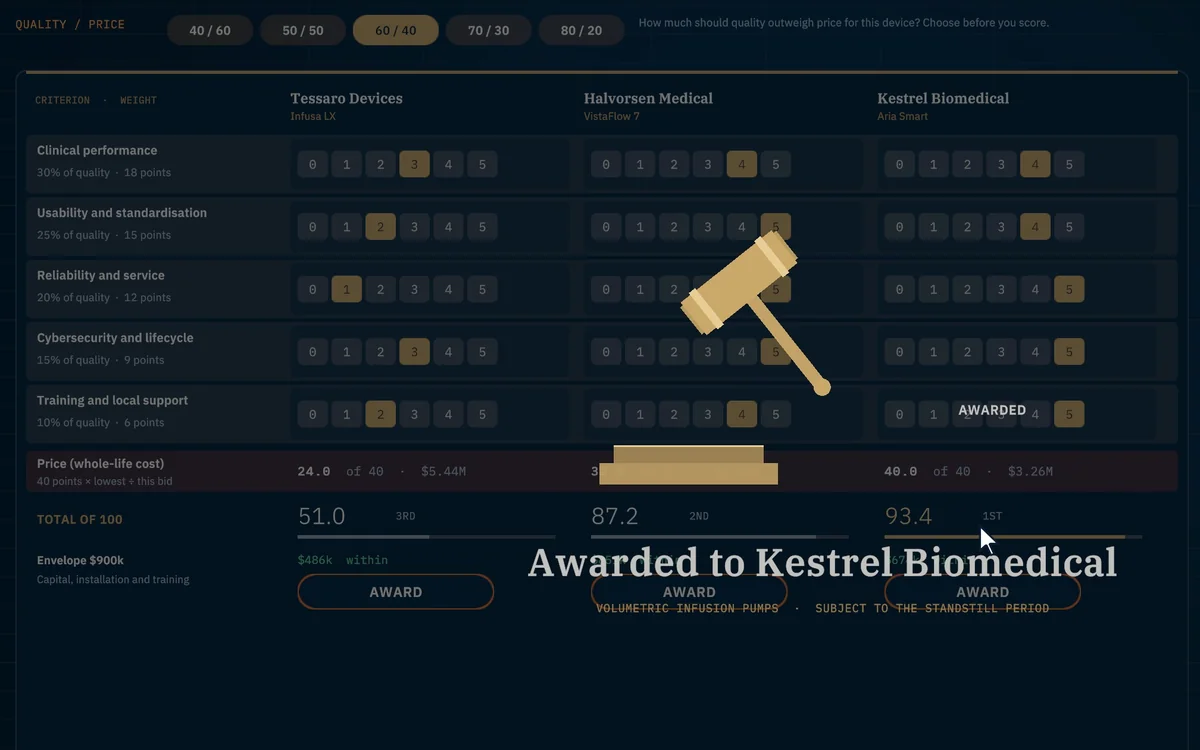
Score each shortlisted bid against the scoring guide, set the quality/price split and award. Award the highest total among compliant bids within the envelope.
Sign the award report
Choose the paragraph that explains the award to the director. A preference, a price or a person is not a reason for an award.
Answer the bidder's challenge
At Expert, a losing bidder challenges the award in the standstill period. Never change the method, the prices or the bidders after the bids are in.
Live with the award
The debrief scores the tender and plays out the years after the award. Buy the right device, not the cheapest one.
What it trains
Skills and competencies.
- Turn clinical needs into a specification
- Check bids against mandatory requirements
- Audit a whole-life cost model
- Score and award on a published method
In the BMEssentia competency framework, this simulation builds 11 competencies across Device Technology & Fault Finding, Procurement & Technology Lifecycle, Regulation, Design & Quality, Leadership & Professional Practice.
- Device Technology & Fault Finding
Device integration and interoperability
Connect devices to central stations, EPR and PACS safely using HL7, DICOM and IEC 80001-1, and validate the data end to end.
- Device Technology & Fault Finding
Medical device cybersecurity
Assess and reduce cyber risk in networked devices: inventory, segmentation, patching, SBOM and incident response.
- Procurement & Technology Lifecycle
Clinical needs and specification
Turn clinical needs into a clear, testable specification with mandatory and scored requirements.
- Procurement & Technology Lifecycle
Tender evaluation and whole-life cost
Evaluate bids fairly with weighted quality and price, whole-life cost and clear award justification.
- Procurement & Technology Lifecycle
Vendor and service contracts
Manage warranties, service contracts, uptime terms and supplier performance, and enforce them with evidence.
- Procurement & Technology Lifecycle
Commissioning and acceptance testing
Inspect deliveries, check site readiness, test and accept equipment so only safe, complete systems go live.
- Procurement & Technology Lifecycle
Asset management and replacement
Keep an accurate asset register and plan replacement, obsolescence and safe decommissioning over the whole life.
- Procurement & Technology Lifecycle
Capital projects and budgets
Set budgets with contingency, manage programme and scope change, and report cost honestly on capital projects.
- Regulation, Design & Quality
Medical device regulation
Know how devices reach and stay on the market: classification, UK MDR, EU MDR, FDA pathways, CE and UKCA marking.
- Leadership & Professional Practice
Board reporting and business cases
Present engineering risk, performance and investment cases to directors and boards in clear, honest terms.
- Leadership & Professional Practice
Professional ethics and integrity
Act with honesty and independence: declare conflicts, refuse to falsify records and speak up when safety is at risk.
The takeaways
- A MUST must be essential and objectively justified.
- Whole-life cost, not purchase price, decides value.
- The award must follow the published method, every time.
The challenges
45 training cases.
- 01 Defibrillator StandardisationFoundation
We have five defibrillator models across the hospital.
- 02 Smart Infusion Pump FleetFoundation
Our volumetric pumps are eleven years old and have no drug library.
- 03 Ward Pulse OximetryFoundation
We have about two hundred pulse oximeters across our three hospitals, of eleven different models, some older than the nurses using them.
- 04 Ward Vital Signs and NEWS2Foundation
Last spring a patient on one of our surgical wards deteriorated over eight hours with every observation charted on paper.
- 05 Neonatal Phototherapy UnitsFoundation
We are a rural hospital two hours from the nearest neonatal intensive care unit, so a jaundiced baby who does not respond to phototherapy here faces a long transfer.
- 06 Connected Glucose MetersFoundation
We do more than three hundred thousand bedside glucose tests a year in this teaching hospital, on meters we cannot see: no operator identification.
- 07 12-Lead ECG Carts and ManagementFoundation
Our two hospitals record about a hundred thousand ECGs a year on forty carts of six makes.
- 08 Ambulatory ECG ServiceFoundation
We fit about 4,800 ambulatory ECG recorders a year and the wait is fourteen weeks.
- 09 Lung Function LaboratoryFoundation
The new community diagnostic centre opens in the spring with a lung function laboratory: four workstations for spirometry, gas transfer and lung volumes.
- 10 Bone Densitometry (DXA)Foundation
We scan eight thousand patients a year on one ageing scanner, and the fracture liaison service is opening a second clinic.
- 11 Video LaryngoscopesFoundation
Last winter a patient in ED resus could not be intubated with a direct laryngoscope, and the only video laryngoscope in the building was in Theatre 1.
- 12 Theatre Electrosurgical UnitsIntermediate
Fourteen theatres, nine generator models, and last month a patient left Theatre 3 with a burn under the return electrode.
- 13 Point-of-Care Ultrasound for EDIntermediate
We scan at the bedside every shift: trauma FAST, lung, aorta, line insertion.
- 14 ICU Ventilator ReplacementIntermediate
Our eighteen ICU ventilators reach end of support next year and the manufacturer has stopped making parts.
- 15 Theatre Anaesthesia WorkstationsIntermediate
Twelve theatres, twelve anaesthetic machines, the youngest fourteen years old.
- 16 NICU Incubator ReplacementIntermediate
Our twenty-eight incubators are fifteen years old.
- 17 Labour Ward Fetal MonitoringIntermediate
We deliver 4,200 babies a year in a district general hospital.
- 18 Point-of-Care Blood GasIntermediate
We run nine blood gas analysers outside the laboratory: four in ICU, two in ED, two in theatres and one on the neonatal unit.
- 19 EMG and Nerve ConductionIntermediate
We do about 4,000 nerve conduction and EMG studies a year: carpal tunnel, neuropathy, motor neurone disease, and critical illness neuropathy on ICU.
- 20 Intra-Aortic Balloon PumpsIntermediate
We are the cardiac centre for a large rural region.
- 21 Paediatric TEE ProbesIntermediate
We do about 1,400 transoesophageal echoes a year in theatre, the cath lab and the echo lab, most of them in children having heart surgery.
- 22 Surgical Stapler FrameworkIntermediate
We spend nearly eight hundred thousand dollars a year on stapler reloads across eight theatres, and almost nothing on the staplers themselves.
- 23 Pattern-Scanning Retinal LasersIntermediate
Our diabetic eye service delivers about two thousand laser sessions a year on a single-spot laser that is fifteen years old.
- 24 Neurosurgical Power ToolsIntermediate
We have six neurosurgery theatres and a mix of air and electric drills, some older than our registrars.
- 25 Digital Radiography RoomsIntermediate
Our two general X-ray rooms still run on computed radiography cassettes, and Room 2 lost nineteen days to generator and table faults last year.
- 26 Home Automated PD ProgrammeIntermediate
We want eighty patients dialysing overnight at home within two years, across three counties.
- 27 Patient Monitoring NetworkAdvanced
Forty-eight bedside monitors for the four theatres and the recovery bays, plus the central stations and the link into the record.
- 28 Dialysis Machines and Water PlantAdvanced
Twenty-four stations, two shifts a day, six days a week.
- 29 CT Scanner ReplacementAdvanced
Our CT is twelve years old; it lost eleven days to tube and gantry faults last year, and every lost day is around forty patients rebooked and the emergency department.
- 30 CSSD Sterilisers and WashersAdvanced
Our sterile services department reprocesses every surgical tray for twenty-two theatres.
- 31 Epilepsy Monitoring Unit EEGAdvanced
We are opening a four-bed epilepsy monitoring unit for adults and children being assessed for surgery, and replacing the routine EEG systems that serve the clinic.
- 32 Intravascular Imaging and FFRAdvanced
In April this district general hospital starts a 24-hour primary PCI service for the first time.
- 33 Heart-Lung MachinesAdvanced
The new cardiothoracic wing opens next spring with four theatres.
- 34 Intraoperative NeuromonitoringAdvanced
We monitor about a thousand spinal and cranial cases a year on two systems that are eleven years old, with two consultant neurophysiologists for six theatres.
- 35 Vitreoretinal and Phaco PlatformAdvanced
We are a stand-alone eye hospital doing about fifteen hundred vitreoretinal and combined cases a year on five consoles of three different makes.
- 36 Lithotripsy for a Stone ServiceAdvanced
We are the stone centre for four hospitals: about eleven hundred shock wave treatments a year, plus ureteroscopy and PCNL in theatre.
- 37 SPECT-CT Gamma CamerasAdvanced
Our two planar-only gamma cameras are fifteen years old.
- 38 Closed-Loop Insulin PumpsAdvanced
We look after three hundred children and young people with type 1 diabetes, and the commissioners have funded hybrid closed-loop systems for a hundred and twenty.
- 39 Endoscope Fleet and ReprocessingExpert
Thirty flexible endoscopes, four washer-disinfectors, and an outbreak review last year that found a damaged channel no one had seen.
- 40 MRI with Site WorksExpert
The board has approved a second MRI.
- 41 Cardiac Cath Lab ReplacementExpert
Our two cath labs are fourteen years old.
- 42 EP Mapping SystemsExpert
We are a private heart hospital, and our two EP labs run about 850 ablations a year on one ageing mapping system and one on loan.
- 43 Regional ECMO ProgrammeExpert
The commissioners have made us the ECMO hub for a region of four million people.
- 44 Soft-Tissue Robotic ProgrammeExpert
The board has approved a soft-tissue robotic programme for urology, colorectal and gynaecological oncology: two systems in Theatres 7 and 8.
- 45 PET-CT for the Cancer CentreExpert
Our PET-CT is thirteen years old and books 2,600 FDG studies a year, rising with every new immunotherapy pathway.
Devices
Devices in this simulation.
- Defibrillator
- Infusion Pump
- Pulse Oximeter
- Blood Pressure Monitor
- Phototherapy Unit
- Glucometer
- ECG
- Holter
- Spirometer
- Laryngoscope
- Electrosurgical Unit
- Ultrasound
- Ventilator
- Anaesthesia Machine
- Infant Incubator
- Fetal Monitor
- Blood Gas Analyser
- EMG
- TEE Probe
- Surgical Stapler
- Retinal Laser
- Cranial Drill
- X-ray
- Peritoneal Dialysis
- Cardiac Monitor
- Haemodialysis Machine
- CT Scanner
- Autoclave
- EEG
- IVUS
- Cardiopulmonary Bypass
- IONM
- SPECT
- Insulin Pump
- Endoscope
- MRI
- EP Mapping System
- ECMO