Medical City · Simulation 08 of 12
Patient Safety Investigator
Investigate incidents: classify, find root causes, report and prevent.
What you do
Patient Safety Investigator
A device-related incident has harmed a patient, or nearly did. You investigate it as the independent clinical engineer: preserve the evidence, read the device and the people, tie the causal chain and recommend controls that stop it happening again.
Most incidents are not caused by one careless person but by a system that made the error likely and hard to catch. Blame removes the person and leaves the system; a good investigation changes the system, so the next patient is safe.
Your role: the independent clinical engineer investigating an incident.
46 challenges, each at Foundation, Practitioner and Expert level.
How it works
Step by step.
Secure the scene
Decide what happens to the device and everything that touched the patient before anyone resets, cleans or reuses it. Quarantine as found, keep everything that touched the patient, photograph, export the log: test later, under witness.
Build the case file
Request the sources, read them, and pin the lines that matter to the board. Look outside the device too: configuration, service history, notices and the environment.
Read the timeline on one clock
Put every timed entry on hospital time and read the true order of events. Find one moment two sources both recorded; the difference between them is the offset.
Tie the causal chain
Tie the pinned facts into a chain from the incident back to the system condition that made it possible. Keep asking why until the answer is something the organisation controls.
Write and sign the findings
Classify the incident, choose the root cause, choose who must be told, and recommend up to three controls. Prefer design changes and forcing functions; training and policy alone are how incidents come back.
Read the debrief
See how the panel marked each part and what happened next because of your choices. An investigation is judged by whether the next patient is safer.
What it trains
Skills and competencies.
- Evidence preservation and chain of custody
- Device log and timeline analysis
- Root cause analysis without blame
- Regulatory reporting and duty of candour
- Hierarchy of controls
In the BMEssentia competency framework, this simulation builds 11 competencies across Patient & Electrical Safety, Maintenance & Performance Testing, Regulation, Design & Quality, Incident Investigation & Learning, Leadership & Professional Practice.
- Patient & Electrical Safety
Alarm safety and configuration
Understand alarm priorities, limits, latency and alarm fatigue, and verify that alarms reach the people who must act on them.
- Patient & Electrical Safety
Electromagnetic compatibility
Recognise, measure and control electromagnetic interference between devices, building services and radio sources (IEC 60601-1-2).
- Maintenance & Performance Testing
Test methods and measurement uncertainty
Choose test conditions that can reveal the fault, use traceable test equipment and judge results within measurement uncertainty.
- Regulation, Design & Quality
Risk management
Identify hazards, estimate and control risk with ISO 14971, and keep risk registers and residual risk honest.
- Regulation, Design & Quality
Usability and human factors
Design and assess devices, training and workflows so that use errors are hard to make (IEC 62366-1).
- Incident Investigation & Learning
Evidence preservation
Quarantine devices, secure logs and consumables, and keep chain of custody so evidence stays trustworthy.
- Incident Investigation & Learning
Root cause analysis
Build timelines and find root and contributing causes with 5 Whys, fishbone and barrier analysis in a just culture.
- Incident Investigation & Learning
Vigilance, recalls and reporting
Report adverse incidents, act on field safety notices and recalls, and meet duty of candour obligations.
- Incident Investigation & Learning
Fleet data and trend analysis
Use downtime, failure and incident data within and across hospitals to find patterns before harm happens.
- Leadership & Professional Practice
Communicating with clinicians and patients
Explain engineering findings in plain words, respect clinical boundaries and communicate openly with patients.
- Leadership & Professional Practice
Professional ethics and integrity
Act with honesty and independence: declare conflicts, refuse to falsify records and speak up when safety is at risk.
The takeaways
- The device's log is the witness that cannot misremember: preserve it first.
- A root cause names a system condition, not a person.
- Design changes and forcing functions beat training and policy.
The challenges
46 training cases.
- 01 The Ten-Fold Dose
A heparin infusion checked at 12 mL/h ran at 120 mL/h until the bag was empty.
- 02 The Shock That Never Came
In a cardiac arrest the ward defibrillator advised a shock, charged, and refused to deliver it.
- 03 Silence in Side Room 4
The ventilator alarmed for a disconnection for almost four minutes.
- 04 The Burn Under the Pad
After a hip replacement, a burn the size of a palm was found under the edge of the return pad.
- 05 The Wrong Bed
A ventricular tachycardia alarm reached the central station labelled with a patient discharged eight hours earlier.
- 06 Zone Four
An oxygen cylinder flew into the bore of a 3 tesla magnet during an emergency stroke scan.
- 07 Air in the Line
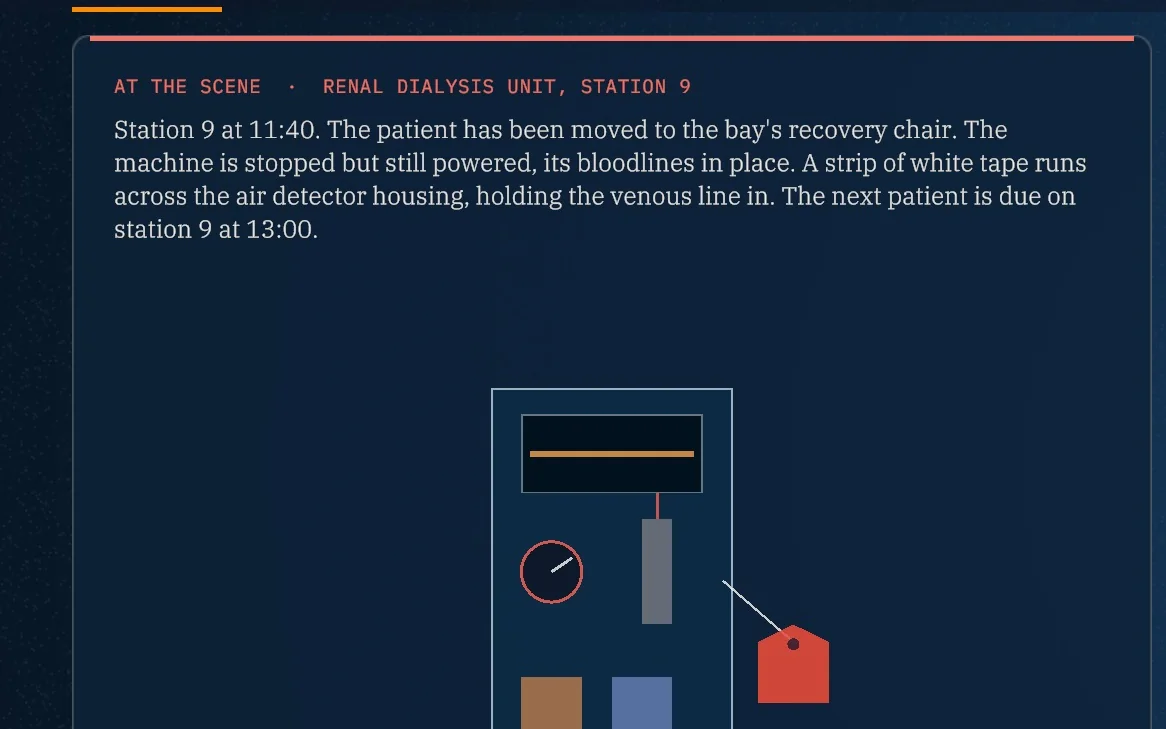
After the twenty-third air alarm of the session, air reached the patient.
- 08 Thirty-Nine Degrees
9 °C.
- 09 Bolus on Release
A child's morphine line was blocked for almost two hours.
- 10 The Notice Nobody Read
A ventilator lost power for nine seconds and came back breathing for a different patient: the factory default one.
- 11 The Common Thread
Three devices failed in three departments.
- 12 Twice the Strength
The pump believed the syringe held 1 mg/mL of morphine.
- 13 Ninety-Four on Air
For six hours the oximeter said 94% while the blood said 86%.
- 14 The Deeper Mattress
A new mattress was ordered to protect her skin.
- 15 Between Floors
The ventilator said there was an hour of oxygen left.
- 16 Six Weeks Later
The embolisation took four hours and went well.
- 17 Two Lots of Insulin
The ward ran an insulin drip while, under her gown, her own pump kept running too.
- 18 Five Hundred a Minute
In a massive haemorrhage the infuser kept stopping for air that was not there.
- 19 The Silent Abort
Three patients, one strain of Pseudomonas, one duodenoscope.
- 20 The Blank Printout
Fourteen instrument trays went to theatre with a signed release.
- 21 Out of Range
A patient on telemetry walked to the bathroom and vanished from the central station.
- 22 The Gold Reload
The surgeon asked for a gold reload and got one.
- 23 Fire in the Airway
The plan was a tubeless airway.
- 24 Thirty-One Minutes
The ventilator's battery gauge said 100% when the lights went out.
- 25 The Wrong Port
A purple syringe of breast milk was meant for a toddler's feeding tube.
- 26 Sweet Numbers
All night the meter said the glucose was fine.
- 27 The Wrong Phase
A routine abdominal scan ran an aortic angiogram protocol: 120 mL of contrast at 6 mL/s through a hand cannula.
- 28 The Short Loop
Halfway between the bed and the chair, a sling strap tore at its stitching and a patient fell to the floor.
- 29 The Crossed Pipe
The anaesthetist pre-oxygenated a healthy young man with 100% oxygen.
- 30 Too Close to the Light
With every LED unit out for repair, a midwife found an old lamp in the store.
- 31 Four Shocks on the Stairs
Four days after an MRI scan, a man's defibrillator shocked him four times for climbing the stairs.
- 32 Analysis Interrupted
In the outpatient pharmacy queue, a man in VF waited six minutes while the AED told everyone to stop moving.
- 33 The Last Litre
On the busiest night of the surge, a high-flow patient's screen read 80% oxygen while she was breathing barely half that, and then nothing at all.
- 34 Two Heartbeats
For the last 46 minutes of labour the trace showed a healthy baby accelerating with every push.
- 35 The Open Clamp
A four-year-old walked to the playroom with her drip.
- 36 Port Wine in the Line
The machine measured the pressure climbing behind a kinked line for over an hour.
- 37 Normal ECG
The printout said NORMAL ECG in bold capitals.
- 38 The White Socket
The lights came back after thirteen seconds and everyone relaxed.
- 39 The Other Mr Pearce
Two men called Pearce were waiting for CT.
- 40 The Mattress That Went Flat
Sometime after midnight the mattress pump stopped and the alarm stayed silent.
- 41 Out of the Camera's View
The robotic hysterectomy went smoothly.
- 42 Something in the Water
A baby born at 26 weeks developed Pseudomonas sepsis on day nine.
- 43 Side by Side
The syringe was labelled morphine and checked by two nurses.
- 44 When the Network Went Dark
At 01:47 ransomware locked the hospital's servers.
- 45 Ninety Percent
All night the monitor alarmed at 89%, as it had every few minutes since he arrived.
- 46 Someone Else's Potassium
1.