Medical City · Simulation 11 of 12
Biomedical Engineering Design Studio
Design a device through risk, validation and regulation.
What you do
Design Studio
Design Studio takes one clinical problem from a need to a device you can defend. You write the need, turn it into measurable inputs, choose an architecture, build the risk file, test the interface with users, verify and validate, classify it and face the design review.
Most device recalls trace back to design: a requirement never written, a hazard never analysed, a use error never tested. Design controls (ISO 13485, FDA 21 CFR 820) and ISO 14971 exist so that the device in the patient is the one the evidence describes.
40 challenges, each at Foundation, Practitioner and Expert level.
How it works
Step by step.
Write the need
Observe the scene and build one need statement: the problem, the population and the outcome, with no device in it. Problem, population, outcome - and no device.
Design inputs
Sort the candidate cards: accept real requirements, reject solutions and noise, make vague cards measurable, set values and trace each to a user need. Every input is a number, a unit and a condition, traced to a user need.
Choose the concept
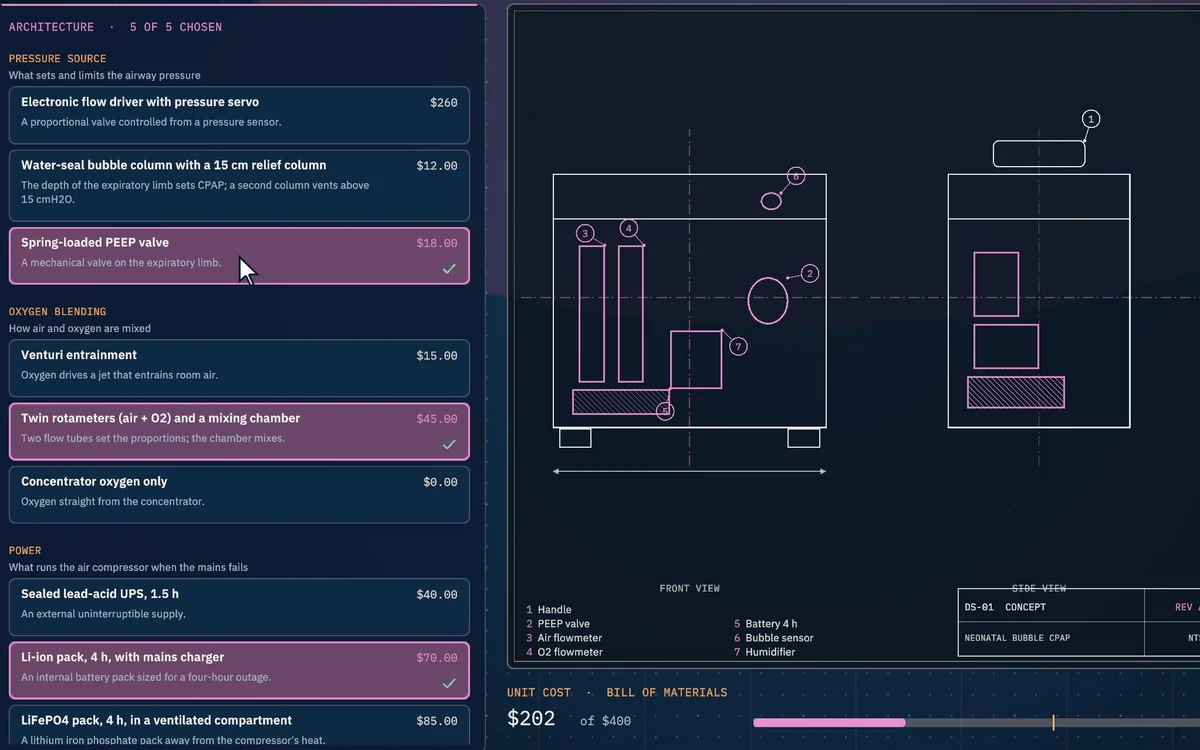
Choose one option for each subsystem against the trade-offs, the unit cost target and the inputs at risk. Prefer designs that make the hazard impossible.
Build the risk file
Add the hazards your concept really has, rate severity and probability, control each in priority order and judge the residual risk. Design first, protection second, information last.
Formative usability test
Mark the critical tasks, run a formative session with real users, choose a design response to each use error and re-test. The best fix removes the step that went wrong; training is the weakest.
Verify and validate
Choose a test for each input and a study for each user need, run them, read the results and resolve every failure. Each input needs the test that actually measures it.
Classify the device
Classify the device for the FDA, the EU MDR and IEC 62304. Intended use drives classification.
Design review
Answer the panel's questions about your evidence. Honest, specific evidence beats confidence.
Debrief
Compare your file with the expert's: score, traceability, risk, concept and findings. Need, input, output, verification, validation: one unbroken chain.
What it trains
Skills and competencies.
- Solution-free need statements
- Measurable, traceable design inputs
- Risk management to ISO 14971
- Usability engineering to IEC 62366-1
- Verification, validation and classification
In the BMEssentia competency framework, this simulation builds 8 competencies across Device Technology & Fault Finding, Procurement & Technology Lifecycle, Regulation, Design & Quality.
- Device Technology & Fault Finding
Device operating principles
Explain how a device turns physics and physiology into a clinical number or therapy, and where its limits come from.
- Device Technology & Fault Finding
Sensors, signals and instrumentation
Use multimeters, oscilloscopes and analysers to follow sensors and signal chains and find drift, noise and calibration errors.
- Procurement & Technology Lifecycle
Clinical needs and specification
Turn clinical needs into a clear, testable specification with mandatory and scored requirements.
- Regulation, Design & Quality
Medical device regulation
Know how devices reach and stay on the market: classification, UK MDR, EU MDR, FDA pathways, CE and UKCA marking.
- Regulation, Design & Quality
Design controls and verification
Develop devices with design inputs, traceability, verification and validation to ISO 13485 and 21 CFR 820.
- Regulation, Design & Quality
Risk management
Identify hazards, estimate and control risk with ISO 14971, and keep risk registers and residual risk honest.
- Regulation, Design & Quality
Usability and human factors
Design and assess devices, training and workflows so that use errors are hard to make (IEC 62366-1).
- Regulation, Design & Quality
Quality systems and audit
Run document control, internal audit, CAPA and accreditation so the department can prove its work is controlled.
The takeaways
- Write the need without a device in it.
- Make every input a number with a unit and a condition.
- Control risk by design first.
- Verify the inputs; validate the need.
The challenges
40 training cases.
- 01 Breath for the Smallest
A low-cost bubble CPAP for district hospitals
- 02 The Silent Line
Downstream occlusion detection at low infusion rates
- 03 Fourteen Days
A wearable ECG patch to find hidden atrial fibrillation after stroke
- 04 Asleep on the Machine
Venous needle dislodgement detection for nocturnal home haemodialysis
- 05 Did I Take It?
A dose-capture cap for insulin pens
- 06 Before the Fall
A bed-exit sensor that warns before a patient stands
- 07 Ultrasound in a Pocket
A handheld probe for point-of-care trauma scanning
- 08 Signal and Noise
Redesigning an ICU ventilator's alarm system
- 09 Clear Air
A quiet surgical smoke evacuator for theatres
- 10 Every Skin
A pulse oximeter accurate across skin pigmentation
- 11 The Quiet Hours
Continuous monitoring for opioid-induced respiratory depression on surgical wards
- 12 Push Hard, Push Fast
Real-time CPR quality feedback for ward resuscitation teams
- 13 The Colour of Day Three
Smartphone screening for newborn jaundice on community midwife visits
- 14 Seven Days of Quiet
Single-use negative pressure wound therapy for patients discharged after surgery
- 15 Ninety-Three Percent
An oxygen concentrator for hospitals where the power cannot be trusted
- 16 The Thousandth Repetition
An assist-as-needed arm robot for stroke rehabilitation
- 17 Half a Millilitre an Hour
Automated hourly urine output for intensive care
- 18 Before the Door
A 12-lead ECG sent from the ambulance to activate the STEMI pathway on the road
- 19 Every Word Back
A self-fitting over-the-counter hearing aid for adults with mild to moderate hearing loss
- 20 Twelve Tablets a Day
A smart medication dispenser for older adults at home with polypharmacy
- 21 Turning Point
A pressure-mapping sensor mat that prompts repositioning in nursing homes
- 22 Without a Needle
A spring-powered needle-free jet injector for mass vaccination campaigns
- 23 Room to Operate
A CO2 insufflator that holds pressure without over-pressurising the abdomen
- 24 The Algorithm at Night
An automated insulin delivery system for adolescents with type 1 diabetes
- 25 The First Degree
Continuous temperature monitoring for chemotherapy patients at home
- 26 The Quiet Cot
Home apnoea and oxygen monitoring for babies born preterm
- 27 The Doorframe
Collision avoidance for powered wheelchair users with limited control
- 28 The Breath Hold
Inhaler technique and adherence sensing for asthma
- 29 Blue at Home
Fibreoptic phototherapy so jaundiced newborns can stay with their mothers
- 30 The Sixth Hour
Early-warning software for sepsis on general wards
- 31 Keeping the Hair
Scalp cooling to reduce hair loss during chemotherapy
- 32 The First Ten Minutes
An infant radiant warmer for delivery rooms that never overheats a baby
- 33 A Drop of Blood
A point-of-care haemoglobin meter for antenatal clinics
- 34 Counting Drops
A low-cost gravity infusion controller for paediatric wards
- 35 Warm Blood, Cold Night
A battery fluid and blood warmer for prehospital trauma care
- 36 Two Heartbeats
Wireless fetal heart rate monitoring for women in labour who want to move
- 37 Ten Times Too Much
Redesigning a patient-controlled analgesia pump's programming interface
- 38 The Wrong Port
An enteral feeding pump that cannot be connected to a vein
- 39 A Second Pair of Ears
A digital stethoscope that flags heart murmurs for primary care
- 40 A Shock You Wear
A wearable cardioverter-defibrillator for patients waiting for an implant
Devices
Devices in this simulation.
Standards