医疗城 · 设备实验室 · 第 52 台,共 69 台
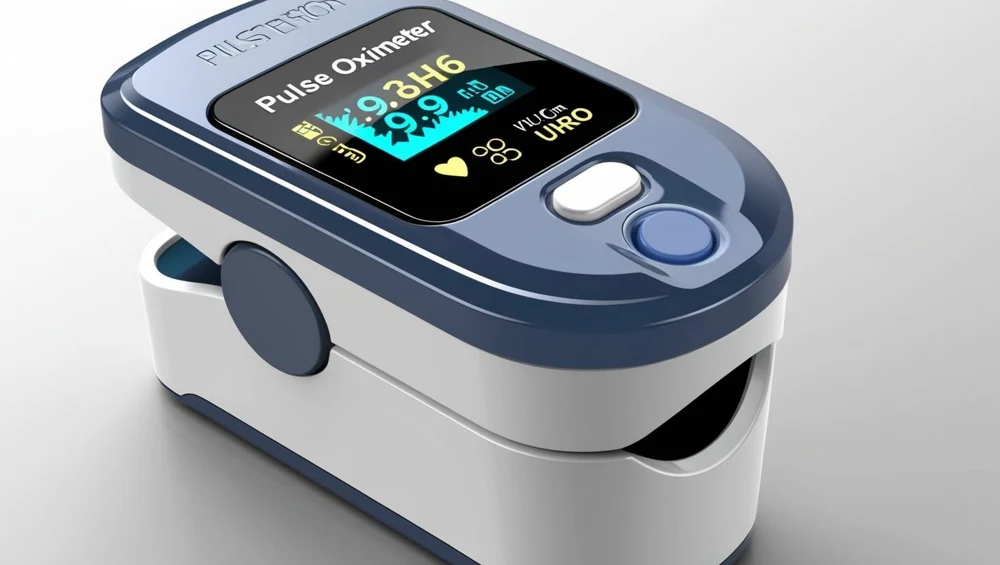
脉搏血氧仪
Pulse Oximeter
BMEssentia 医疗城设备实验室中的脉搏血氧仪。以可交互 3D 打开设备,逐个部件拆解,了解其工作原理,然后在 BMEssentia 平台上系统学习,并向 Essentia 提问。
本页的设备实验室内容为英文,与医疗城中的内容一致。
- 10 个部件
- 设备实验室中有 2 种配置
- 又称: Spo2
设备实验室
Pulse Oximeter
A sprung clip that closes across a digit, with the two emitters in one jaw and the photodiode directly opposite in the other. The optical path is a straight line through the tissue, its length is whatever the digit is, and the housing is shaped and coloured to keep room light out of the space between the two jaws. A single cable carries the emitter drive down and the photodiode current back, to a bedside monitor on a rolling stand.
配置
设备实验室中的各个版本。
Transmittance sensor, a spring clip across a digit
A sprung clip that closes across a digit, with the two emitters in one jaw and the photodiode directly opposite in the other. The optical path is a straight line through the tissue, its length is whatever the digit is, and the housing is shaped and coloured to keep room light out of the space between the two jaws. A single cable carries the emitter drive down and the photodiode current back, to a bedside monitor on a rolling stand.
Reflectance sensor, a flat-site pad at a fixed separation
A thin adhesive pad carrying the two emitters and the photodiode on the same face, a declared distance apart, with an opaque optical barrier moulded between them and a headband to hold it against a flat site. Light enters the tissue, scatters, and some of it turns round and reaches the detector; the deepest such path has a semicircular lower bound of exactly pi/2 times the separation, so the sampled depth is set by a number on a drawing rather than by the anatomy. The same cable and the same monitor.
部件
逐个部件讲解。
Red emitter at 660 nm, its die, lens and centre-wavelength bin
A red light-emitting diode roughly a quarter of a millimetre across, mounted in the emitter jaw of the sensor behind a small moulded lens, its die bonded to a lead frame and its emission aimed straight at the site. It is one of exactly two light sources on this representative device.
Infrared emitter at 940 nm, and why the pair straddles the crossing
The second and final light source: an infrared diode sitting beside the red one in the same jaw, behind the same kind of moulded lens, invisible to the eye and indistinguishable from its neighbour by inspection. Its declared representative centre wavelength is 940 nm.
Silicon photodiode, its active area and its spectral responsivity
A single reverse-biased silicon photodiode with an active area of a few square millimetres, sitting behind a window in the opposing jaw of a clip sensor or alongside the emitters on a flat pad. It produces a current proportional to the optical power falling on it.
Multiplexed emitter drive and the three-slot timing
A small constant-current sink with a switch matrix and a timing generator, on the board inside the monitor rather than in the sensor. It turns each emitter on for a short slot, in a repeating frame of three slots, red, infrared, and one with both emitters off, at a declared representative rate of 500 samples per second per slot.
The dark slot, and the subtraction that removes the room
The only component on this device with no hardware of its own. It is the third slot of the frame, both emitters off, the photodiode read anyway, and one subtraction performed on the numbers.
Transimpedance amplifier and the current it turns into a voltage
An operational amplifier with a large feedback resistor across it, on the monitor board at the end of the sensor cable. The photodiode's current flows into its summing node and comes out as a voltage; the resistor's value is the conversion factor, and a small capacitor across that resistor keeps the stage stable and sets its bandwidth.
The alternating and direct separation, and why the ratio needs both
Two filters and a division, performed on the digitised stream of one channel. The steady part is the mean level of the detected light over several cardiac cycles; the pulsating part is the peak-to-peak swing riding on it.
Analogue-to-digital converter and where the quantisation floor sits
A declared sixteen-bit converter on the monitor board, sampling at a representative 500 samples per second in each slot of the frame, triggered by the same sequencer that lights the emitters. It takes the voltage the transimpedance stage produced and turns it into an integer.
The ratio of ratios, which is the only thing this device measures
Not an object at all but a single division, performed in firmware, taking the red channel's swing-over-mean and dividing it by the infrared channel's. One dimensionless number comes out, conventionally written R.
The empirical calibration curve, and where the physics stopped
A memory device a few millimetres across, potted inside the SENSOR CONNECTOR, holding the coefficients that turn a measured ratio into the number on the screen. It is the smallest component on the device and the most important.