المدينة الطبية · مختبر الأجهزة · الجهاز 50 من 69
وحدة الجراحة الكهربائية
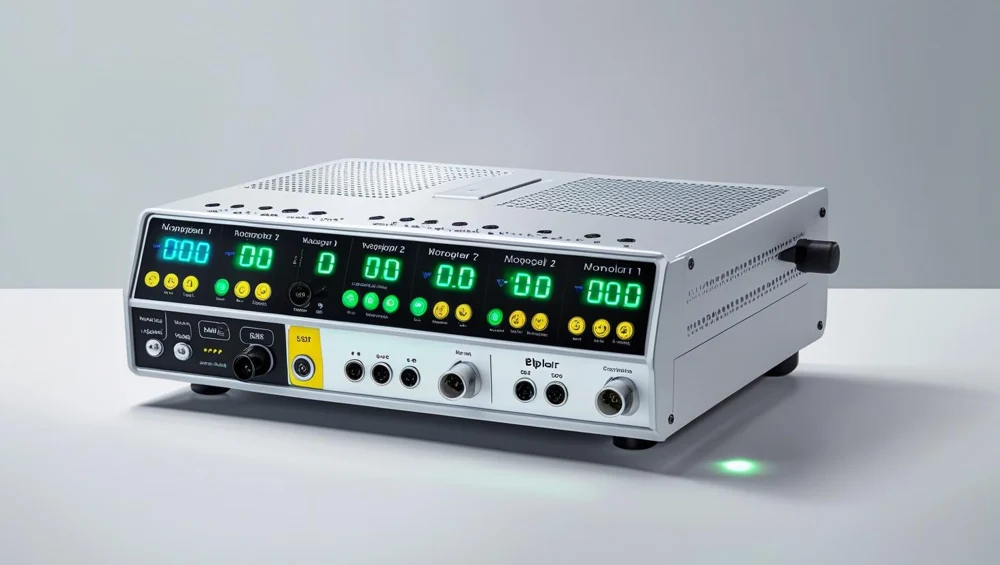
Electrosurgical Unit
وحدة الجراحة الكهربائية في مختبر الأجهزة في المدينة الطبية من BMEssentia. افتحه بتقنية ثلاثية الأبعاد تفاعلية، وفكّكه قطعةً قطعة، وتعرّف إلى طريقة عمله، ثم تعلّمه على منصة BMEssentia واسأل إسنشيا عنه.
محتوى مختبر الأجهزة في هذه الصفحة باللغة الإنجليزية، كما هو داخل المدينة الطبية.
- عدد الأجزاء: 10
- عدد التكوينات في مختبر الأجهزة: 2
- يُعرف أيضًا باسم: Diathermy, Electrocautery, Bovie
مختبر الأجهزة
Electrosurgical Unit
One electrode does the work and the other one collects. The surgeon holds a pencil with a tip a square millimetre across; a dispersive pad of about a hundred and ten square centimetres is stuck to the patient somewhere well perfused and close to the site. The current that leaves the tip crosses the patient and arrives at the pad undiminished, because there is nowhere else for it to go, and it is only the area it arrives over that makes the pad harmless.
التكوينات
نسخ الجهاز في مختبر الأجهزة.
Monopolar circuit with dispersive return electrode
One electrode does the work and the other one collects. The surgeon holds a pencil with a tip a square millimetre across; a dispersive pad of about a hundred and ten square centimetres is stuck to the patient somewhere well perfused and close to the site. The current that leaves the tip crosses the patient and arrives at the pad undiminished, because there is nowhere else for it to go, and it is only the area it arrives over that makes the pad harmless.
Bipolar circuit confined between the forceps tines
Both electrodes are in the surgeon hand, two millimetres apart, and the tissue between them is the whole of the circuit. Current crosses from one tine to the other and returns. Nothing flows through the rest of the patient, so there is no dispersive pad, no return cable and nothing at the return site to monitor, because there is no return site.
كيف يعمل
استكشفه في مختبر الأجهزة.
The two areas, and why one of them burns
Set the power, then change nothing except how much of the pad is in contact, and watch four numbers at once: the load impedance, the current, the current density at the return site, and the temperature rise there.
Duty cycle, crest factor and the voltage nobody asked for
Fix the power at a hundred and twenty watts and step through the modes from pure cut to coagulation, reading only two numbers: the root-mean-square voltage and the peak.
The load that fights back
Hold an electrode in contact and watch the impedance during a single activation. It does not sit still. It starts near a few hundred ohms in moist tissue and climbs past a thousand and then past three thousand as the water boils out of the tissue in the current path.
Where the current goes when it does not come back
Compare the reading from the current transformer on the active lead against the one on the return lead. On a healthy monopolar circuit they agree, because it is one circuit. When they do not, the difference left by another route.
A measurement added because the available one cannot answer
The load impedance is measured continuously, accurately, and for a completely different purpose. It cannot detect a pad coming off, because the pad is a few ohms out of several hundred. So a second measurement was added that is sensitive to exactly the thing the first one is blind to.
الأجزاء
قطعةً قطعة.
Mains inlet, fuse and protective earth
One moulding on the back panel carrying three things that are usually separate: the socket the power lead goes into, a drawer holding two fuses, and a small window showing which supply voltage the unit has been strapped for. Beside it, a brass stud with a green ring around it.
Controlled DC bus
Two electrolytic cans the size of drinks cans, a choke, and a converter block on a small board. Nothing about it looks like the interesting part of an electrosurgical generator, and it is the only place in the machine where the amount of power is decided.
Radiofrequency inverter
A board with four switching devices bolted to a finned heatsink, a pair of small transformers beside them, and more copper than anything else on it. It is the component that turns a direct rail into something that alternates, and it runs at a frequency chosen for a reason that has nothing to do with electronics.
Waveform gating stage
A small board with a handful of logic and one component that looks like it belongs in a signal circuit rather than a power one. It is physically the least impressive stage in the machine and it is the one that decides whether the machine cuts or coagulates.
Output stage and isolating transformer
A toroidal core wound in two halves with a visible gap between the windings, sitting astride a slot cut clean through the circuit board beneath it. The slot is the most informative feature on the board and it is empty on purpose: no copper, no solder resist, no substrate.
Output sensing and power control loop
Two identical ring cores on the output board with a conductor threaded through each, a resistive divider beside them, and a second small processor with its own reference. Two of everything, and the reason for the duplication is different in each case.
Front panel and displays
Three numeric readouts in a row, each with its own mode lamps and its own pair of arrow keys, a bar of segments labelled for the neutral electrode with an amber lamp beside it, and a strip of differently shaped sockets along the bottom. Three readouts rather than one, because there are three outputs rather than three settings.
Activation tone and alarms
A small sounder near the top of the enclosure behind a pattern of holes, and the only part of this machine whose output is meant for everybody in the room rather than for the person holding the instrument.
Dual footswitch
Two pedals on a sealed base, one yellow and one blue, under a guard bar, with a cable that runs back to a socket on the rear of the generator. Yellow is cutting and blue is coagulation, and that pairing is the same on the pencil, on the panel and on every accessory in the set.
Enclosure, cooling and cart
A box with a blue lid, louvres along both sides and across the top, a fan behind a finger guard on the back, and a handle each side. It stands on a shelf rather than on the floor, and on most references there is a second shelf beneath it carrying everything else.