المدينة الطبية · مختبر الأجهزة · الجهاز 5 من 69
التصوير المقطعي بإصدار الفوتون المفرد
SPECT
التصوير المقطعي بإصدار الفوتون المفرد في مختبر الأجهزة في المدينة الطبية من BMEssentia. افتحه بتقنية ثلاثية الأبعاد تفاعلية، وفكّكه قطعةً قطعة، وتعرّف إلى طريقة عمله، ثم تعلّمه على منصة BMEssentia واسأل إسنشيا عنه.
محتوى مختبر الأجهزة في هذه الصفحة باللغة الإنجليزية، كما هو داخل المدينة الطبية.
- عدد الأجزاء: 10
- عدد التكوينات في مختبر الأجهزة: 2
- يُعرف أيضًا باسم: Single Photon Emission, Gamma Camera
مختبر الأجهزة
SPECT
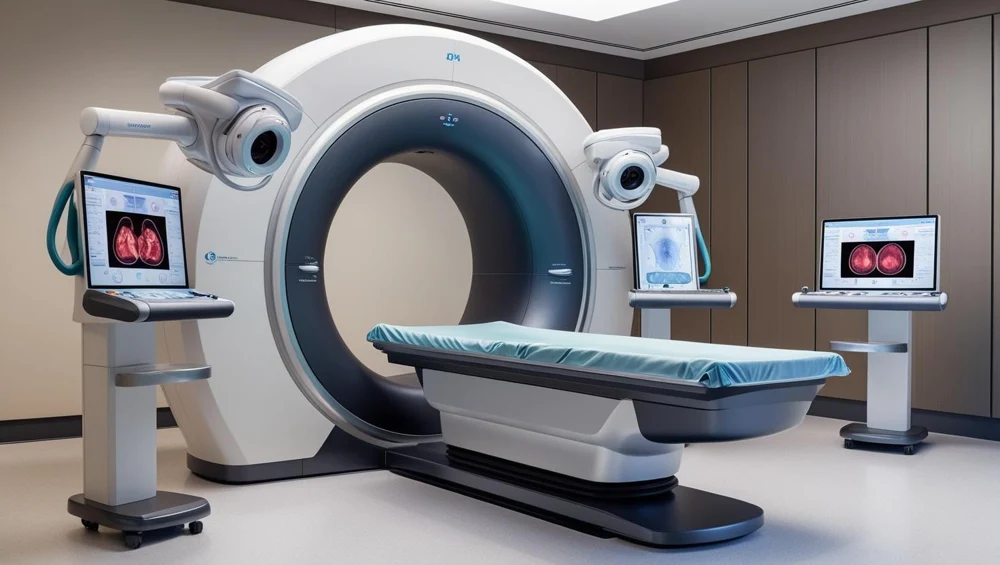
A gamma camera on a rotating gantry. Two detector heads orbit the patient and record where photons left the body, from enough directions to reconstruct a volume.
التكوينات
نسخ الجهاز في مختبر الأجهزة.
Dual-head variable-angle SPECT
A gamma camera on a rotating gantry. Two detector heads orbit the patient and record where photons left the body, from enough directions to reconstruct a volume.
SPECT/CT with attenuation correction
The same gamma camera with a low-dose CT behind it on the same axis. The CT measures how much each path through the patient attenuates, and the reconstruction uses that rather than assuming it.
كيف يعمل
استكشفه في مختبر الأجهزة.
Resolution and sensitivity are the same dial
Change the collimator and watch two numbers move in opposite directions, every time, without exception. Longer, narrower holes accept a narrower range of directions, so the image resolves better and fewer photons get through. Shorter, wider holes accept more, so the count rate rises and the resolution falls.
The free control nobody writes down
Resolution at the object falls off with distance from the collimator face, roughly linearly, because the cone of directions a hole accepts widens with distance. Move a head from 250 mm to 150 mm from the axis and the system resolution improves by about a third.
Energy is a direction test in disguise
The camera measures how much energy each photon had, and it does so to find out whether the position it just recorded is a lie.
Counts you cannot get back
Set the delay between injection and imaging to six hours and watch what is left. For technetium-99m, with a six-hour half-life, about half. Those counts are not delayed; they are gone, and noise rises as the square root of what remains.
The quantity the camera cannot measure
Put a source eighty millimetres inside a body of soft tissue and count what comes out. Roughly a third of what was emitted. Put the same source near the surface and almost all of it arrives.
الأجزاء
قطعةً قطعة.
Collimator
A slab of lead drilled with tens of thousands of parallel holes, bolted to the face of the detector head. It weighs between eighty and two hundred kilograms, it is changed by hand on a trolley, and it throws away more than ninety-nine point nine per cent of everything that reaches it.
Scintillation crystal
A single sheet of sodium iodide about 540 by 400 millimetres and under a centimetre thick, sealed behind a thin aluminium window. It is the point at which a gamma photon stops being radiation and becomes light.
Light guide
A slab of optically clear material between the crystal and the photomultipliers, doing something that sounds like a mistake: deliberately spreading the light out.
Photomultiplier array
Around fifty tubes in a hexagonal close packing behind the light guide, each one turning a few hundred photons of visible light into a measurable pulse of current.
Detector head shielding
The lead that surrounds everything except the collimator face. A detector head weighing four hundred kilograms is mostly this.
Position and energy electronics
The boards immediately behind the tubes that turn a set of simultaneous pulses into three numbers: x, y, and how much energy the event deposited.
Pulse height analyser
The circuit that looks at each event’s energy and decides whether it is counted or discarded. On a typical technetium study it throws away most of what reaches it.
Acquisition computer
The computer that records accepted events and assembles them into projections. On a tomographic study it is also what tells the gantry when to move.
Gantry ring and covers
The thick ring standing on edge that the heads live inside. It is the silhouette that tells a gamma camera from a CT across a room: a doughnut rather than a cabinet with a hole in it.
Patient aperture
The padded, quilted opening the patient lies in. It is the softest thing on the machine and the only part designed around how long somebody has to stay still.
ملاحظات الطُّرز
طُرز حقيقية، بعد المراجعة.
Next
تعلّمه، ثم اسأل عنه.
- BMEssentia Platformالتصوير المقطعي بإصدار الفوتون المفرد على منصة BMEssentiaدورة مكتبة الأجهزة: 13 قسمًا من الفيزياء إلى الصيانة.
- Essentiaاسأل إسنشيا عن التصوير المقطعي بإصدار الفوتون المفردإجابات من مصادر مسمّاة، مع ذكر مصدر كل معلومة.
- مختبر الأجهزةجميع الأجهزة الـ69كل أجهزة مختبر الأجهزة، قطعةً قطعة.