医疗城 · 设备实验室 · 第 64 台,共 69 台
体温计
Thermometer
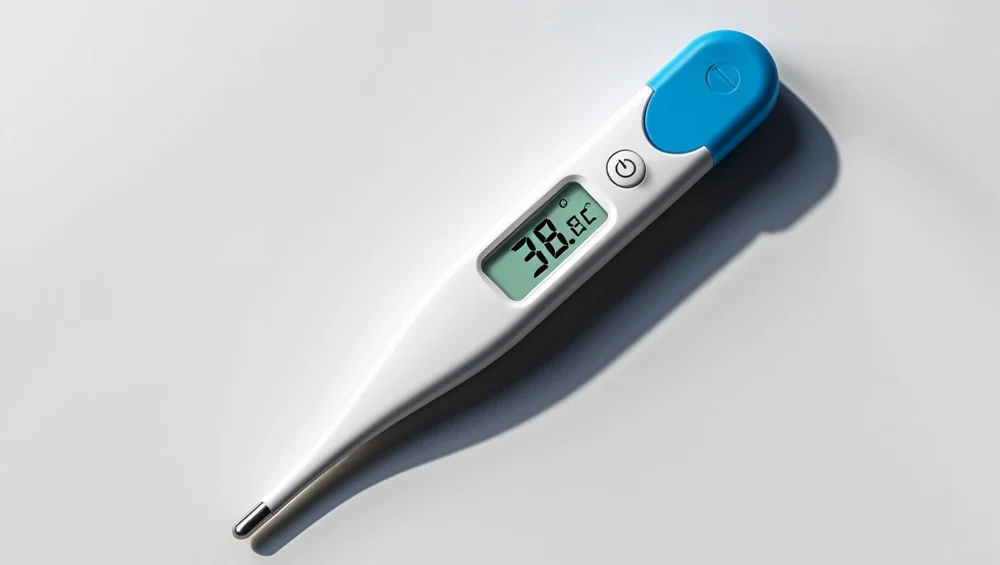
BMEssentia 医疗城设备实验室中的体温计。以可交互 3D 打开设备,逐个部件拆解,了解其工作原理,然后在 BMEssentia 平台上系统学习,并向 Essentia 提问。
本页的设备实验室内容为英文,与医疗城中的内容一致。
- 10 个部件
- 设备实验室中有 2 种配置
- 又称: Clinical Thermometer
设备实验室
Thermometer
A stainless-sheathed negative-temperature-coefficient bead on a lead, placed in a closed axillary pocket, reporting the temperature the bead has reached.
配置
设备实验室中的各个版本。
Contact thermistor probe, sheathed, at a closed axillary pocket
A stainless-sheathed negative-temperature-coefficient bead on a lead, placed in a closed axillary pocket, reporting the temperature the bead has reached.
Non-contact infrared thermometer, fixed standoff, at the forehead surface
A thermopile behind a lens and a field stop, converting the net radiative exchange with a patch of forehead into a temperature using an emissivity fixed in firmware.
工作原理
在设备实验室中探索。
The instrument that has to become the thing it measures
Set the contact configuration on the bench and read the number at five seconds, at ten, at fifteen, at thirty and at sixty. Then read the time constant off the board and check that the sequence is the exponential it claims to be.
The probe as a thermal path to somewhere colder
Leave the contact configuration to settle completely, so nothing anywhere is still changing, and then look at what it reports. 767 kelvin below the site. There is no transient left to blame and no fault anywhere.
A radiance divided by an assumption
Set the non-contact configuration at its standoff, so the geometry is exactly right, and then move only the true emissivity of the surface. 98 because there is no control for it.
A field of view that grows until it is averaging the room
Take the non-contact configuration off its standoff and move it away from the site while watching the reported value and the spot diameter together. Nothing about the instrument changes.
The term that is in neither instrument
Leave both instruments alone and move only the room. Then move only the tissue layer. Neither of those is a control on anything and both of them move the answer more than anything you can adjust.
部件
逐个部件讲解。
Instrument stand, articulated arm and cradle
A weighted disc 520 millimetres across on five rubber pads, an aluminium column just over a metre tall, and a two-segment arm on ball joints with a fitting at the far end. On one configuration that fitting is an open tray the instrument lies in.
Single-use barrier over the sensing face
A thin polyethylene sleeve about 62 millimetres long with a moulded collar at the open end, pulled on over the sensing face before every use and taken off after it. The same consumable serves both configurations, and on both it is the only thing between the instrument and a succession of different people.
Stainless sensing tip and the mass it has to warm
5 millimetres across and 8 millimetres long with a hemispherical end, at the patient end of a flexible lead. It looks like nothing at all and it is the numerator of everything difficult about this configuration.
Negative-temperature-coefficient bead and its resistance law
A sintered metal-oxide bead a little over a millimetre across with two fine leads out of it, potted into the closed end of the tip. Its resistance falls steeply as it warms, and that steepness is the only reason a cheap converter can resolve a hundredth of a kelvin.
Sheath between the tip and the housing, which is the drain
The continuation of the same stainless tube, 30 millimetres of it inside the closed pocket and 60 millimetres standing out in room air, with a witness band where one becomes the other. It is the reason this configuration reads low even after it has finished settling.
Strain relief boot where the lead leaves the housing
A tapered rubber boot about 22 millimetres long with four moulded ribs, where the lead comes out of the nose of the case. It is the most boring component on the instrument and it is where these probes die.
Flexible lead and its conductors
2 millimetre jacketed cable from the sheath to the boot, with two clips holding it where it would otherwise catch. It routes up and clear of the body rather than straight across it, which is a choice with a reason.
Bench board: the approach, and the error at the moment of reading
A 440 by 330 millimetre board on its own post beside the couch, drawing the exponential approach against time with a mark where somebody actually reads and another where the instrument decides it has finished. Across the top it says that no instrument shows you this, and it means it.
Internal reference temperature sensor
A three millimetre package near the tail of the board, inside a ring of eight plated vias that deliberately do not connect it to the warm parts of the board. It is present on both configurations, doing two jobs with nothing in common.
Analogue front end and its resolution
A five millimetre converter with eighteen passive parts around it, including one visibly larger part with tolerance bands on it. That larger part is a precision reference resistor and it carries as much of the measurement as the converter does.