医疗城 · 设备实验室 · 第 59 台,共 69 台
喉镜
Laryngoscope
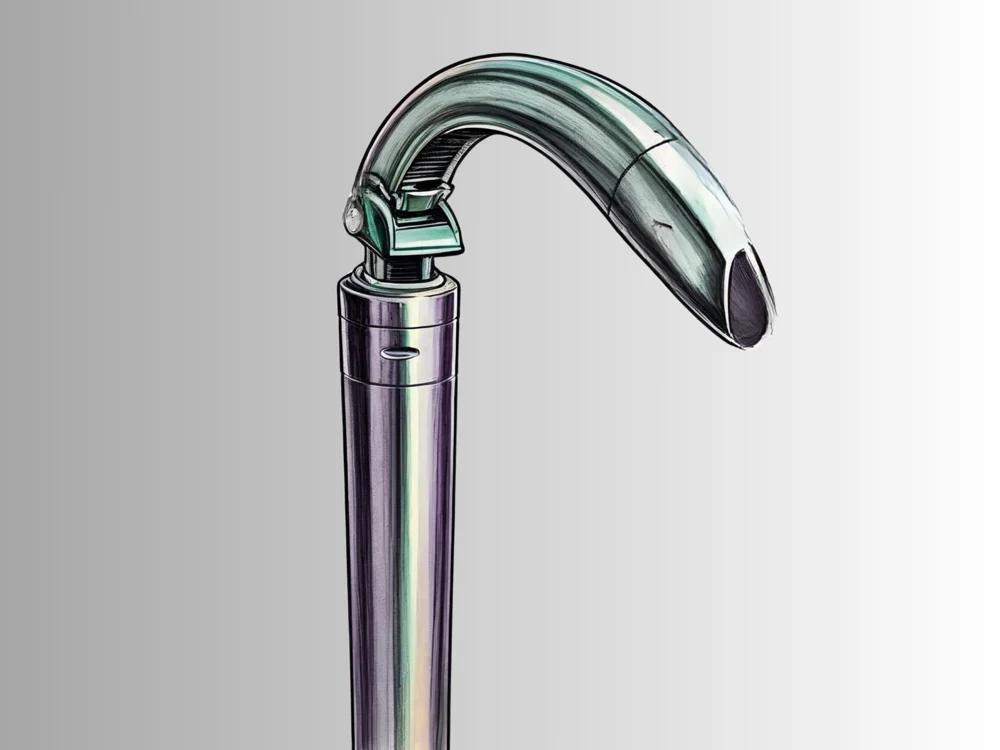
BMEssentia 医疗城设备实验室中的喉镜。以可交互 3D 打开设备,逐个部件拆解,了解其工作原理,然后在 BMEssentia 平台上系统学习,并向 Essentia 提问。
本页的设备实验室内容为英文,与医疗城中的内容一致。
- 10 个部件
- 设备实验室中有 2 种配置
- 又称: Video Laryngoscope
设备实验室
Laryngoscope
A rigid curved spatula on a hook-on handle, lit by a fibre bundle that carries light from the handle lamp to a polished exit port near the tip. The blade is reusable stainless and goes through a wash and a steam cycle between uses.
配置
设备实验室中的各个版本。
Curved direct blade, size 3, fibre-optic illumination
A rigid curved spatula on a hook-on handle, lit by a fibre bundle that carries light from the handle lamp to a polished exit port near the tip. The blade is reusable stainless and goes through a wash and a steam cycle between uses.
Hyperangulated blade, distal camera, single-use shell
A hyperangulated spatula carried in a single-use shell over a reusable optical stick. The objective and its LED sit at the tip, past the corner, and the image arrives on a screen through an umbilical.
部件
逐个部件讲解。
Handle barrel
The handle is the input arm of a lever, and almost everything else about it follows from that. It is a hollow stainless barrel that your hand closes around, and the resultant of that grip acts at one point roughly two thirds of the way down it.
Knurled grip band
The knurled band is where the hand actually meets the instrument, and it is the only part of the device designed around the fact that the operator may be wearing wet gloves. It is a moulded elastomer sleeve with raised longitudinal ribs, bonded over the middle third of the barrel.
Cell stack
Two cells in series, stacked nose to tail inside the handle barrel, held down by a return spring at the bottom and making contact at the top. They are the entire energy supply for the light, and on both configurations the light is the only thing that lets anybody see anything at all.
Hook-on fitting and latch contact
The hook-on fitting is the interface between the handle and the blade, and it is doing three jobs at once. It is a hinge, so the blade can be folded for storage.
Lamp housing
The lamp housing is the small can that holds the emitter, sets where it points and gets rid of its heat. On both configurations it sits at the top of the handle just below the saddle, angled so its output aims into whatever is latched on.
Light-emitting diode
The emitter is a small white light-emitting diode on a carrier, sitting behind the housing window. It is the origin of the entire optical chain on both configurations, and it is the point at which a quantity of electrical energy becomes a quantity of luminous flux poured into a cone.
Blade heel and locking bar
The heel is the thick block at the near end of the blade that engages the hook bar and turns the whole spatula into a rigid extension of the handle. It carries the slot that drops onto the bar, the face the latch pawl catches, and the pad the contact pin presses against.
Spatula
The spatula is the curved blade proper: the long, shallow trough that runs from the heel out to the tip. It is the output arm of the lever and it is also the part that decides where the output arm ends, because the straight line from the hinge to the tip is the distance every reaction is divided by.
Tissue bearing surface
The bearing surface is the flattened, marked band on the underside of the spatula that the instrument is meant to load through. It is not a separate part bolted on; it is a region of the blade that has been finished and marked so that it is identifiable.
Lateral flange
The flange is the wall that rises from one edge of the spatula, turning a flat plate into a trough. Its job is retention: it stops what the blade is displacing from sliding back across the working area.