医疗城 · 设备实验室 · 第 7 台,共 69 台
体外循环机
Cardiopulmonary Bypass
BMEssentia 医疗城设备实验室中的体外循环机。以可交互 3D 打开设备,逐个部件拆解,了解其工作原理,然后在 BMEssentia 平台上系统学习,并向 Essentia 提问。
本页的设备实验室内容为英文,与医疗城中的内容一致。
- 10 个部件
- 设备实验室中有 2 种配置
- 又称: Heart-Lung Machine, Perfusion Pump
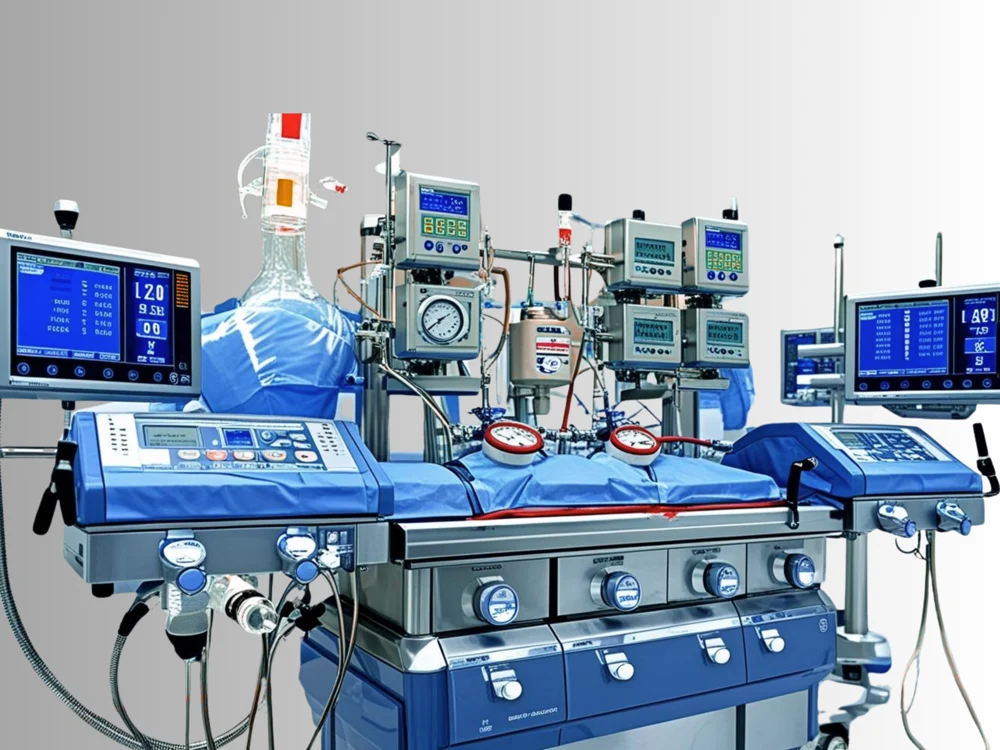
设备实验室
Cardiopulmonary Bypass
The arterial pump is occlusive and positive displacement. Flow is whatever the rollers sweep, it does not change with what is downstream, and it will deliver air as readily as blood.
配置
设备实验室中的各个版本。
Roller-pump bypass console
The arterial pump is occlusive and positive displacement. Flow is whatever the rollers sweep, it does not change with what is downstream, and it will deliver air as readily as blood.
Centrifugal-pump bypass console
The arterial pump is non-occlusive. Flow falls as resistance downstream rises, so the speed set is not the flow delivered and it has to be measured. It de-primes rather than pumping air.
部件
逐个部件讲解。
Cannulae and patient lines
Four connections into one opening in a chest, and several metres of half-inch PVC back to a console at the patient’s side. This is the part of the machine that is inside a person, and it is the part that decides how much of everything else there has to be.
Venous drainage
A wide tube from the right atrium down to a reservoir, and nothing pulling on it. Blood arrives in this machine because the reservoir is lower than the patient and for no other reason.
Venous reservoir
A clear column on the mast with blood in the bottom of it. It is the buffer between what is coming back from the patient and what is being pumped out to them, and its level is the number watched more closely than any other on this machine.
Oxygenator and heat exchanger
A clear housing on the mast with blood going in dark at the bottom and coming out red at the top. It is the lung, and in the same shell there is a heat exchanger that sets the patient’s temperature.
Gas blender and sweep
A small panel with two flowmeters and a mount for a vaporiser. It decides two things that people constantly confuse: how much oxygen the blood gains, and how much carbon dioxide it loses.
Heater-cooler unit
A box on the floor beside the console with a water tank in it. It cools the patient at the start of the operation and warms them at the end, through water that never touches blood, and it is the one part of this machine with an infection story attached to it.
Arterial filter and bubble trap
A clear bowl on the arterial line, the last thing blood passes through before it reaches the aorta. It catches what everything upstream let past, and it has a purge line off the top so that what it catches can leave the circuit rather than sit in it.
Air bubble detector
A small clamp on the arterial line with an ultrasonic head each side of the tube. It listens for anything that is not blood and stops the pump when it hears it.
Inline blood gas sensors
Two small cuvettes in the circuit, one on each side of the oxygenator. The pair is the point: what went in and what came back, and the difference between them is what the patient took.
Cardioplegia circuit
A separate pump, a separate heat exchanger and a line into the aortic root. It stops the heart and keeps it stopped, cold and still, for as long as the operation needs, which is the second thing this machine does and the one people forget it does at all.