المدينة الطبية · مختبر الأجهزة · الجهاز 41 من 69
جهاز تخطيط الدماغ الكهربائي
EEG
جهاز تخطيط الدماغ الكهربائي في مختبر الأجهزة في المدينة الطبية من BMEssentia. افتحه بتقنية ثلاثية الأبعاد تفاعلية، وفكّكه قطعةً قطعة، وتعرّف إلى طريقة عمله، ثم تعلّمه على منصة BMEssentia واسأل إسنشيا عنه.
محتوى مختبر الأجهزة في هذه الصفحة باللغة الإنجليزية، كما هو داخل المدينة الطبية.
- عدد الأجزاء: 10
- عدد التكوينات في مختبر الأجهزة: 2
- يُعرف أيضًا باسم: Electroencephalograph
مختبر الأجهزة
EEG
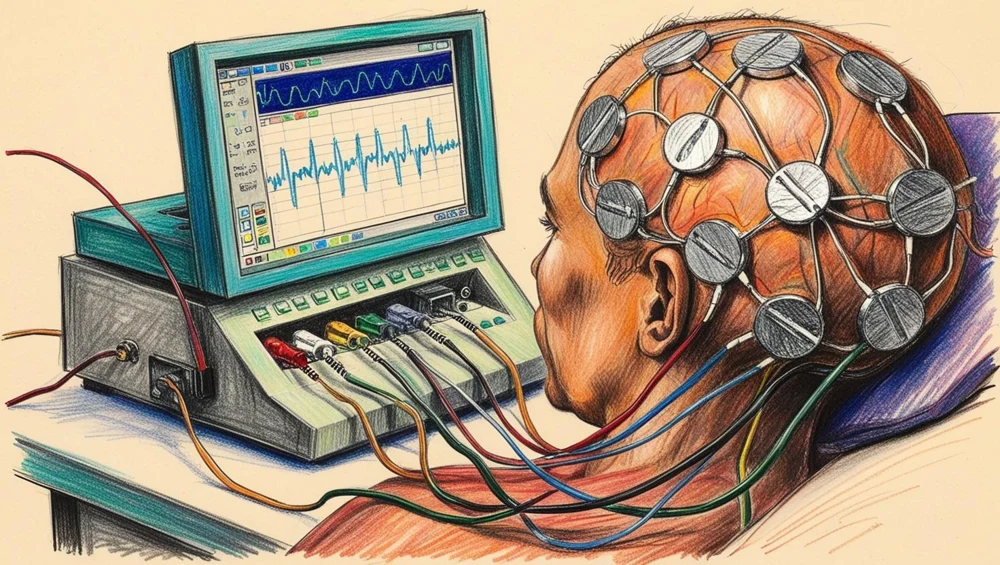
Nineteen recording electrodes placed at every position of the international 10-20 system, measured onto the head with a tape rather than estimated, with the two earlobes as a linked reference and a ground at Fpz. Half an hour of recording with a technologist in the room, who measures every impedance before it starts, watches the traces while it runs, and re-applies an electrode the moment one of them drifts.
التكوينات
نسخ الجهاز في مختبر الأجهزة.
Routine diagnostic recording, full 10-20 array
Nineteen recording electrodes placed at every position of the international 10-20 system, measured onto the head with a tape rather than estimated, with the two earlobes as a linked reference and a ground at Fpz. Half an hour of recording with a technologist in the room, who measures every impedance before it starts, watches the traces while it runs, and re-applies an electrode the moment one of them drifts.
Continuous monitoring, reduced array
Eight recording electrodes over the frontal and temporal regions, a single reference at Cz and a ground at Fpz, applied to hold for days rather than for half an hour, and left running in an intensive care bay with nobody in the room. It answers a different question: not what this brain looks like now, but whether something happened in the last three days.
كيف يعمل
استكشفه في مختبر الأجهزة.
The reference is in every channel that names it
Put a fault on the reference electrode and count how many channels carry it, in each of the three montages in turn.
What actually sets the rejection
Set the two electrode impedances equal and note the interference. Then unbalance them and watch it grow, and compare the rejection the channel achieves against the figure the amplifier is sold with.
Two channels with opposite polarity
Put a fault on one electrode and count the channels that carry it, with the polarity of each, in a bipolar montage. Then do it on an electrode at the end of a chain.
A floor as well as a ceiling
Take one electrode out of the window in each direction in turn, too high, then too low, and look at what each does to the record.
Where the muscle went
Raise the muscle content in the record, then change the sampling rate and watch what the fast activity does.
الأجزاء
قطعةً قطعة.
Electrode leads and their screening
Twenty-two thin coloured wires leaving twenty-two silver cups, sweeping back over the scalp and gathered into one clip at the crown, from where a single braid runs to the headbox. They look like the least interesting part of the machine and they carry a signal that is a hundred times smaller than the interference around them.
Headbox and electrode inputs
A small moulded box on a stand at the patient shoulder, its face printed as a head seen from above: the vertex in the middle, the circumference around the rim, a notch for the nose. One socket per electrode, laid out where that electrode goes.
Input protection and patient current limiting
A board inside the headbox carrying a resistor and a pair of clamping diodes for every input. It does nothing at all in normal use and it is the reason the machine can be connected to a person.
Differential amplifier, one per channel
A row of small packages on a board, one for every recording channel, each with a single resistor beside it that sets its gain. This is the component the device exists around: it subtracts one electrode from another and multiplies the difference.
Ground electrode and common-mode feedback
One more cup, usually on the forehead, with a green lead, and a small board in the amplifier that does something to it. It is the electrode most often described wrongly: it is not a reference, and it is not a safety earth.
System reference electrode
On the routine configuration, two ear clips joined together. On the continuous one, a single cup at the vertex.
Twenty-four bit digitiser
A row of converters, sampling every channel hundreds of times a second and turning the whole record into numbers before it has travelled a metre. Everything before it is analogue and fragile; everything after it can be copied without loss.
High-pass, low-pass and notch filters
Three settings, shown as three legends on the front of the amplifier, applied to numbers after the recording rather than to the signal before it. Every one of them removes evidence along with noise.
Montage processor and re-referencing
A board drawn as a matrix of crosspoints: rows are electrodes, columns are channels, and a lit node is a term in a subtraction. Change the montage and a different set of nodes lights while the recording does not change at all.
Review display, sensitivity and page
A screen showing ten seconds of recording at a time, one line per derivation, with a calibration mark in the corner saying what a millimetre is worth. The page is the unit this device is read in, and it is ten seconds wide because paper used to move at thirty millimetres a second.
المعايير
المعايير الخاصة بهذا الجهاز.
ملاحظات الطُّرز
طُرز حقيقية، بعد المراجعة.
Next