医疗城 · 设备实验室 · 第 32 台,共 69 台
玻璃体切割系统
Vitrectomy System
BMEssentia 医疗城设备实验室中的玻璃体切割系统。以可交互 3D 打开设备,逐个部件拆解,了解其工作原理,然后在 BMEssentia 平台上系统学习,并向 Essentia 提问。
本页的设备实验室内容为英文,与医疗城中的内容一致。
- 10 个部件
- 设备实验室中有 2 种配置
- 又称: Vitrectomy Machine
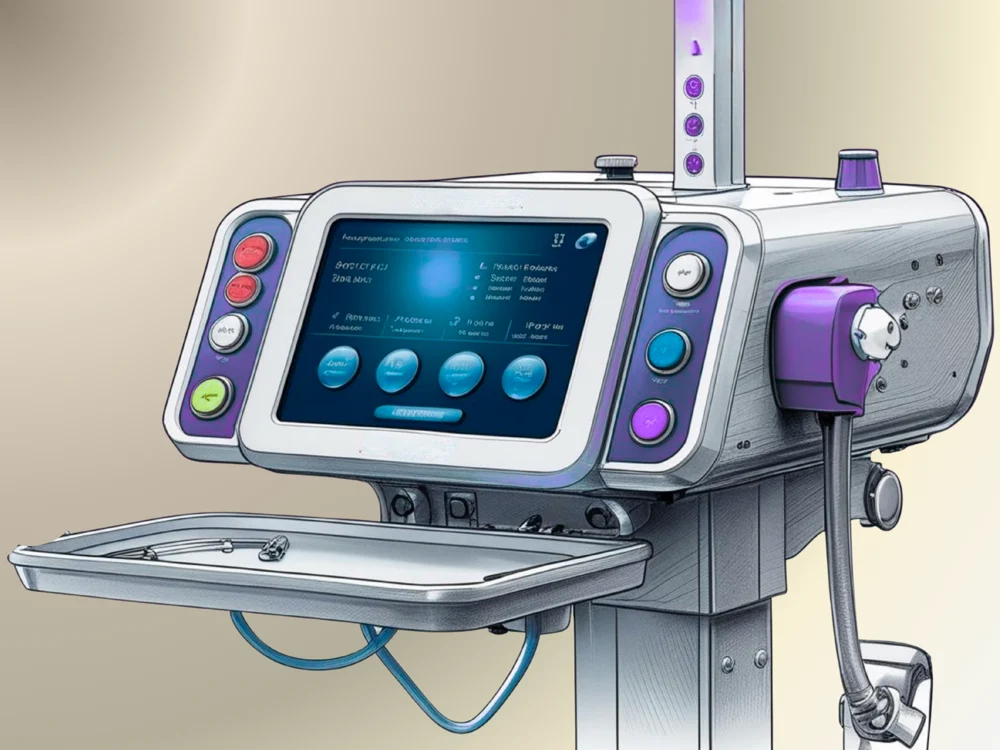
设备实验室
Vitrectomy System
A jet of compressed gas through a restriction pulls a vacuum on the collection chamber, and the eye is connected to that chamber through the probe. The surgeon commands a vacuum with the pedal; the flow is then whatever the port, the needle and the fluid in front of it allow. Nothing in the machine measures or controls the flow, and nothing needs to: the pressure difference is the setting and the flow is the consequence.
配置
设备实验室中的各个版本。
Vacuum-controlled vitrectomy console with a Venturi pump
A jet of compressed gas through a restriction pulls a vacuum on the collection chamber, and the eye is connected to that chamber through the probe. The surgeon commands a vacuum with the pedal; the flow is then whatever the port, the needle and the fluid in front of it allow. Nothing in the machine measures or controls the flow, and nothing needs to: the pressure difference is the setting and the flow is the consequence.
Flow-controlled vitrectomy console with a peristaltic roller pump
Rollers occlude a soft segment of the aspiration line and carry a fixed volume of fluid per revolution, so the pump commands a flow directly and the vacuum in the line is whatever that flow costs. Against an open port the vacuum is low. Against an occluded one no flow can be delivered, so the pump simply compresses the line and the vacuum climbs - at a rate the commanded flow divided by the line compliance, and no faster - until it reaches the limit that was set.
工作原理
在设备实验室中探索。
The balance, and the pressure nothing measures
Set the applied infusion pressure, then sweep the aspiration and watch the eye. The relationship is a straight line with a slope, and the slope is the resistance of the infusion path.
Raising the rate to lower the flow
The one idea, on the bench. Fix everything else and sweep the cut rate, then read the mean flow.
Occlusion break, on each configuration
Occlude the port, let the vacuum build, then release it, and read what comes out and what happens to the pressure.
A loop closed on an estimate
Turn the pressure compensation on and off while sweeping the flow, then lie to it about the gauge in use.
A dose with no display
Sweep the working distance and read the irradiance, then compute how long a given radiant exposure takes at each distance.
部件
逐个部件讲解。
Console enclosure, chassis, mast and castors
A cabinet about a metre high on four castors, with a screen on a swivel arm above it, a bay in the front face for a cassette, and a tall mast off the back corner carrying a bottle of saline. Two brakes on the front castors and none behind.
Touch fascia, fluidics display and pressure readouts
A wide glass fascia on a swivel arm, split into a fluidics window and a narrower cutter window, with four hard keys under the glass and a mechanical vacuum gauge beside it. The fluidics window carries pressures and flow on one axis.
Dual-linear foot pedal and its side switches
A treadle on a base with a guard hoop over it, a raised heel pad behind, and a switch on each flank. The treadle moves in two directions, down, and side to side, and the two axes do different things.
Compressed-gas supply, regulator and accumulator
Low in the cabinet: a small compressor on rubber mounts, a steel accumulator beside it, a regulator with a relief port on top, a clear water trap and a connector on the back panel for the theatre’s own air pipeline. It is noisy, it is the heaviest thing in the machine, and it is the single source for everything pneumatic, the cutter’s drive, the forced infusion if the machine has one, and the vacuum jet if it has one.
Infusion pressure source and irrigation bottle
A half-litre bottle of balanced salt solution hanging inverted from the mast, and, depending on the configuration, either a pinch clamp and a graduated mast, or a regulated air line into the bottle’s own vent with a transducer beside it. This is the side of the balance that holds the eye up.
Infusion tubing, drip chamber and pinch valve
A spike into the bottle, a clear chamber below it with fluid standing in the bottom, then about two metres of wide-bore tubing down the mast, through a pinch valve on the console, and away across the floor to the eye. A stopcock on the console body.
Valved trocar cannulae and the infusion cannula
Three short metal tubes through the white of the eye, each with a flange lying flat on the surface and a soft valve inside it. One carries the infusion, one the light probe, one the instrument.
Vitrectomy probe, outer needle and guillotine port
A moulded handpiece the size of a thick pen with a steel needle half a millimetre across projecting from it, two thin gas lines and one fluid line leaving the back. The tip of the needle is CLOSED.
Probe pneumatic drive, solenoid pair and return
A valve block low in the console with one or two solenoid coils on it, and at the other end of a thin gas line, inside the handpiece, a small diaphragm connected to the inner needle. On one configuration there is a spring beside that diaphragm.
Aspiration tubing and its compliance
About two metres of soft clear tubing with a one-millimetre bore and a wall about as thick as the bore is wide, running from the back of the handpiece across the floor to a port on the cassette, held down by a few clips. It looks like the least interesting object in the room.