医疗城 · 设备实验室 · 第 43 台,共 69 台
尿动力学系统
Urodynamics System
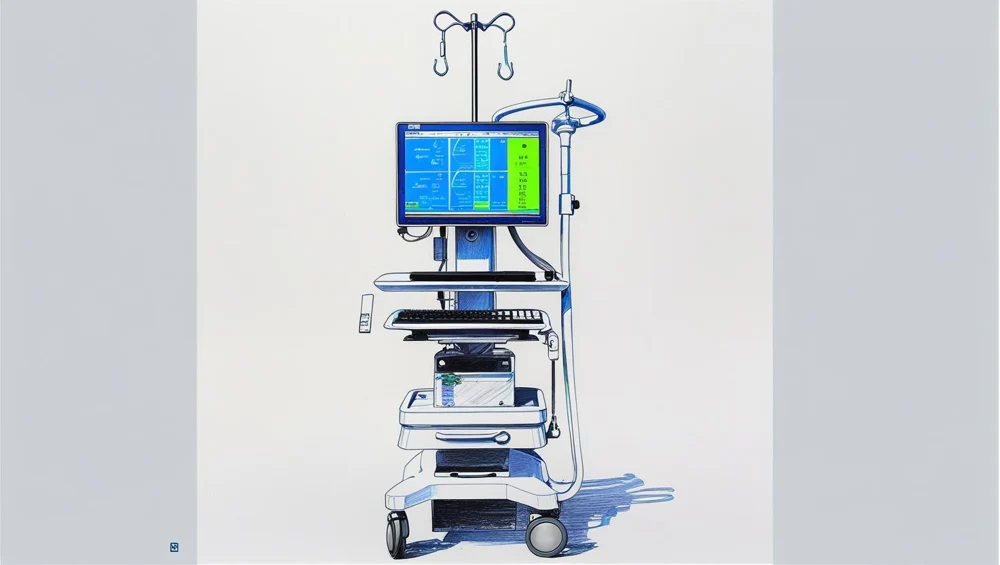
BMEssentia 医疗城设备实验室中的尿动力学系统。以可交互 3D 打开设备,逐个部件拆解,了解其工作原理,然后在 BMEssentia 平台上系统学习,并向 Essentia 提问。
本页的设备实验室内容为英文,与医疗城中的内容一致。
- 10 个部件
- 设备实验室中有 2 种配置
- 又称: Urodynamics
设备实验室
Urodynamics System
Two fluid-filled catheter lines to two external transducers on a common levelling bar on the pole, each with a three-way tap to atmosphere for zeroing, a slow flush to keep the lines patent, and a rectal balloon catheter charged with a small volume of fluid or air. The reference level is established once, by putting both diaphragms at the same declared height, and every pressure in the study is quoted against it.
配置
设备实验室中的各个版本。
Fluid-filled lines with external transducers
Two fluid-filled catheter lines to two external transducers on a common levelling bar on the pole, each with a three-way tap to atmosphere for zeroing, a slow flush to keep the lines patent, and a rectal balloon catheter charged with a small volume of fluid or air. The reference level is established once, by putting both diaphragms at the same declared height, and every pressure in the study is quoted against it.
Catheter-mounted tip transducers
Pressure sensors mounted on the catheters themselves, one facing the bladder lumen and one on the rectal catheter, each with its own bridge amplifier and its own calibration. There is no fluid line and no external diaphragm, so there is no tap to open to atmosphere at the measuring site and no levelling bar to set. An air-charged catheter, where a small balloon at the tip is coupled to an external sensor through a gas column, sits between the two configurations and is recorded in the dossier as a variant rather than as a third configuration.
工作原理
在设备实验室中探索。
What the subtraction keeps and what it throws away
Leave everything else alone and move both measuring heights together. Then move only one of them. Watch the two absolute pressures in one experiment and the difference in the other.
What a cough leaves behind, and exactly how much
Set both channels alike and ask for a cough. Then spoil one of them, slower, more heavily damped, whatever a bubble does, and ask again. Read the residual on the detrusor trace both times.
A compliance that belongs partly to the pump
Hold the wall exactly where it is and change only the pump rate. Fill to the same volume every time and read the pressure at the end of the fill and the compliance computed from it.
The error that is invisible in one number and decisive in another
Put a constant offset on one channel. Then read two things: the compliance, and the detrusor pressure at the moment of peak flow. One of them has not moved at all and the other has moved by exactly the offset.
A peak flow that belongs partly to the instrument
Change only the smoothing window on the flowmeter and read the peak flow and the total volume. Then shorten the void and do it again.
部件
逐个部件讲解。
Vesical filling and measuring catheter
A fine tube, a little over two millimetres across and a few hundred millimetres long, with two separate passages inside it and a moulded hub at the outside end where the two separate. One passage delivers fluid into the bladder.
Abdominal line and its rectal balloon
A thinner tube than the vesical one, with a single passage, ending in a small soft balloon a centimetre or so across. It is the channel that makes the whole measurement possible, and it is the component most often treated as an accessory to the interesting one.
Catheter fixation and the drape window
Adhesive tape, two strain reliefs and one rectangular opening in a sheet. Nothing about it is electronic and nothing about it is optional, because every pressure in the study is quoted against a geometry that this is the only thing holding still.
Peristaltic filling pump and its rate
A small rotating head clamped to the pole, with three rollers on a rotor pinching a length of soft tube against a curved race. Turn the rotor and each roller pushes a sealed pocket of fluid along the tube.
Filling line, warming and the infused-volume count
A length of tubing from the reservoir to the catheter with three things in it: a chamber where drops are visible, a warming section, and a clamp that can stop everything by hand. Plus the count of how much has gone in, which is not an object at all and is one of the two most important numbers in the study.
Irrigant reservoir and its hanger
A bag of sterile fluid on a hook on the pole, with graduations up one side. It is the simplest object on the machine and it carries the one number in the study that nothing electronic produced.
Vesical pressure channel
Everything between the pressure inside the bladder and a number on a screen: a pressure path, a sensing element, a calibration that turns a bridge voltage into centimetres of water, a filter, and a converter. On this device it is one half of a subtraction, which means its accuracy matters much less than its comparability.
Abdominal pressure channel
The same electronics as the vesical channel, doing the same job, on the other cavity. It is the channel that gets less attention, and almost every failure of the subtraction is a failure of this one or of its relationship to the other.
Detrusor subtraction stage
A differential stage with two inputs and one output, and the output is the entire reason the machine exists. It measures nothing.
Zero to atmosphere, both channels at one moment
One key, and an event rather than an object. Both channels are opened to the pressure of the room and told that this is zero.