医疗城 · 设备实验室 · 第 49 台,共 69 台
皮肤激光
Skin Resurfacing Laser
BMEssentia 医疗城设备实验室中的皮肤激光。以可交互 3D 打开设备,逐个部件拆解,了解其工作原理,然后在 BMEssentia 平台上系统学习,并向 Essentia 提问。
本页的设备实验室内容为英文,与医疗城中的内容一致。
- 10 个部件
- 设备实验室中有 2 种配置
- 又称: Co2 Laser
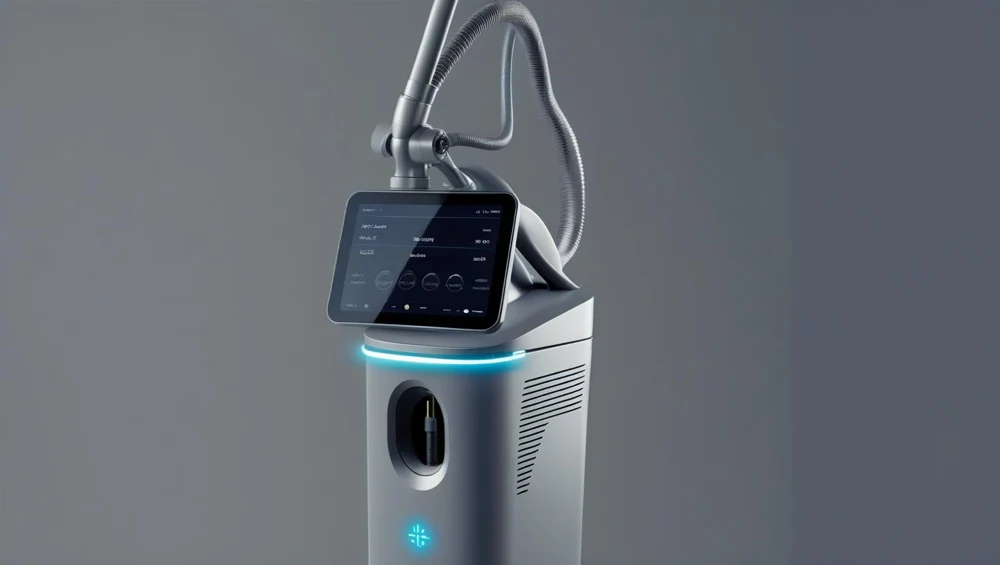
设备实验室
Skin Resurfacing Laser
6 µm, a seven-mirror counterbalanced articulated arm because silica fibre does not transmit that wavelength, a galvanometer scanner that writes a lattice of microbeams into the field, a disposable standoff spacer that fixes the working distance and therefore the spot, and a plume evacuator whose hose is clipped to the handpiece. The stratum corneum inside each column is vaporised and leaves.
配置
设备实验室中的各个版本。
Fractional ablative, 10.6 µm
6 µm, a seven-mirror counterbalanced articulated arm because silica fibre does not transmit that wavelength, a galvanometer scanner that writes a lattice of microbeams into the field, a disposable standoff spacer that fixes the working distance and therefore the spot, and a plume evacuator whose hose is clipped to the handpiece. The stratum corneum inside each column is vaporised and leaves.
Non-ablative fractional, 1550 nm
A diode-pumped erbium-glass fibre laser at 1550 nm through an armoured silica umbilical to a handpiece with a thermoelectrically cooled sapphire contact window and an optical roller encoder in the tip that counts distance travelled and gates the pulse train against it. There is no articulated arm, no plume and no evacuator, because nothing is removed. The stratum corneum is in contact with cooled sapphire throughout and stays intact.
工作原理
在设备实验室中探索。
The pulse you are allowed, and why it is a square law
Change only the spot diameter on the focusing optic and recompute the relaxation time of the column it writes. Then change only the pulse duration and watch which side of that time you are on.
The bridge that decides the density, with no time in the geometry
Hold the spot diameter and the count per cm² fixed. Change only the pulse duration, and compute the bridge you need rather than the bridge you have.
Two absorption depths, and which dimension is left to do the work
Take the two published absorption coefficients of water and do nothing but divide. 24 µm. 4 µm.
A threshold with nothing fitted in it
Build the threshold from enthalpy and refuse to fit anything. 5205×10⁹ J/m³. 160 J/cm² at a declared 70 % hydration, which is ILLUSTRATIVE.
Where each wavelength stops inside an eye, from the same two numbers
Do not look up a hazard class. Take the two absorption depths already derived and ask where each one runs out inside an eye, using only the thickness of the tissue in front of it.
Why one configuration can set fire to a drape and the other cannot
Compare the two configurations at the SAME radiant exposure and ask only what happens in the first few micrometres of whatever the beam lands on.
部件
逐个部件讲解。
Mains inlet, key switch, remote interlock connector and emergency stop
At the bottom rear of the console, a filtered inlet module with a fuse carrier and a protective earth stud. On the fascia, three controls: a barrel key switch, a screw-collar socket for a remote loop that runs out of the room, and a mushroom head on a red plate.
Closed-loop coolant circuit, heat exchanger and flow switch
On the lower shelf of the cart, a reservoir, a pump, a run of reinforced hose, a finned heat exchanger with a fan behind the vented rear panel, and one small brass body in the return line with two wires coming out of it. The last of those is the only part of the circuit that the emission chain can hear.
Internal energy monitor and closed-loop pulse control
A small optic that takes a known, tiny fraction of the beam off its path before it leaves the console, and a detector behind it on a board with a fast integrator. Its whole output is a number per pulse, and that number is the only evidence the machine has that what it asked for is what it made.
Mechanical safety shutter and internal beam stop
A blade on a rotary solenoid at the last aperture inside the console, and behind it, off to one side, a small block of absorbing material with fins on it. When the blade is across the aperture the beam does not stop existing; it lands on the block instead.
Galvanometer scanner and the microbeam pattern it writes
Two small mirrors on two torque motors, at right angles to one another, each with a position sensor on the shaft. Between them they can put the beam anywhere in a square field without anything else moving.
Treatment handpiece, focusing optic and its cradle
A shaped body you can hold in one hand, with a lens assembly in its nose, a keyed mount at the back for the delivery path, a bayonet at the front for a disposable spacer, and a moulded cradle on the right cheek of the console where it lives when it is not held. Inside it, one optic sets the single number every thermal argument here is built on.
Disposable standoff spacer and its optical window
A short moulded tube that clips onto the nose of the handpiece, with a flat window across its end and a rim that touches the skin. It is the cheapest part on the device, it is thrown away after one use, and it is the part that decides where the focal plane lands.
Visible aiming beam and its coaxiality
A low-power visible diode inside the console, its output combined onto the working path so that the two travel together, and a mark it leaves on the surface. On this device it is not an accessory.
Console enclosure, cart, castors and cable management
The box everything else is mounted in and the wheeled frame it stands on. 140 m.
Footswitch, arming logic and the two-stage trigger
A guarded pedal on the floor in front of the cart, on a lead that enters the cabinet at the bottom. It is the only control on the whole device that causes light to leave the room, and it is deliberately the control furthest from the hands, the screen and everything that looks like a setting.