医疗城 · 设备实验室 · 第 69 台,共 69 台
体外冲击波碎石机 (ESWL)
Lithotripter (ESWL)
BMEssentia 医疗城设备实验室中的体外冲击波碎石机 (ESWL)。以可交互 3D 打开设备,逐个部件拆解,了解其工作原理,然后在 BMEssentia 平台上系统学习,并向 Essentia 提问。
本页的设备实验室内容为英文,与医疗城中的内容一致。
- 10 个部件
- 设备实验室中有 2 种配置
- 又称: Lithotripter, Lithotripsy, Shock Wave Lithotripsy
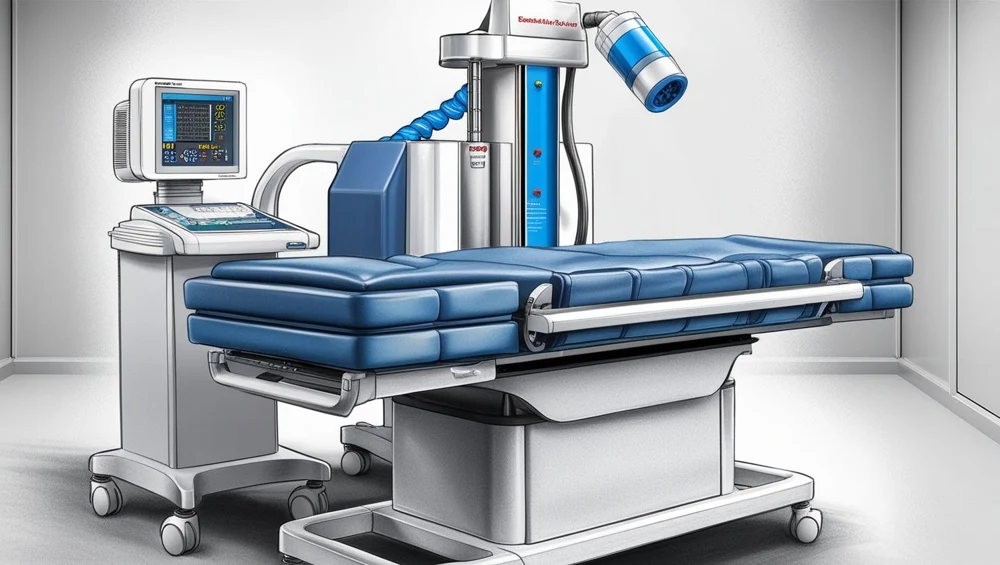
设备实验室
Lithotripter (ESWL)
A spark fired between two electrode tips under degassed water, at the near focus of a truncated ellipsoidal brass reflector. The spark vaporises a small volume of water into plasma; the bubble expands faster than sound in water and the shock front it launches is reflected by the ellipsoid onto the second focus inside the patient. The geometry does the focusing and nothing else has to.
配置
设备实验室中的各个版本。
Electrohydraulic spark-gap lithotripter
A spark fired between two electrode tips under degassed water, at the near focus of a truncated ellipsoidal brass reflector. The spark vaporises a small volume of water into plasma; the bubble expands faster than sound in water and the shock front it launches is reflected by the ellipsoid onto the second focus inside the patient. The geometry does the focusing and nothing else has to.
Electromagnetic coil and lens lithotripter
A capacitor discharged through a flat spiral coil behind a thin copper membrane, separated from it by an insulating film. The current pulse induces opposing eddy currents in the membrane, the two fields repel, and the membrane is thrown away from the coil hard enough to launch a planar pressure wave into the water in front of it. An acoustic lens then focuses that plane wave to a point.
工作原理
在设备实验室中探索。
A squeeze that arrives as a pull
A compressive pulse crosses from tissue into stone. Some of it reflects at that first boundary and the rest travels through. When what travelled through reaches the far side of the stone and meets tissue again, it reflects a second time, and this time the coefficient is negative.
The half of the mechanism a fast treatment throws away
Behind the compressive spike the pulse goes negative for several microseconds, and liquid under tension does not stretch, it tears. Bubbles grow on the stone surface, expand for a few hundred microseconds, and then collapse violently. A bubble collapsing against a solid surface does not collapse symmetrically: it involutes and drives a jet of liquid at several hundred metres a second into whatever it was touching.
Why the sharper machine is the worse one
Take two sources delivering comparable total energy. One puts it into a zone about eleven millimetres across at around fifty megapascals; the other into about five millimetres at nearly ninety. Measured on stones, the broad low-pressure one comminutes roughly twice as well.
Two per cent that costs a fifth
Everything between the emitter and the stone has to pass the wave along, and almost everything does. Water, gel, skin, fat and muscle are close enough in acoustic impedance that the losses at each boundary are small.
Accurately aimed at the wrong place
The machine converges its wave onto one point, and the imaging is centred on one point, and everything depends on those being the same point. If they are, putting the stone on the crosshairs puts it in the focus. If they are not, the machine is precise, the image is correct, the operator is competent, and the treatment is going into tissue with no stone in it.
部件
逐个部件讲解。
Water cushion and coupling membrane
A domed rubber membrane full of water on the top of the therapy head, with a bellows behind it and a film of gel on top. It is the only part of this machine that touches the patient.
Coupling quality monitor
Two or three small cameras looking sideways across the coupling interface from inside the head, and a picture of what they see on the console. It exists to make visible the one thing that ruins treatments and cannot otherwise be seen.
Degassed water conditioning circuit
A tank with a sight glass, a small pump and a heater, plumbed to the therapy head with two lines. It exists to take the dissolved air out of a few litres of water and keep it out.
High-voltage capacitor bank
Three cylinders the size of coffee flasks in the bottom of the machine, with a red bar across their terminals and a warning label nobody reading it is reassured by. This is where a second of ordinary mains power is stored up so that it can be spent in a millionth of one.
Charging and trigger circuit
A board with a row of indicator lamps behind a ventilated panel, and a thick coaxial run leaving it towards the emitter. It decides when the stored energy goes, and how consistently.
Fluoroscopy X-ray tube
A cylindrical housing under the table with a collimator on its front, aimed up through the patient at the treatment point. It is the only source of ionising radiation anywhere in this machine.
X-ray image receptor
A cylindrical can on the opposite arm of the gantry from the tube, facing it through the patient. Older machines use an image intensifier; newer ones a flat panel in the same place doing the same job.
Ultrasound localisation probe
A small probe on an articulated arm that reaches over to the flank, with its own image on the console. It finds the stone without any radiation at all, and it is the only thing here that can watch during treatment.
Isocentric positioning gantry
The C-shaped arm carrying the tube and the receptor, on a bearing that lets the whole thing rotate. Its axis of rotation passes through one point in space, and that point is where the shock wave converges.
Patient treatment table
A long padded table on a motorised column, with a hole in it where the therapy head comes through. She lies on it for forty minutes, sedated, while something strikes her flank once a second.