医疗城 · 设备实验室 · 第 65 台,共 69 台
离心机
Centrifuge
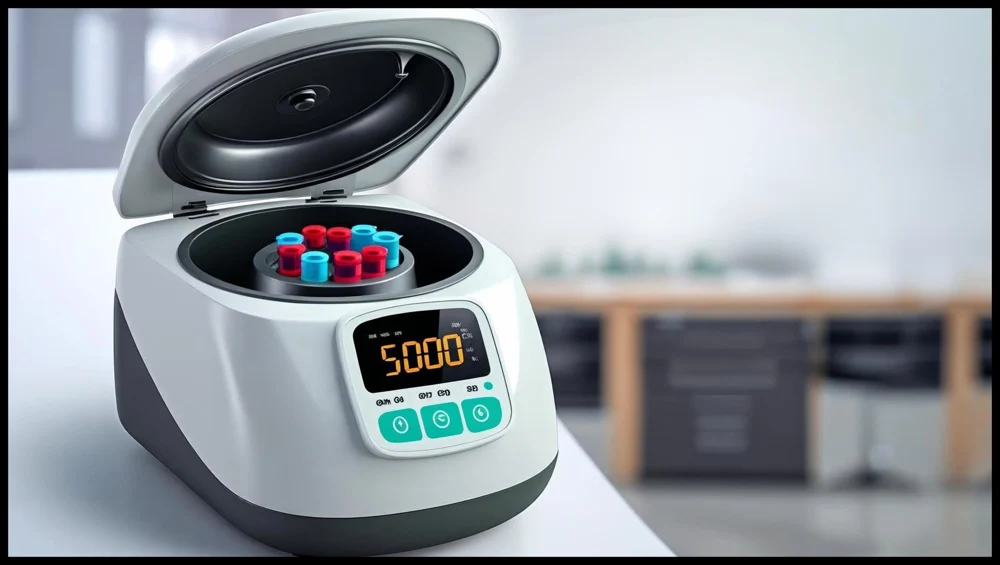
BMEssentia 医疗城设备实验室中的离心机。以可交互 3D 打开设备,逐个部件拆解,了解其工作原理,然后在 BMEssentia 平台上系统学习,并向 Essentia 提问。
本页的设备实验室内容为英文,与医疗城中的内容一致。
- 10 个部件
- 设备实验室中有 2 种配置
- 又称: Lab Centrifuge
设备实验室
Centrifuge
Eight bores cut at thirty degrees into a solid aluminium block, closed at the bottom, with a screw-down lid that seals the whole rotor. The tubes never move relative to the rotor: they sit at thirty degrees standing still and at thirty degrees at four thousand revolutions a minute, and the centrifugal field arrives across them rather than along them.
配置
设备实验室中的各个版本。
Fixed-angle rotor, eight places at 30°
Eight bores cut at thirty degrees into a solid aluminium block, closed at the bottom, with a screw-down lid that seals the whole rotor. The tubes never move relative to the rotor: they sit at thirty degrees standing still and at thirty degrees at four thousand revolutions a minute, and the centrifugal field arrives across them rather than along them.
Swing-out rotor, four buckets on trunnions
A four-armed yoke with a bucket hanging from a pair of trunnion pins on each arm. At rest the buckets hang straight down. As the rotor turns they swing outward until they are horizontal, and they are horizontal long before the machine is anywhere near its working speed, the angle is set by the ratio of centrifugal to gravitational force at the bucket centre of mass, so they are halfway out at about ninety revolutions a minute.
工作原理
在设备实验室中探索。
The number on the dial is the wrong number
Set a speed and read the field at the three radii at once, then look at what the same dial setting would be in the other rotor.
The field is not the whole story
Set both rotors to their rated speeds, note that the field averaged over the tube is almost identical, and then time the pellet.
Separation and destruction are the same number
Put a mass difference between two opposing tubes and watch the force through the spindle, then compare that force with the weight of the mass you moved.
Where the energy goes, both ways
Bring the rotor to speed, read the stored energy, then stop it with the brake and without it.
What the lid is actually for
Break a tube at speed in a sealed rotor and in an unsealed one, and try to open the lid while the rotor is still turning.
部件
逐个部件讲解。
Brushless drive motor
A sealed can about ninety millimetres across hanging under the floor of the chamber, with a fan on its lower end and a cradle of rubber mounts under that. It is the only part of the machine that does work, and everything above it exists to hold what it has made.
Spindle, taper hub and bearings
A short steel shaft through the floor of the chamber, carried in two bearings, with a shallow tapered hub on its upper end and a small drive pin standing out of that hub. It is the one mechanical interface between the machine and the rotor, and it is about forty-six millimetres across.
Motor controller and speed regulation
A board low in the chassis carrying a heatsink, six switching devices, two large capacitors and a small current shunt. It is the part of the machine that decides what speed means.
Tachometer and rotor recognition
A small sensor on a bracket beside the hub, under the floor of the chamber, looking at a ring of twelve magnets on the underside of the rotor. It does two entirely different jobs with one measurement.
Braking and controlled run-down
Three resistors on a clamp, a relay, and a setting on the panel. Between them they decide how a rotor carrying several hundred joules is brought to rest, and how long a lid stays locked.
Enclosure and cast chassis
A squat moulded box about half a metre across and a third of a metre high, most of whose volume is the round chamber in the middle of it, sitting on a heavy cast base plate with moulded hand recesses in both flanks. It weighs far more than it looks as though it should.
Rotor chamber and spill bowl
A stainless steel vessel four hundred millimetres across and a hundred and fifty deep, with a rolled lip at its mouth, a drain at its lowest point and a spigot under it running to a small catch bottle. The rotor turns inside it with clearance all round.
Lid, window and gas strut
A moulded lid the full width of the machine, hinged along the back edge, with a round window in the middle of it, a handle across the front and a gas strut on one side that holds it up. It is heavier than it looks.
Chamber and lid sealing
A rubber ring seated in the deck around the mouth of the chamber, a second one where the liner meets the chassis, a small seal where the spindle passes through the chamber floor, and a grommet at the drain. Four unremarkable rubber parts, and between them they decide what leaves the machine.
Lid interlock and lid-closed sensing
A solenoid with a steel bolt standing out of it beside the chamber mouth, a striker plate in the underside of the lid for the bolt to pass through, a separate microswitch that senses the lid is down, a lamp on the deck, and a recessed release loop under the front edge. Five small parts, and they are the whole safety case of the device.