المدينة الطبية · مختبر الأجهزة · الجهاز 55 من 69
جهاز قياس السكر
Glucometer
جهاز قياس السكر في مختبر الأجهزة في المدينة الطبية من BMEssentia. افتحه بتقنية ثلاثية الأبعاد تفاعلية، وفكّكه قطعةً قطعة، وتعرّف إلى طريقة عمله، ثم تعلّمه على منصة BMEssentia واسأل إسنشيا عنه.
محتوى مختبر الأجهزة في هذه الصفحة باللغة الإنجليزية، كما هو داخل المدينة الطبية.
- عدد الأجزاء: 10
- عدد التكوينات في مختبر الأجهزة: 2
- يُعرف أيضًا باسم: Glucose Meter, Blood Glucose Meter
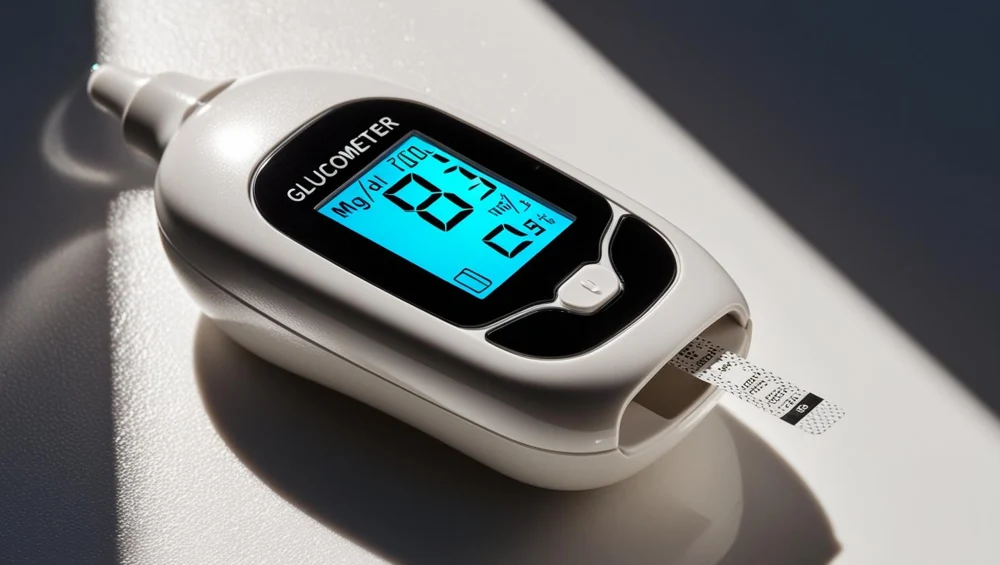
مختبر الأجهزة
Glucometer
A three-electrode printed strip carrying a dry film of glucose oxidase over a large excess of potassium ferricyanide, in a laminated capillary chamber of declared volume, read by a handheld meter that steps the working electrode to a fixed potential and samples the current at a declared time. Glucose oxidase is a flavoprotein: each glucose reduces the flavin, and the flavin is reoxidised by whatever accepts electrons fastest. The strip supplies a large excess of mediator so that it usually wins, and the sample supplies dissolved oxygen, which is what the enzyme evolved to use.
التكوينات
نسخ الجهاز في مختبر الأجهزة.
Glucose oxidase strip, ferricyanide mediated
A three-electrode printed strip carrying a dry film of glucose oxidase over a large excess of potassium ferricyanide, in a laminated capillary chamber of declared volume, read by a handheld meter that steps the working electrode to a fixed potential and samples the current at a declared time. Glucose oxidase is a flavoprotein: each glucose reduces the flavin, and the flavin is reoxidised by whatever accepts electrons fastest. The strip supplies a large excess of mediator so that it usually wins, and the sample supplies dissolved oxygen, which is what the enzyme evolved to use.
PQQ glucose dehydrogenase strip, oxygen independent
The same printed strip, the same chamber, the same mediator loading, the same electrodes and the same meter, carrying a dry film of a pyrroloquinoline quinone dependent glucose dehydrogenase in place of the oxidase. The quinone cofactor is reoxidised by the mediator and by nothing else in the sample, so the chain from sugar to electrode has one branch fewer than the other configuration has.
كيف يعمل
استكشفه في مختبر الأجهزة.
Move the instant the meter looks, and watch a calibration move
42, 25 C. Leave the strip, the geometry and the lot alone. 0 s, and read the sampled current on the chain board, the collected charge, and the reported value beside the sample value on the bench display.
Inject something that is not glucose and read the exchange rate off the slope
0 mmol/L. Read the reported value against the sample value each time. 0 mmol/L instead.
A packing fraction that does two things, and the only correction not modelled
60. Read the current on the chain board and the reported value against the sample value. Then do it again with the plasma-equivalent factor held at its reference figure instead of recomputed, and compare the two sets.
Warm the strip, cool the meter, and correct the wrong temperature
Set the sample value and the haematocrit at the reference state and sweep the temperature: 10, 20, 25, 30, 37 and 40 C. Read the current and the reported value at each. Then do the experiment the meter cannot: hold the thermistor at 25 C while the chamber runs at 10 C, and read again.
One strip, two ways of going off, and they pull in opposite directions
Two sweeps on the same strip, side by side. 01 per cent. 5 per cent, 1 per cent, 3 per cent.
الأجزاء
قطعةً قطعة.
Meter body, case and the shape of a thing carried in a pocket
A moulded handheld shell about eighty-five by forty-eight by sixteen millimetres, with a slot in one end, a dark window over most of one face, two or three buttons, a battery door on the back and a lanyard eye. It closes in one hand.
Strip port, its contacts and the wake switch
A slot in one end of the meter body about nine millimetres deep, with three sprung gold-plated fingers inside it and a moulded stop at the back so a strip can only go in one way and only go in so far. Push a strip in and the display lights without anybody touching a button.
Display, and the single number on it
A segment panel behind a window about thirty-four millimetres by twenty-four, showing a value to one decimal place with a unit beside it, and occasionally a countdown, a code or a battery symbol instead. On the bench it is drawn with the sample value printed beside the reported one, which no real meter does.
Coin cell, power management and the one fault the meter announces
A lithium coin cell twenty millimetres across and a little over three thick, behind a door on the back of the case, with a spring contact and a clip. It powers everything: the potentiostat, the front end, the digitiser, the panel and the clock that keeps the timestamps.
Potentiostat and the applied potential
One of four functional blocks on a small board inside the case, drawn here as a block rather than as a circuit. It has one job: hold the working electrode at four tenths of a volt with respect to the printed silver counter, from the instant the chamber is confirmed full until the reading is taken, whatever current that requires.
Transimpedance front end and its current ranges
The second block on the board. The current returning from the strip arrives here as a few microamps and leaves as a voltage the digitiser can work with.
Digitiser and the sampling of a decaying current
The third block. It turns the front end output into a number, once, at an instant the clock chooses.
Thermistor, and the difference between the meter and the reaction
A small bead component soldered to the board inside the case, nowhere near the chamber and separated from it by a moulded wall, the strip port and several millimetres of air. It is the only sensor in this instrument that measures a physical condition rather than a current, and it measures the wrong one.
Read clock, and why a time is part of a calibration
No visible part at all: a counter in the controller started by the fill electrode going wet and stopped five seconds later, at which instant the digitiser is told to take its one sample. Most people who use this device know it as a countdown on the display, and it is the only calibration constant in the instrument that is made of time.
Meter memory, the log and what the log does not carry
A stored list, reachable through the buttons, of the last few hundred results with a date and a time against each. On the bench it is drawn as a scrolling panel.
ملاحظات الطُّرز