المدينة الطبية · مختبر الأجهزة · الجهاز 42 من 69
جهاز تخطيط العضلات الكهربائي
EMG
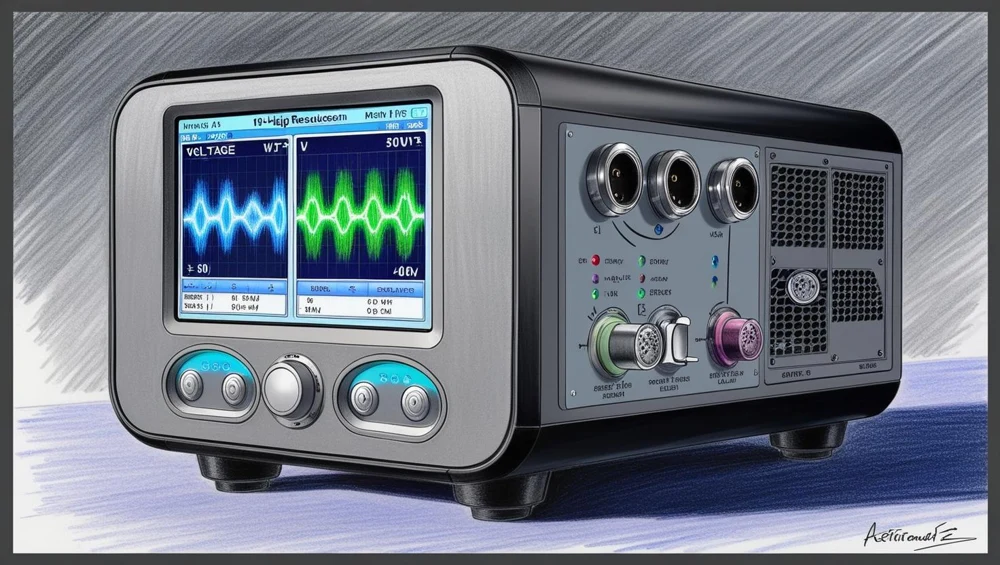
جهاز تخطيط العضلات الكهربائي في مختبر الأجهزة في المدينة الطبية من BMEssentia. افتحه بتقنية ثلاثية الأبعاد تفاعلية، وفكّكه قطعةً قطعة، وتعرّف إلى طريقة عمله، ثم تعلّمه على منصة BMEssentia واسأل إسنشيا عنه.
محتوى مختبر الأجهزة في هذه الصفحة باللغة الإنجليزية، كما هو داخل المدينة الطبية.
- عدد الأجزاء: 10
- عدد التكوينات في مختبر الأجهزة: 2
- يُعرف أيضًا باسم: Electromyograph, Nerve Conduction
مختبر الأجهزة
EMG
A hand-held bipolar probe delivers a constant-current pulse over the nerve at the wrist, and a pair of surface discs over the muscle it supplies records what arrives. The same stimulus is repeated at the elbow, the two latencies are subtracted, and the surface distance between the two cathode positions, measured with a tape, on the skin, over a nerve that does not run straight, is divided by the difference. That quotient is the only number in the study that is a velocity, and it exists because there were two sites rather than one.
التكوينات
نسخ الجهاز في مختبر الأجهزة.
Surface nerve conduction study, stimulating at two sites
A hand-held bipolar probe delivers a constant-current pulse over the nerve at the wrist, and a pair of surface discs over the muscle it supplies records what arrives. The same stimulus is repeated at the elbow, the two latencies are subtracted, and the surface distance between the two cathode positions, measured with a tape, on the skin, over a nerve that does not run straight, is divided by the difference. That quotient is the only number in the study that is a velocity, and it exists because there were two sites rather than one.
Concentric needle electromyography, no stimulator
No stimulator and no second site. A concentric needle is put through the skin into the muscle and what it records is the potential of its core measured against its own cannula, a fifth of a millimetre away. The examiner looks at the trace and listens to the loudspeaker while the muscle is at rest, then while it is gently contracted, then while it is contracted hard, and moves the needle to a new position and does it again.
كيف يعمل
استكشفه في مختبر الأجهزة.
What the second site actually removes
Record a distal latency and divide the distal distance by it. Then record a proximal latency, subtract, divide the measured distance by the difference, and compare the two answers.
The instrument nobody calls an instrument
Take a correct velocity and then change one thing: the distance you claim to have measured. Move it by a centimetre and watch the reported velocity move. Then express that change in degrees of limb cooling, and then in sampling intervals of cursor error.
The one thing the subtraction cannot remove
Record a velocity at thirty-two degrees. Cool the limb by four degrees and record it again without changing anything else. Then try to remove the difference by subtracting something.
Recovering from your own stimulus
Compute how large the stimulus is at the skin, compute the largest signal the amplifier can accept, and compare the two. Then watch what the amplifier does when the artefact exceeds that, and how long it takes to be of any use again.
A subtraction made of metal
Work out the recording area of a concentric needle core from two numbers you can read off the needle, compare it with a surface disc, and then put the same muscle fibre at two distances and compare what arrives.
الأجزاء
قطعةً قطعة.
Patient cable and input connectors
Individually screened leads from each electrode gathering into a clip on the limb and continuing as one jacketed multicore to the input box, with a separate heavier lead for the stimulator that is a different colour and runs on the other side of the patient. Nothing here amplifies anything.
Differential preamplifier and gain stage
A small box on a short boom at the patient’s side with the electrode sockets on its face, a few centimetres from where the leads come off the limb. Inside it are an instrumentation amplifier, one resistor that sets the gain, and a guard driver.
High-pass and low-pass filters
Two rotary selectors on the fascia, one for each end of the window, set differently for each of the three things this machine records. They are the settings most often left where the last operator put them, and the ones that most change what a reader sees.
Digitiser, sweep and timebase
A converter, a crystal, and a knob marked in milliseconds per division. Everything after this point in the machine is numbers, and the crystal is the reason a latency is a measurement rather than an estimate.
Display, sweep speed and sensitivity
A screen with a graticule, a knob marked millivolts per division and another marked milliseconds per division. Neither of them changes anything about what was recorded, and both of them change what a reader concludes.
Measurement cursors and the derived-values table
Two vertical markers, a baseline marker, a wheel to drive them, and a table beside the trace showing latency, amplitude, duration, distance and velocity. This is the component where the subtraction that the whole device exists for finally appears as a number.
Loudspeaker and audio monitor
A small cone behind a grille in the front panel with a volume knob beside it. On a nerve conduction study it is turned down and barely used.
Patient ground electrode
A single larger disc or strap on the limb between the recording electrodes and wherever the interference is coming from, with a green lead of its own. It records nothing, it measures nothing, and without it neither configuration works at all.
Skin preparation, antisepsis and conductive medium
An alcohol wipe, a tube of mildly abrasive gel, a pot of conductive gel and a pack of gauze on the trolley, and on the needle configuration a chlorhexidine swab instead of two of them. A minute of work with these decides more about the recording than any setting on the machine.
Electrode impedance and lead integrity test
A button, a row of lamps and a small display showing an impedance per input. It takes a few seconds, it is the only thing on the machine that measures the half of the device that decides the recording, and it is the check most often skipped because everything looks fine without it.
Next