医疗城 · 设备实验室 · 第 35 台,共 69 台
结肠镜
Colonoscope
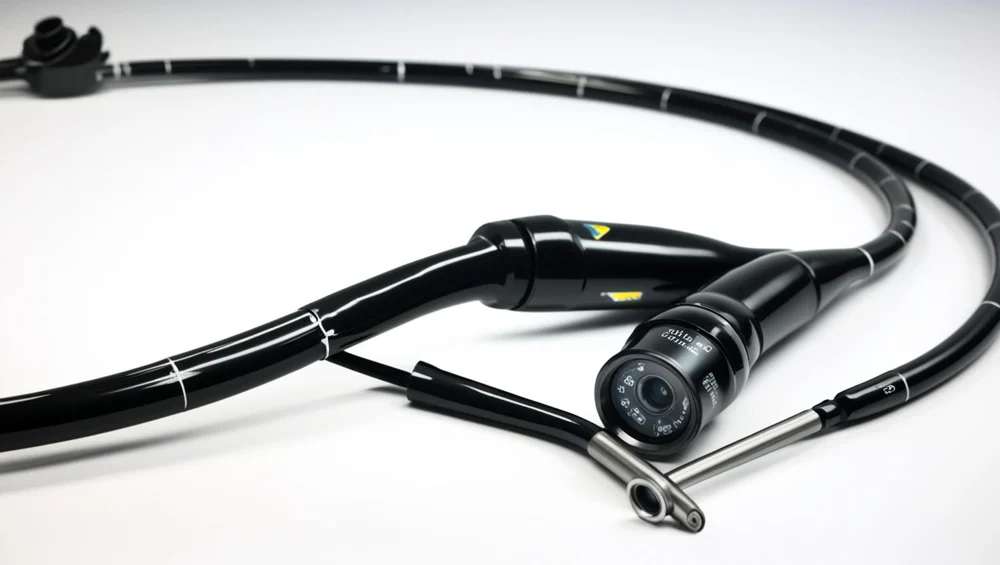
BMEssentia 医疗城设备实验室中的结肠镜。以可交互 3D 打开设备,逐个部件拆解,了解其工作原理,然后在 BMEssentia 平台上系统学习,并向 Essentia 提问。
本页的设备实验室内容为英文,与医疗城中的内容一致。
- 10 个部件
- 设备实验室中有 2 种配置
- 又称: Colonoscopy
设备实验室
Colonoscope
Room air is drawn through an intake filter by a diaphragm pump inside the light source, held at a delivery pressure by a mechanical relief, and vented continuously past a hole in the air and water valve until somebody covers the hole. There is no flow measurement anywhere in the path and no setting except a two- or three-step pump speed.
配置
设备实验室中的各个版本。
Ambient-air insufflation from a pump in the light source
Room air is drawn through an intake filter by a diaphragm pump inside the light source, held at a delivery pressure by a mechanical relief, and vented continuously past a hole in the air and water valve until somebody covers the hole. There is no flow measurement anywhere in the path and no setting except a two- or three-step pump speed.
Regulated carbon dioxide insufflation from an external supply
Carbon dioxide arrives from a cylinder or a wall outlet, through a yoke with a contents gauge, into a regulator that meters a set flow electronically and passes it through a bacterial filter and a non-return valve into the instrument air channel. Four components and three failure modes exist here that do not exist on the other configuration at all.
工作原理
在设备实验室中探索。
Two functions of one unobservable, and both of their zeros
Leave everything alone and move only the wrap. Read the force factor and the advance factor at nothing, at a quarter turn, at a half, at three quarters, at a full turn, and past it.
One reading, two tip states, and a factor of three and a half
Set the wrap to nothing and the push to five newtons, and read the tip force. Then set the wrap to one complete turn, leave the push at five newtons, and read it again.
A load that falls as the square of a length nobody measures
Set the push to one newton and sweep the free span from a hundred millimetres to eight hundred, watching the critical load and the signature.
Two gases, two different orders of kinetics
This experiment is the comparison. Set the same distension on both configurations and read the gradient, the absorption rate, the floor and the standing load.
Three bounds, and one of them rewards doing less
Three experiments on the reprocessing chain, and each of them produces a number rather than a description.
部件
逐个部件讲解。
Distal tip face and the only end that matters
A flat disc of moulded polymer thirteen point two millimetres across, on the end of a tube one thousand six hundred and eighty millimetres long. Four apertures are let into it: an objective window, two illumination windows, and the mouth of the instrument channel.
Bending section, articulation links and the elastomeric sheath
The last hundred millimetres before the tip, and visibly a different thing from the tube behind it: no braid pattern under the surface, a softer feel, and a covering that is rubber rather than the harder polymer of the shaft. It is the only part of the instrument that changes shape on purpose.
Angulation wires, coil pipes and the travel they carry
Four stranded steel wires, each running the whole length of the instrument inside its own close-wound coil pipe, positioned on the diagonals of the cross-section about four point five millimetres out from the centre. At the far end they terminate on the last articulation ring.
Angulation knobs, drums and the friction brakes
Two coaxial discs on one face of the control body, the larger one outboard for up and down and the smaller one inboard for left and right, each with three raised lugs so a thumb can find and turn it without looking. Outboard of each sits a small lever, which is a friction brake.
Counter-wound braid, helical band and the torque path
Two layers under the outer sheath that you can feel through it rather than see: a flat metal strip wound in a long helix, and over that a woven mesh of fine wires laid in both directions at once. Together they are about seven tenths of a millimetre thick and they are the reason the instrument can be steered by twisting it.
Insertion tube wall, the stiffness gradient and the depth graduations
One thousand six hundred and eighty millimetres of grey tube thirteen point two millimetres across, with black rings printed on it at every hundred millimetres from two hundred onwards. It is noticeably floppier near the tip than near the handle if you flex it along its length.
Variable-stiffness adjuster and the coil it tensions
A knurled collar at the base of the control body, just above where the insertion tube leaves it, with a scale marked nought to three on it. Turning it makes the shaft measurably firmer along most of its length, and it is the only control on the instrument that changes the instrument rather than pointing it.
Instrument and suction channel, and 1.78 metres of it
A single lumen three point seven millimetres across running one thousand seven hundred and eighty millimetres from the distal face to a junction inside the control body, where it becomes two branches. It is the largest thing inside the wall and the only one anything solid ever goes down.
Instrument port, biopsy valve and the branch behind it
A short angled boss on the side of the control body with a metal collar and a small rubber cap on it, slit across the middle. Instruments are pushed through the slit into the channel, and the slit closes behind them.
Suction valve, the suction line and the trap
A cylinder in a port on top of the control body with a red cap, pressed down with a finger to aspirate. Behind it, a hose runs down the universal cord to a trap jar on a shelf and from there to the building suction.