医疗城 · 设备实验室 · 第 66 台,共 69 台
助听器
Auditory Amplifiers
BMEssentia 医疗城设备实验室中的助听器。以可交互 3D 打开设备,逐个部件拆解,了解其工作原理,然后在 BMEssentia 平台上系统学习,并向 Essentia 提问。
本页的设备实验室内容为英文,与医疗城中的内容一致。
- 10 个部件
- 设备实验室中有 2 种配置
- 又称: Hearing Aid, Auditory Amplifier
设备实验室
Auditory Amplifiers
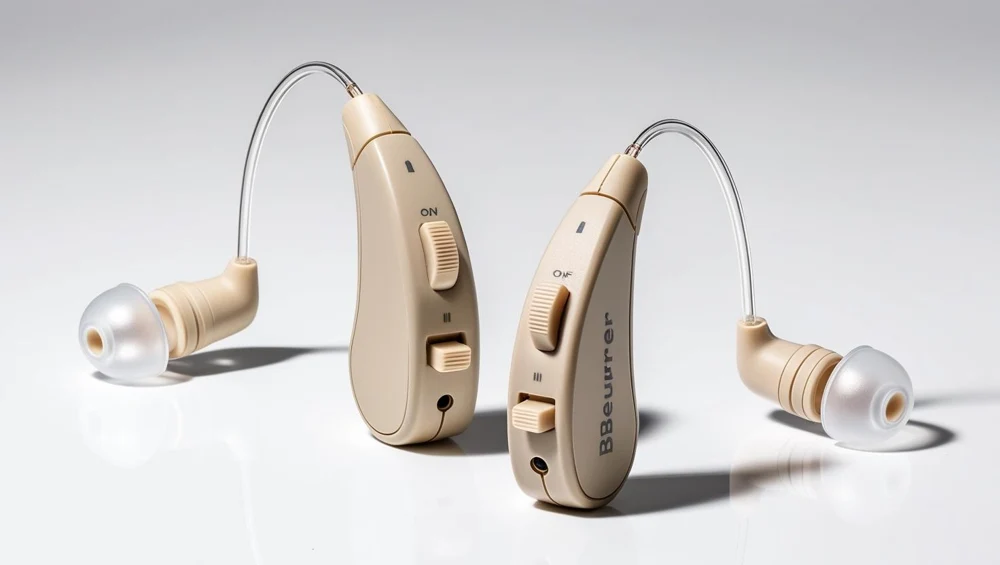
A behind-the-ear case carrying the microphones and the processor, with the receiver itself on a thin wire down into the canal and a flexible dome whose flutes leave the canal substantially open.
配置
设备实验室中的各个版本。
Receiver-in-canal, open dome
A behind-the-ear case carrying the microphones and the processor, with the receiver itself on a thin wire down into the canal and a flexible dome whose flutes leave the canal substantially open.
Behind-the-ear receiver, tubed to a vented custom mould
The receiver stays inside the behind-the-ear case and its output travels down a length of tubing, through an earhook, into a custom mould that seals the canal apart from one drilled parallel vent.
部件
逐个部件讲解。
Microphone inlet ports and wind screens
80 mm across, each with a fine woven screen set just below the surface and a moulded surround that keeps a finger off it. They are the only way sound gets into this device, and they are also the place the device hears itself.
Front MEMS microphone
50 mm wide and just under a millimetre tall, sitting immediately behind the forward inlet port. Its diaphragm is etched from silicon, a few microns thick, moving perhaps a nanometre for an ordinary conversational sound.
Rear MEMS microphone
0 mm behind it along the case. On its own it does nothing the front one does not.
Microphone preamplifier and anti-alias filter
A small amplifier and its filter sitting a millimetre from the microphones, with four passive components beside it. It does two jobs that sound unrelated and are not: it lifts a very small signal before anything can spoil it, and it removes everything above the converter's usable band before the converter is allowed to see it.
Sigma-delta analogue-to-digital converter
The converter that turns the amplified microphone signal into numbers. It is a sigma-delta design, which means it samples far faster than the audio needs and uses very few bits at each sample, then trades that speed back for resolution in a digital filter.
Digital processor and filterbank
0 mm package, the largest piece of silicon in the device, carrying the filterbank and every processing stage as firmware. It splits the incoming stream into bands, works on each one separately, and puts them back together.
Wide-dynamic-range compression stage
A labelled plate on the signal chain of the schematic board, because this stage is firmware inside the processor rather than a separate piece of silicon. Its job is to take a range of input levels far wider than the wearer can use and fit it into one that is narrower, and every consequence in this device that depends on level starts here.
Adaptive feedback canceller
The second plate on the signal chain, and the one that is most often misunderstood. It does not block the return path and it does not reduce the gain.
Noise manager and expansion stage
The third plate on the chain. Below the compression threshold it does the opposite of compression: it reduces gain as the input falls, so that the gain at the very bottom of the range is not the full low-level gain.
Output converter and class-D output stage
The output converter and the stage that drives the receiver. It is a class-D design, which means it switches rather than dissipates, and it has two capacitors beside it.