Skip to content

Biomedical technician · Core track · The Workshop

Ready Technician

Your first months as a biomedical technician: maintain devices, test their electrical safety, find common faults and keep the records right, on your own.

For: New biomedical technicians in their first months, and the clinical engineering heads who hire them.

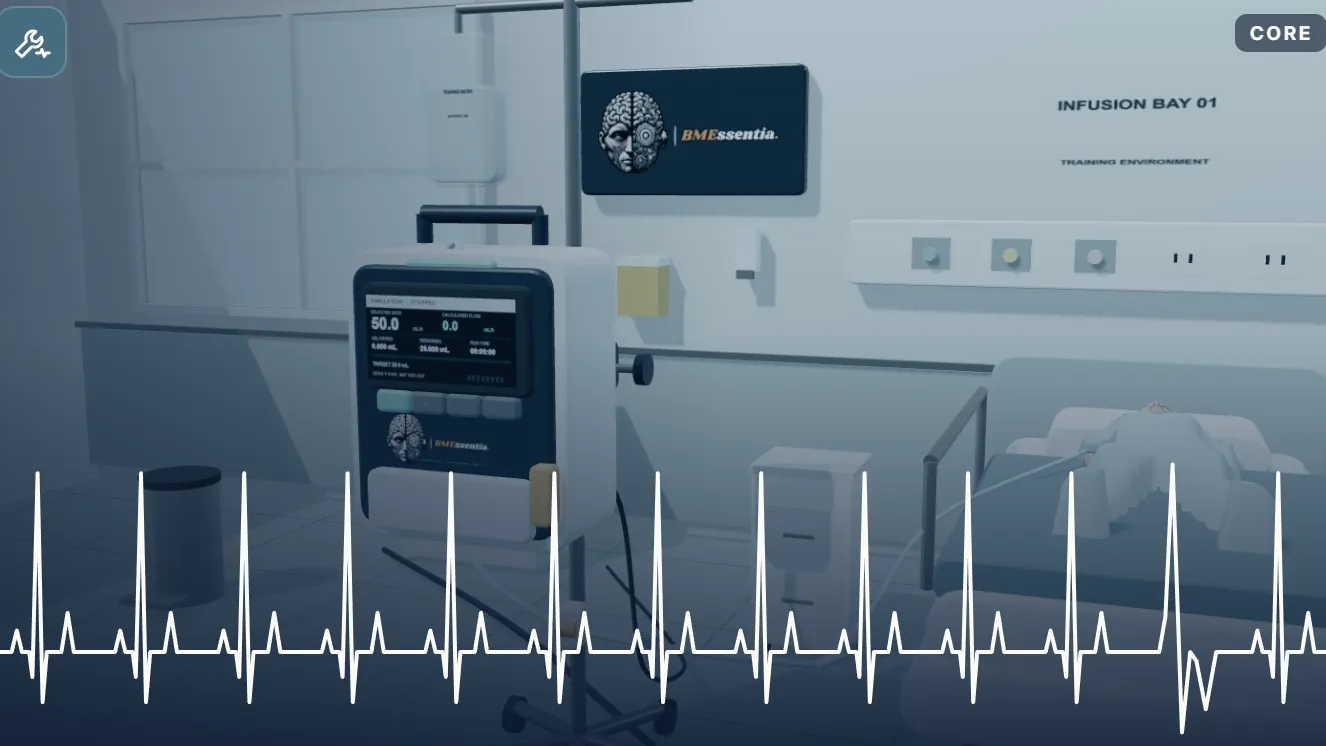
Ready Technician: Device Lab 56, infusion pump
Device Lab 56 · infusion pump

The arc · 13 weeks · The Workshop

Your mentor, a character in the trackDr Amira HaddadHead of Clinical Engineering
Length
13 weeks
Time
3-5 hours a week
Levels
Easy, Medium, Hard
Certificate
Certificate of Completion
On your own
$399, 12 months

What you'll be able to do

The job, done properly.

  • Runs the IEC 62353 recurrent test in order, with the correct limits for every class and applied part type, and decides pass or fail correctly
  • Verifies infusion pumps, syringe drivers, monitors, NIBP, pulse oximeters, defibrillators, ventilators and electrosurgical units against manufacturer limits
  • Finds the common causes of ward calls (user, accessory, environment, device) and closes jobs with traceable service reports
  • Knows what takes a device out of service, quarantines correctly and preserves evidence after an incident
  • Acts on field safety notices asset by asset with evidence
  • Recognises power, earth, gas and network causes and hands them to the right owner with measurements

The story

BMEssentia Medical City Hospital, Clinical Engineering workshop. You are the new biomedical technician assigned to Ward 4 (Acute Medicine) and the Intensive Care Unit.

Dr Amira HaddadHead of Clinical Engineering · your mentor (a character in the track)
“Electrical safety is the one test that protects people who never touch the screen: the porter, the cleaner, the patient with a central line. The order exists because each step makes the next one safe.”

Inside the track

What you actually use, every week.

The real screens: My track, a step with your mentor, a simulation, your skills map and the certificate.

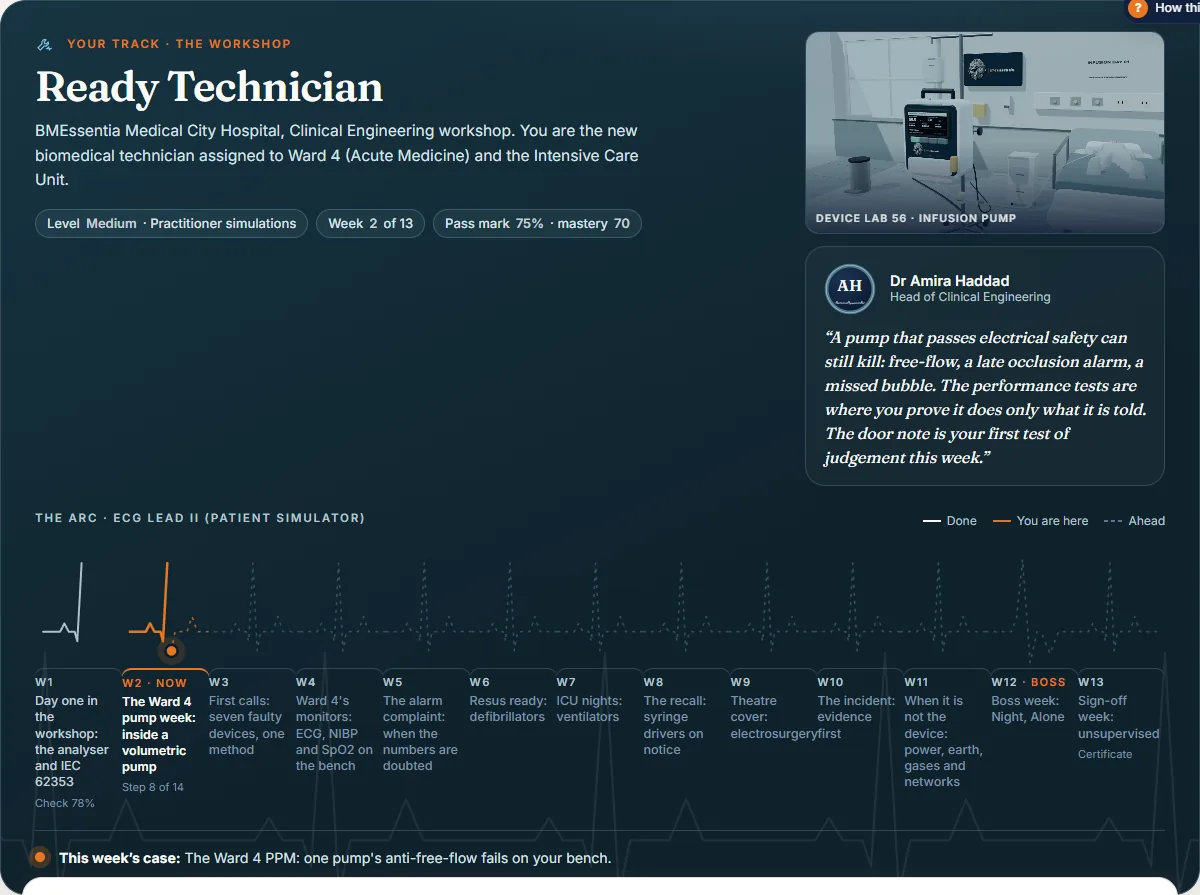
My track
My trackThe arc of 13 weeks, this week's case, your mentor and your next step, in Ready Technician's own colours.
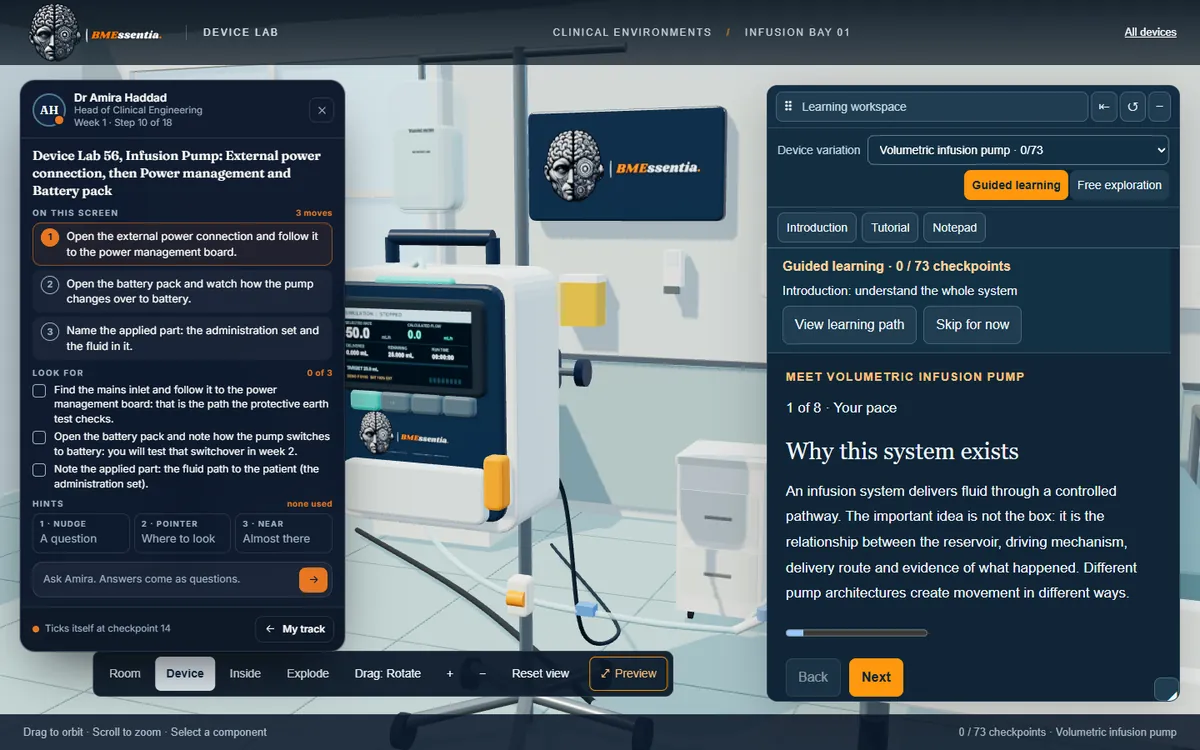
A step with your mentor in the Device Lab
A step with your mentor in the Device LabThe step names what to look at on the real device, with hints that never give the answer away.Shown: Infusion Pump with Dr Amira Haddad, this track's mentor
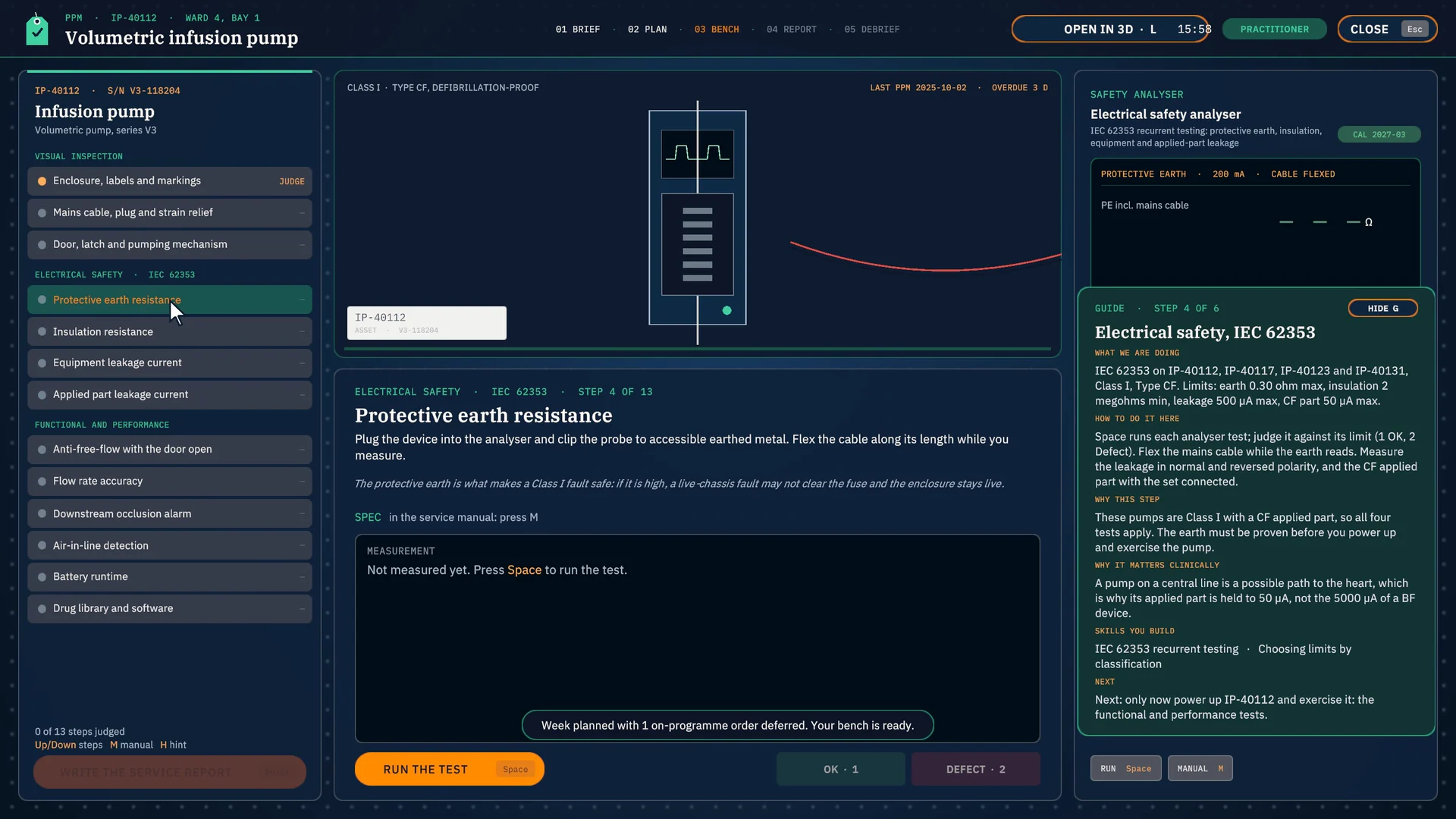
A simulation
A simulationReal hospital work in Medical City, scored and debriefed, at your level.
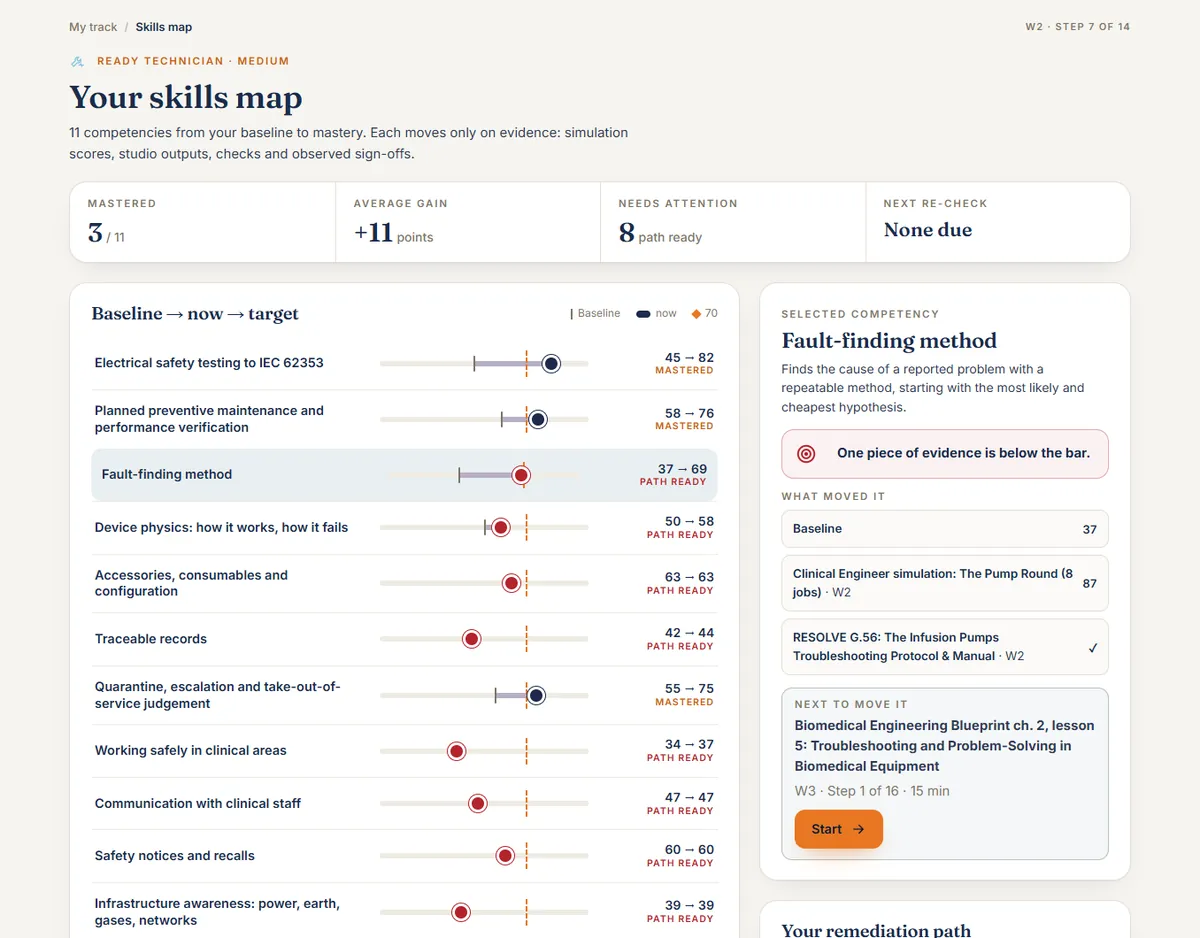
Your skills map
Your skills mapThis track's own competencies, from your baseline to mastery. They move only on evidence.Shown: a sample learner's progress
The certificate
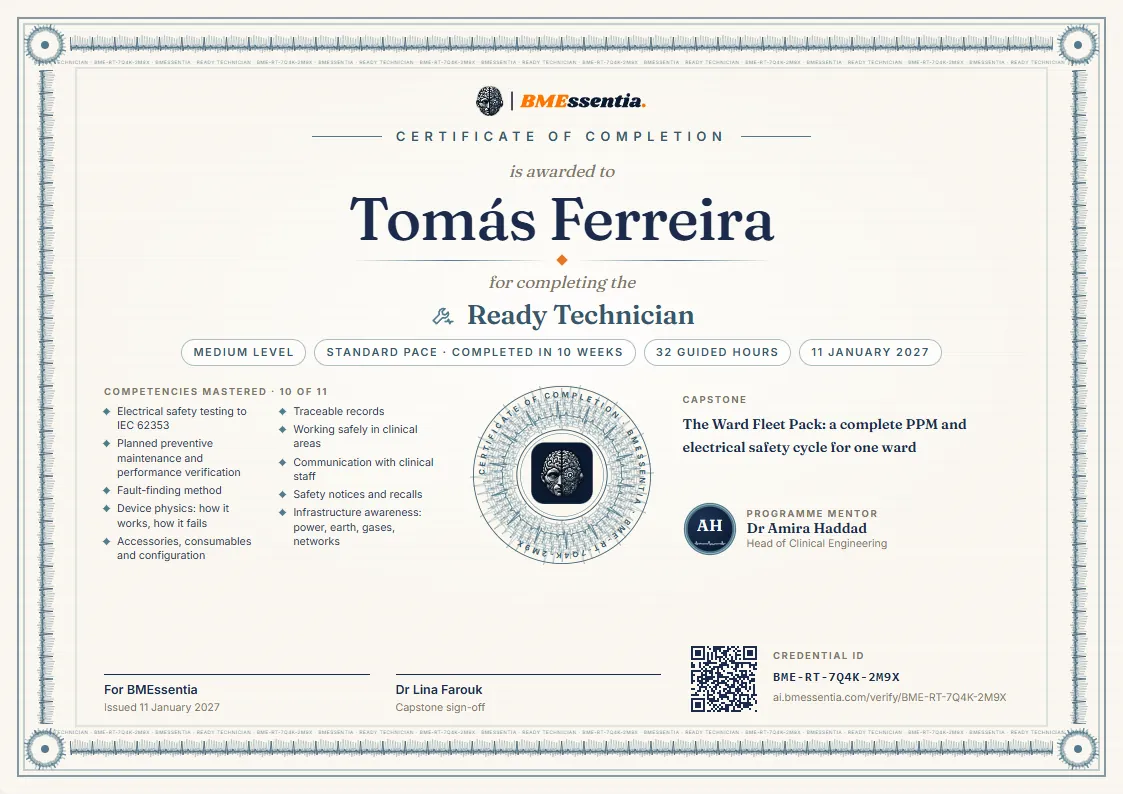
The certificateA Certificate of Completion in the track's colours, with the work behind it.Shown: a sample for Tomás Ferreira, a fictional learner

The arc

13 weeks, one running case.

Each week is one working shift: learn, see inside, do, work, think, check, reflect. Open a week to see its real steps.

Your job cards, one a week

  1. Week 1Day one in the workshop: the analyser and IEC 62353Your first IEC 62353 test record (Class I pump)
  2. Week 2The Ward 4 pump week: inside a volumetric pumpCompleted PM checklist with limits for a volumetric pump
  3. Week 3First calls: seven faulty devices, one methodFault log: seven calls with cause category, evidence and fix
  4. Week 4Ward 4's monitors: ECG, NIBP and SpO2 on the benchMonitor PM record plus a noise investigation note
  5. Week 5The alarm complaint: when the numbers are doubtedComplaint investigation note with paired readings and a ward action list
  6. Week 6Resus ready: defibrillatorsDefibrillator PM record plus a readiness checklist for Ward 4's trolley
  7. Week 7ICU nights: ventilatorsVentilator performance-check procedure with limits
  8. Week 8The recall: syringe drivers on noticeNotice action log: every affected asset, action, date and evidence
  9. Week 9Theatre cover: electrosurgeryESU PM checklist plus a pad-placement card for theatre staff
  10. Week 10The incident: evidence firstIncident report and evidence custody record
  11. Week 11When it is not the device: power, earth, gases and networksInfrastructure fault log with measurements and the owner each fault was handed to
  12. Week 12Boss week: Night, AloneShift handover pack: every call, decision, device status and open item
  13. Week 13Sign-off week: unsupervisedCapstone plus the signed competency record
  1. Week 1Day one in the workshop: the analyser and IEC 623534.9 h

    Ward 4's 14 volumetric pumps are due their annual PPM; the first four are on your bench.

    • DoPreventive Maintenance simulation: Ward 4 pump fleet PPM (Foundation)20 min
    • See insideGuided learning, day 1: Volumetric infusion pump, checkpoints 1-23 of 7325 min
    • WorkProcedure studio: your electrical safety procedure for the Ward 4 pumps15 min
    • LearnClinical Engineering ch. 6, lesson 1: Evaluating Safety and Performance Metrics15 min
    • + 14 more steps

    You make: Your first IEC 62353 test record (Class I pump)

  2. Week 2The Ward 4 pump week: inside a volumetric pump3 h

    The Ward 4 PPM: one pump's anti-free-flow fails on your bench.

    • DoClinical Engineer simulation: The Pump Round (8 jobs)20 min
    • See insideDevice Lab 56: Peristaltic finger assembly, Door & pressure platen, Free-flow protection, Air-in-line detector15 min
    • WorkMaintenance studio: the Ward 4 pump PM checklist with limits15 min
    • LearnTherapeutic Medical Devices ch. 8, lesson 4: Components of a Drug Infusion Pump15 min
    • + 10 more steps

    You make: Completed PM checklist with limits for a volumetric pump

  3. Week 3First calls: seven faulty devices, one method5 h

    Ward 4's first morning of calls lands on you.

    • DoClinical Engineer simulation: The First Call (7 jobs)25 min
    • See insideGuided learning, day 1: Transmittance, checkpoints 1-29 of 8030 min
    • WorkFault studio: the 91% oximeter call10 min
    • LearnBiomedical Engineering Blueprint ch. 2, lesson 5: Troubleshooting and Problem-Solving in Biomedical Equipment15 min
    • + 12 more steps

    You make: Fault log: seven calls with cause category, evidence and fix

  4. Week 4Ward 4's monitors: ECG, NIBP and SpO2 on the bench5.5 h

    Monitor PPM on Ward 4; a night-time ECG noise complaint opens.

    • DoTech Detective: The Night Shift Hum20 min
    • See insideGuided learning, day 1: Bedside monitoring, checkpoints 1-28 of 7930 min
    • WorkMaintenance studio: Ward 4 monitor PM checklist15 min
    • LearnInstrumentation ch. 6, lesson 2: Electrode-Skin Interface: Impedance and Noise15 min
    • + 15 more steps

    You make: Monitor PM record plus a noise investigation note

  5. Week 5The alarm complaint: when the numbers are doubted5.6 h

    The Ward 4 alarm complaint: BPs high, SpO2 alarms late.

    • DoTech Detective: A Size Too Small20 min
    • See insideGuided learning, day 1: Oscillometric, checkpoints 1-23 of 7425 min
    • WorkDocument studio: the complaint inspection record15 min
    • LearnInstrumentation ch. 9, lesson 3: Sphygmomanometers and Automated BP Devices15 min
    • + 16 more steps

    You make: Complaint investigation note with paired readings and a ward action list

  6. Week 6Resus ready: defibrillators5.5 h

    Ward 4's trolley check fails; ED Resus 2 will not shock.

    • DoClinical Engineer simulation: Resus Ready (8 jobs)25 min
    • See insideGuided learning, day 1: Manual monitor-defibrillator, checkpoints 1-18 of 6620 min
    • WorkMaintenance studio: defibrillator PM checklist15 min
    • LearnTherapeutic Medical Devices ch. 3, lesson 4: Types of Defibrillators: A Detailed Breakdown15 min
    • + 14 more steps

    You make: Defibrillator PM record plus a readiness checklist for Ward 4's trolley

  7. Week 7ICU nights: ventilators5.3 h

    ICU nights: three ventilator calls in one shift.

    • DoClinical Engineer simulation: ICU Nights (8 jobs)25 min
    • See insideGuided learning, day 1: ICU turbine ventilator, checkpoints 1-22 of 6925 min
    • WorkProcedure studio: ventilator performance verification15 min
    • LearnTherapeutic Medical Devices ch. 7, lesson 2: Components of a Ventilator15 min
    • + 14 more steps

    You make: Ventilator performance-check procedure with limits

  8. Week 8The recall: syringe drivers on notice4.8 h

    The ICU syringe drivers are under a field safety notice.

    • DoPreventive Maintenance simulation: Field safety notice: drivers20 min
    • See insideGuided learning, day 1: Syringe pump, checkpoints 1-13 of 6315 min
    • WorkDocument studio: the notice work order and action log15 min
    • LearnClinical Engineering ch. 10, lesson 2: Steps in the Medical Device Recall Process15 min
    • + 13 more steps

    You make: Notice action log: every affected asset, action, date and evidence

  9. Week 9Theatre cover: electrosurgery5.3 h

    Theatre cover: return electrode alarms and an ESU on the bench.

    • DoClinical Engineer simulation: The Theatre List (7 jobs)25 min
    • See insideGuided learning, day 1: Monopolar, checkpoints 1-24 of 7525 min
    • WorkMaintenance studio: theatre ESU PM checklist15 min
    • LearnTherapeutic Medical Devices ch. 9, lesson 5: Safety Features and Considerations in Electrosurgical Units15 min
    • + 14 more steps

    You make: ESU PM checklist plus a pad-placement card for theatre staff

  10. Week 10The incident: evidence first2.8 h

    The Ward 7B heparin incident: you secure the pump.

    • DoPatient Safety simulation: The Ten-Fold Dose25 min
    • See insideDevice Lab 56: Display & controls, then Controller electronics10 min
    • WorkDocument studio: incident report and custody record15 min
    • LearnClinical Engineering ch. 10, lesson 1: Identifying and Reporting Adverse Events15 min
    • + 8 more steps

    You make: Incident report and evidence custody record

  11. Week 11When it is not the device: power, earth, gases and networks3 h

    Ward 4's refurbished bay: power, earth and battery problems.

    • DoTech Detective: Eight Seconds of Dark20 min
    • See insideDevice Lab 56: Battery pack and Power management10 min
    • WorkFault studio: the restarting monitors15 min
    • LearnClinical Engineering ch. 11, lesson 4: Implementing Safety Protocols in Clinical Environments15 min
    • + 9 more steps

    You make: Infrastructure fault log with measurements and the owner each fault was handed to

  12. Week 12Boss week: Night, Alone3.2 h

    Your first solo night: the whole hospital.

    • DoClinical Engineer simulation: Night, Alone (8 jobs, interleaved families)40 min
    • WorkDocument studio: the morning handover20 min
    • CheckCheck: night calls, interleaved, plus two from earlier weeks15 min
    • Your organisationYour hospital: the on-call procedure and escalation tree30 min
    • + 5 more steps

    You make: Shift handover pack: every call, decision, device status and open item

  13. Week 13Sign-off week: unsupervised2.8 h

    Ward 4 and ICU are now your patch.

    • WorkCareer studio: your next 12 months15 min
    • LearnIllustration: calibration, why every measurement is a promise (Blueprint ch. 2)5 min
    • CheckFinal skills check (the day-one baseline, again)45 min
    • Your organisationYour hospital: the technician competency sign-off form30 min
    • + 2 more steps

    You make: Capstone plus the signed competency record

Proof

Only evidence counts.

A step is done when there is evidence: a simulation score, a saved work document, a passed check or a signed observation. Opening a page never ticks anything.

  • Before and afterThe same baseline check on day one and in the final week, scored per competency.
  • Mastery, not attendanceA competency below its threshold routes the learner to its named remediation items, then a re-check of the competency's bank questions; the week cannot be ticked complete by opening items alone (automatic checks need a score or a saved output).
  • The audit packYour weekly work documents and capstones, ready for a supervisor, an employer or an inspector.

The certificate

BMEssentia Certificate of Completion: Ready Technician

It names the track and the level you completed. Your portfolio holds the work behind it.

  • All 13 weeks' required items done
  • Final skills check at or above the level's pass mark
  • At least 9 of 11 competencies at mastery, including Electrical safety testing to IEC 62353, Quarantine, escalation and take-out-of-service judgement and Traceable records
  • Capstone graded 60 or above
  • For institutions: the observed sign-off rt.w13.obs signed by the supervisor (individual buyers: self-assessed with uploaded evidence, shown as such on the certificate)

The Ward Fleet Pack: a complete PPM and electrical safety cycle for one ward

Take one real ward's fleet (at least 10 devices across at least 3 families) through a full PPM and IEC 62353 cycle: plan, test, record, decide, and report the findings to the ward manager and the head of department.

Evidence it gives: A dated PPM and ESA record set for one ward with instrument calibration, showing a functioning medical equipment programme (JCI FMS / CBAHI / Joint Commission EC medical equipment inspection, testing and maintenance).

The Fault Casebook: five real faults traced to cause

Document five faults you handled in your own hospital during the 90 days (anonymised), at least one user cause, one accessory or consumable cause, one environment or infrastructure cause and one device fault, each traced from the call to the verified fix.

Evidence it gives: Traced corrective maintenance records with cause categories: evidence for the equipment programme's failure analysis and user-error trending.

The Acceptance and Recommissioning Pack

Accept a batch of new, loaned or returned-from-storage devices (at least five units of one family) into service: incoming inspection, electrical safety, performance verification, configuration check (profiles, drug library, alarm defaults), battery runtime, asset registration and handover to the ward.

Evidence it gives: Documented acceptance testing before first use (equipment programme requirement for new and returned devices).

Three levels

Easy, Medium or Hard.

A baseline check on day one places you, or you choose. The competencies are the same at every level; the support and the pressure change.

Easy

Baseline under 50% · simulations at Foundation

Worked examples first, then guided practice. Simulations at Foundation difficulty with the coach on and marking as you go. Fewer cases per week (the extra and hard-only cases are hidden). Mastery thresholds 10 points lower.

Medium

Baseline 50% to 74% · simulations at Practitioner

Guided to independent: the standard track. Simulations at Practitioner difficulty, the coach hidden but available, the extra cases each week from the middle of the track, mastery thresholds as stated.

Hard

Baseline 75% and above · simulations at Expert

Independent and interleaved: every simulation at Expert difficulty, all extra and hard-only cases, stricter mastery thresholds (+5), and time pressure.

Ways to get this track

On your own, with a plan, or with your organisation.

Complete track

This track

$399for 12 months

  • The track's lessons, labs and Medical City scenarios
  • The certificate when you finish
  • The track mentor: 100 questions for the track, more with credit top-ups
  • Or the Full family with its 5 Deep Dives: $899 ($1,394 bought one by one)

General Essentia, the Studios and Design are not included. Subscribe within 30 days and what you paid counts toward your plan.
Premium · Pro

Included in Premium and Pro

$299a year with Premium

  • Premium: 1 active track family at a time, this one or any other
  • Pro: 3 active track families at a time, with heavy AI use
  • Or Premium at $39 a month; one-time tracks cost 25% less with Premium, 40% less with Pro

Organisation licence

Every track for every seat

  • Every track and product, and the dashboard
  • Enrol people or cohorts and follow their progress
  • Seats for a year, an academic year or a semester

Branches

Make it yours with a branch.

Each branch keeps the core track's shape and focuses on one area of work. Each is sold on its own as a Deep Dive, and all of them come in the Full family.

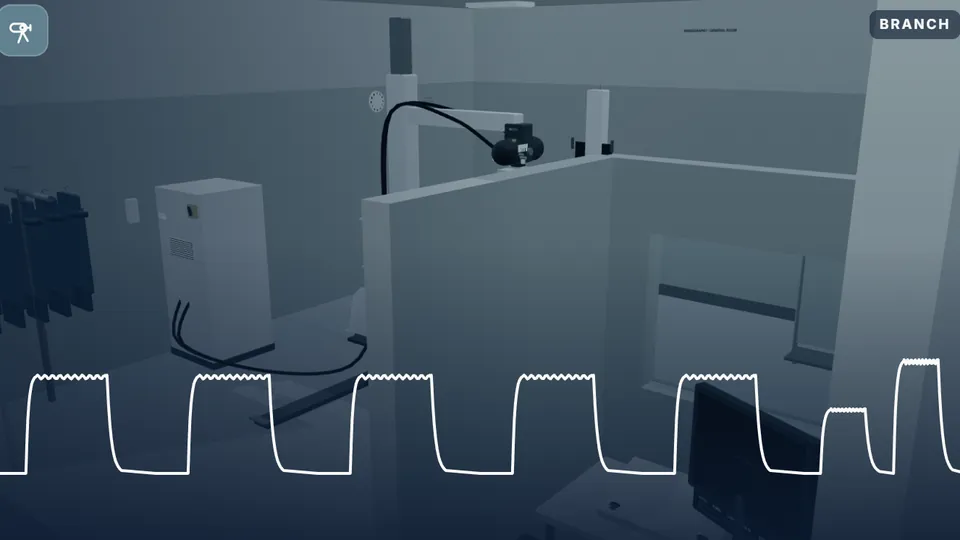
Ready Technician: Imaging: Device Lab, X-ray

Branch · Ready Technician

Imaging

In six weeks a ready technician supports the Imaging Floor: first-line checks within authorisation, artefacts read as evidence, MR and radiation safety kept honest, and vendor calls made with evidence.

6 weeks · 3-5 hours a week
EasyMediumHard

Certificate of Completion: Ready Technician, Imaging

Deep Dive · $199 · 12 monthsIncluded in every organisation licenceSee the track
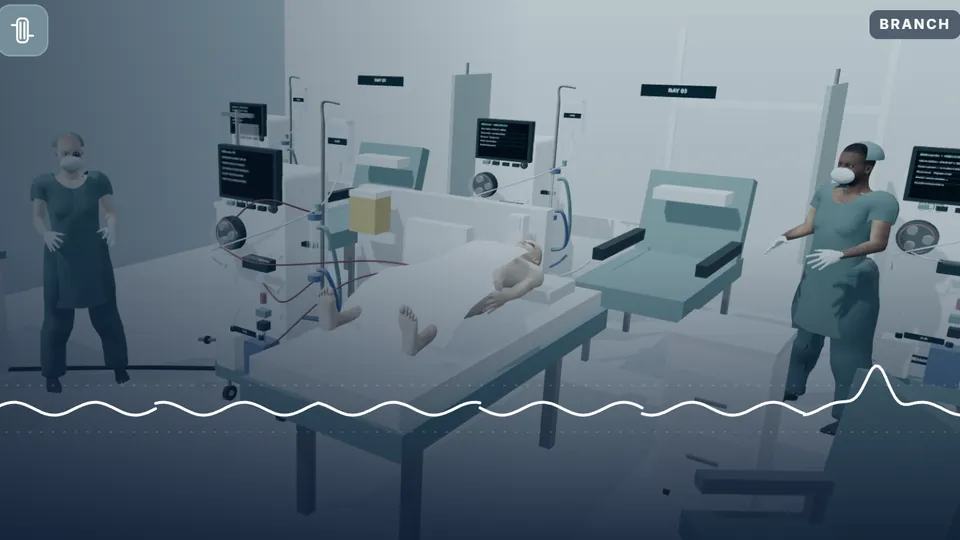
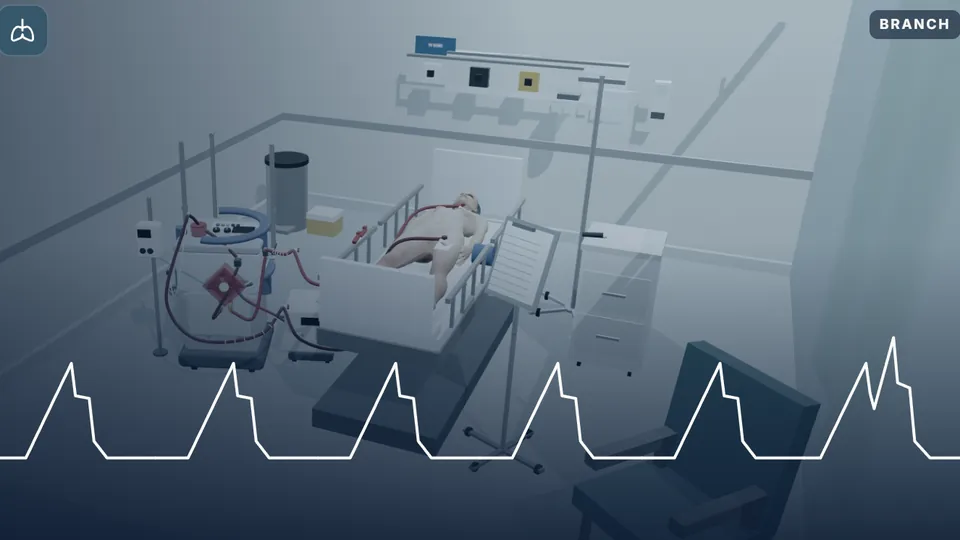
Ready Technician: Critical Care: Device Lab 8, ECMO

Branch · Ready Technician

Critical Care

In six weeks a ready technician supports the ICU's life support: finds circuit, supply and configuration causes, keeps spares and batteries honest, and never touches a clinical setting.

6 weeks · 3-5 hours a week
EasyMediumHard

Certificate of Completion: Ready Technician, Critical Care

Deep Dive · $199 · 12 monthsIncluded in every organisation licenceSee the track
Ready Technician: Renal / Dialysis: Device Lab 22, haemodialysis

Branch · Ready Technician

Renal / Dialysis

In six weeks a ready technician keeps a dialysis unit safe: machines verified against independent meters, barriers never bypassed, water proven, machines released on test results, homes commissioned properly.

6 weeks · 3-5 hours a week
EasyMediumHard

Certificate of Completion: Ready Technician, Renal and Dialysis

Deep Dive · $199 · 12 monthsIncluded in every organisation licenceSee the track
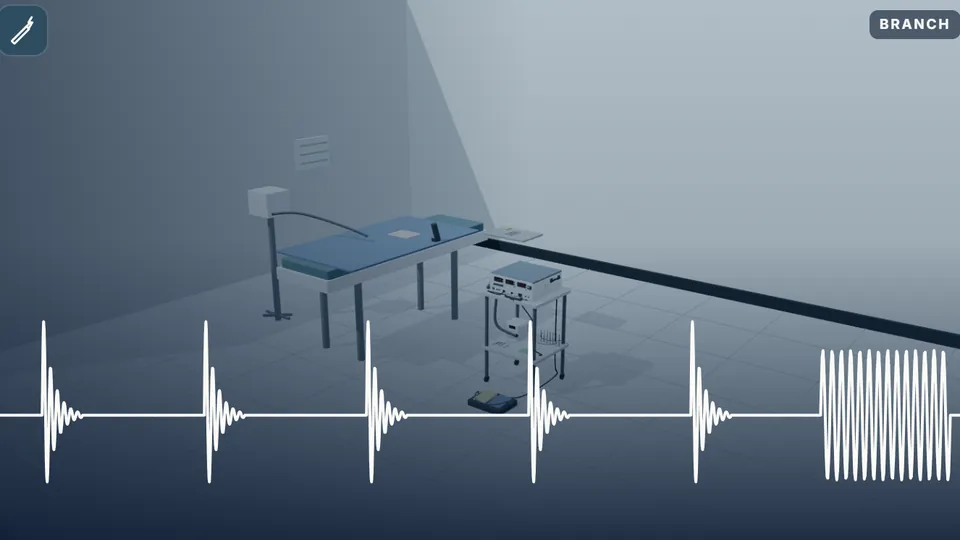
Ready Technician: Operating Theatre: Device Lab, electrosurgical unit

Branch · Ready Technician

Operating Theatre

In six weeks a ready technician keeps theatres safe: workstations verified to their interlocks, gases released only on the permit, energy kept on its intended path, robots and scopes supported without guesswork.

6 weeks · 3-5 hours a week
EasyMediumHard

Certificate of Completion: Ready Technician, Operating Theatre

Deep Dive · $199 · 12 monthsIncluded in every organisation licenceSee the track
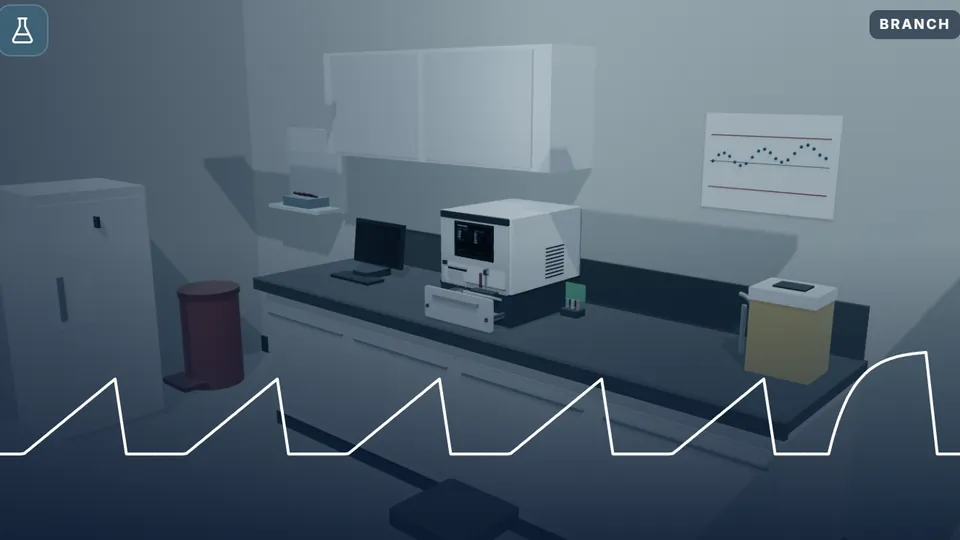
Ready Technician: Laboratory: Device Lab, blood gas analyser

Branch · Ready Technician

Laboratory

In six weeks a ready technician supports POCT and laboratory equipment: analysers and meters understood to their chemistry, identity protected end to end, centrifuges kept safe, cold chain alarms that reach someone.

6 weeks · 3-5 hours a week
EasyMediumHard

Certificate of Completion: Ready Technician, Laboratory and Point of Care

Deep Dive · $199 · 12 monthsIncluded in every organisation licenceSee the track

FAQ

Answers before you start.

Anything else, write to the team and we answer directly.

  • Yes. An organisation's licence includes every track, core and branch, with the Platform, Medical City, Essentia, the App and the dashboard. Your organisation enrols you on the track, and it appears under My track; there is nothing extra to buy.