Skip to content

Hospital-Ready GraduateMedtech Industry pathway

Branch · From the ward to the company

Hospital-Ready Graduate:Medtech Industry pathway

From the ward to the company: design controls, risk, regulation and how devices are sold.

For: University BME departments and programmes with industry placements; device companies' graduate programmes

Before you start: The Hospital-Ready Graduate core track, or its baseline check at Medium or above

Your mentor, a character in the trackDr Amira HaddadHead of Clinical Engineering
Length
6 weeks
Time
About 3.5 hours a week
Levels
Easy, Medium, Hard
Certificate
Certificate of Completion
On your own
$149, 12 months
Hospital-Ready Graduate: Medtech Industry pathway: Device Lab, prosthetic limb
Device Lab · prosthetic limb

The arc · 6 weeks · From the ward to the company

What you'll be able to do

The job, done properly.

  • Write user needs and testable design inputs and start a risk file
  • Plan formative and summative usability work
  • Classify a device and its software and plan the evidence
  • Present clinical and financial value with sourced claims
  • Present a traced design decision at a design review and an interview

The story

You move from Medical City Hospital's clinical engineering floor to the R&D, regulatory and clinical teams of a device company that works with the hospital's clinicians on four projects.

Dr Amira HaddadHead of Clinical Engineering · your mentor (a character in the track)
“A feature request is not a user need. Keep the diagnostic question narrow, write needs before features, and start the risk file on day one, because every later decision has to trace back to both.”

Inside the track

What you actually use, every week.

The real screens: My track, a step with your mentor, a simulation, your skills map and the certificate.

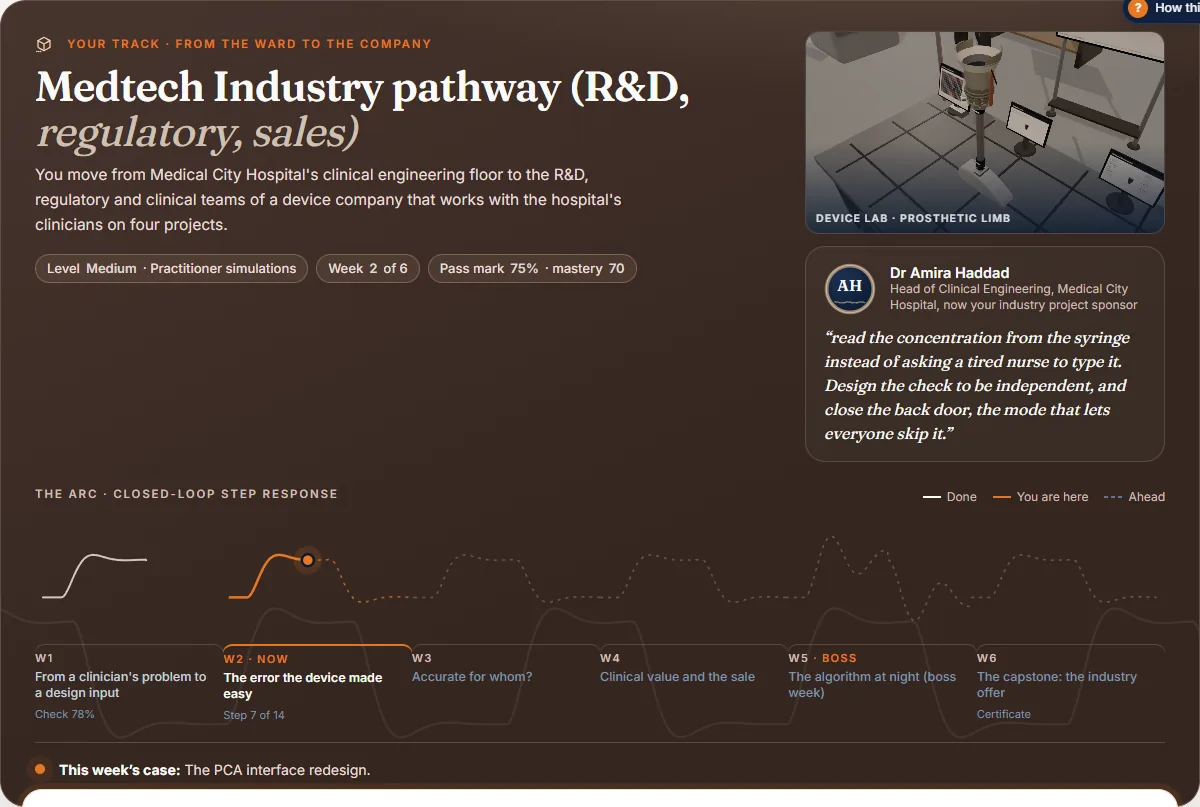
My track
My trackThe arc of 6 weeks, this week's case, your mentor and your next step, in Hospital-Ready Graduate: Medtech Industry pathway's own colours.
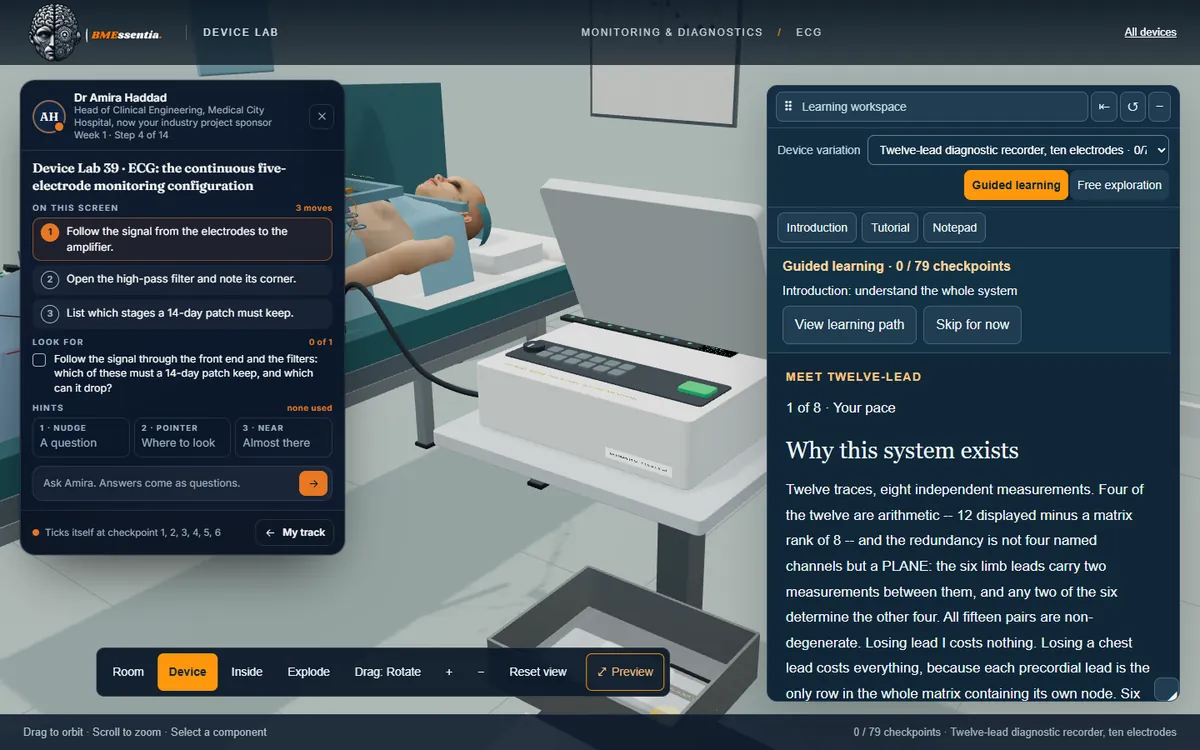
A step with your mentor in the Device Lab
A step with your mentor in the Device LabThe step names what to look at on the real device, with hints that never give the answer away.Shown: ECG with Dr Amira Haddad, this track's mentor
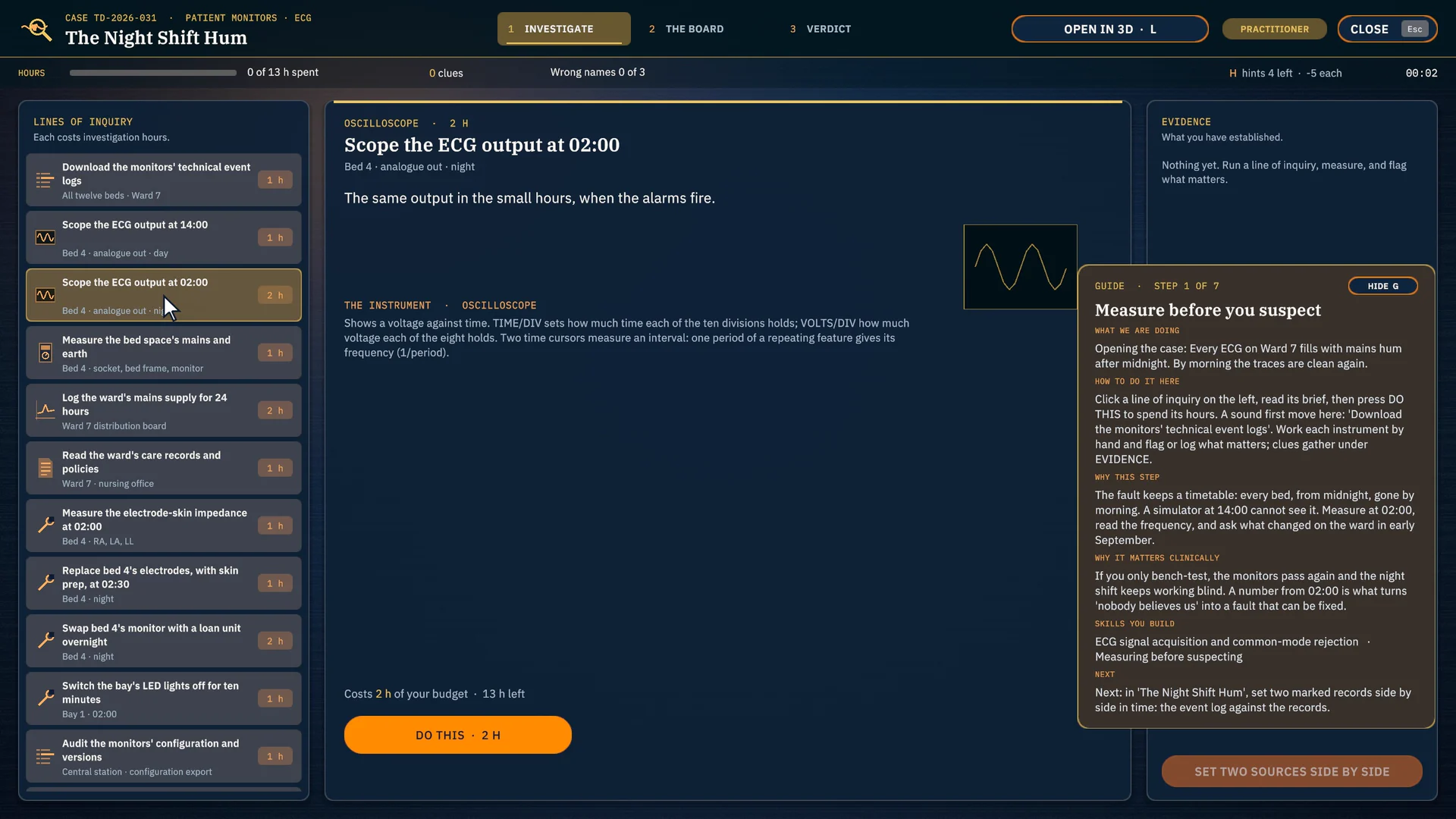
A simulation
A simulationReal hospital work in Medical City, scored and debriefed, at your level.
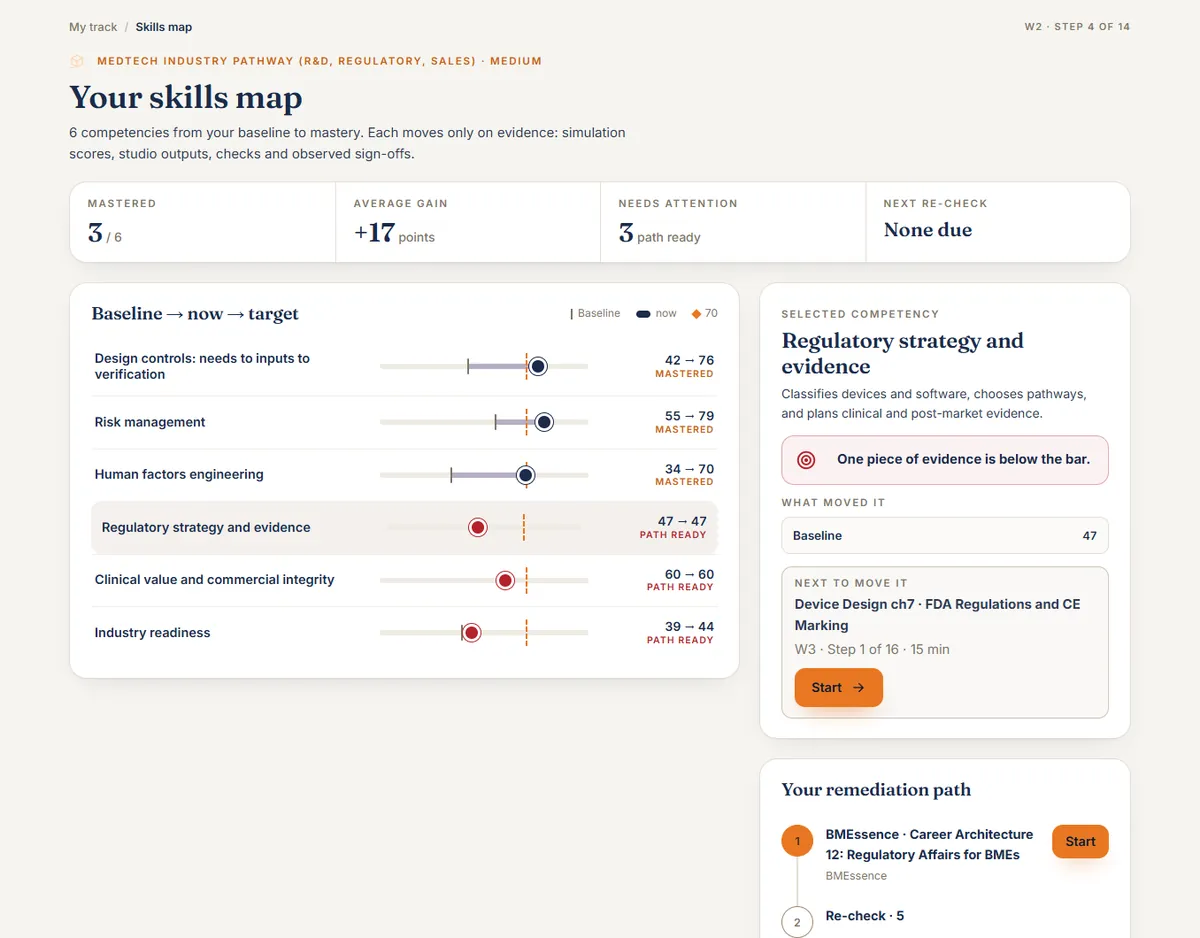
Your skills map
Your skills mapThis track's own competencies, from your baseline to mastery. They move only on evidence.Shown: a sample learner's progress
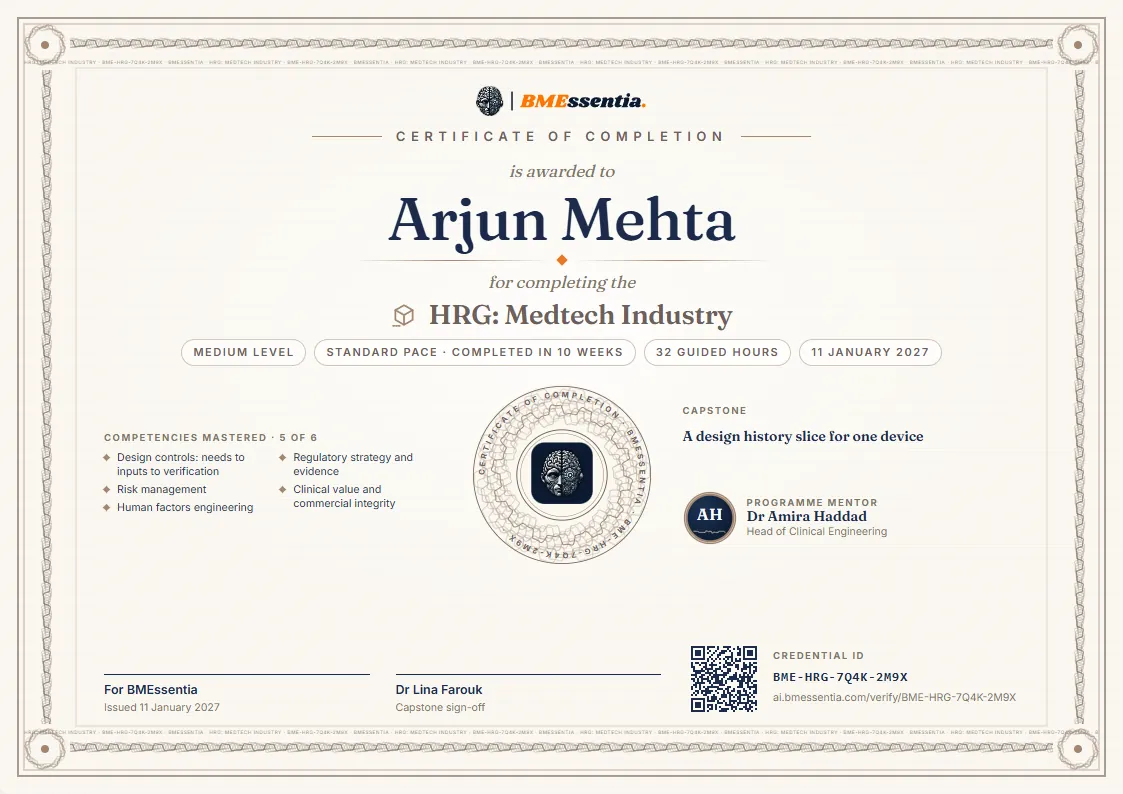
The certificate
The certificateA Certificate of Completion in the track's colours, with the work behind it.Shown: a sample for Arjun Mehta, a fictional learner

The arc

6 weeks, one running case.

Each week is one working shift: learn, see inside, do, work, think, check, reflect. Open a week to see its real steps.

Your term timetable

  1. Week 1From a clinician's problem to a design input
  2. Week 2The error the device made easy
  3. Week 3Accurate for whom?
  4. Week 4Clinical value and the sale
  5. Week 5The algorithm at night (boss week)
  6. Week 6The capstone: the industry offer
  1. Week 1From a clinician's problem to a design input4 h

    The 14-day ECG patch: from the neurologist's problem to design inputs.

    • DoDesign Studio · Fourteen Days (14-day ambulatory ECG patch)20 min
    • See insideDevice Lab 39 · ECG: the continuous five-electrode monitoring configuration10 min
    • WorkDesign input and first risk sheet: 14-day ECG patch20 min
    • LearnDevice Design ch1 · Overview of Medical Device Development15 min
    • + 10 more steps

    You make: Design input and first risk sheet

  2. Week 2The error the device made easy3.3 h

    The PCA interface redesign.

    • DoDesign Studio · Ten Times Too Much (PCA programming interface)20 min
    • See insideDevice Lab 56 · Syringe pump: the recognition and force sensing10 min
    • WorkFormative usability test plan: PCA interface20 min
    • LearnDevice Design ch6 · Usability Testing and Iteration15 min
    • + 10 more steps

    You make: Formative usability test plan

  3. Week 3Accurate for whom?5.3 h

    The equitable spot-check oximeter: evidence and the regulatory path.

    • DoDesign Studio · Every Skin (spot-check pulse oximeter)20 min
    • See insideDevice Lab 52 · Pulse Oximeter: show that the shunt fraction does not move with pigment10 min
    • WorkRegulatory strategy note: equitable oximeter20 min
    • LearnDevice Design ch7 · FDA Regulations and CE Marking15 min
    • + 12 more steps

    You make: Regulatory strategy note

  4. Week 4Clinical value and the sale2.6 h

    Your company's monitors in the surgical wing tender.

    • DoProcurement · Patient Monitoring Network (from the buyer's chair)20 min
    • See insideDevice Lab 38 · Cardiac Monitor: chest pain with ST elevation10 min
    • WorkValue case and objection map15 min
    • LearnClinical Engineering ch3 · Evaluating Clinical and Financial Value in New Acquisitions15 min
    • + 9 more steps

    You make: Value case and objection map

  5. Week 5The algorithm at night (boss week)3.8 h

    The closed-loop insulin system at the design review board.

    • DoDesign Studio · The Algorithm at Night (automated insulin delivery)20 min
    • See insideDevice Lab 27 · Insulin Pump: the outlet resistance has risen a thousandfold10 min
    • WorkDesign review presentation: closed-loop insulin20 min
    • LearnDevice Library · Insulin Pump: Safety (the whole section)15 min
    • + 8 more steps

    You make: Design review presentation

  6. Week 6The capstone: the industry offer2.7 h

    Your interview at a device company.

    • WorkApplication, CV lines and six-month plan20 min
    • LearnBMEssentials · The Biomedical Career Path Diagnostic: R&D, Clinical or MedTech Sales (first 20 minutes)20 min
    • ThinkBMEssence · Career Architecture 2: The BME Career Path Map15 min
    • CheckWarm-up: retrieval from earlier weeks (spaced)8 min
    • + 7 more steps

    You make: Capstone and application

Proof

Only evidence counts.

A step is done when there is evidence: a simulation score, a saved work document, a passed check or a signed observation. Opening a page never ticks anything.

  • Before and afterThe same baseline check on day one and in the final week, scored per competency.
  • Mastery, not attendanceEach competency has a mastery threshold. Below it, the track routes you to the named remediation items and a re-check; a week cannot be ticked complete by opening items alone.
  • The audit packYour weekly work documents and capstones, ready for a supervisor, an employer or an inspector.

The certificate

BMEssentia Certificate of Completion: Hospital-Ready Graduate, Medtech Industry pathway (R&D, regulatory, sales) branch

It names the track and the level you completed. Your portfolio holds the work behind it.

  • All 6 weeks' required items done at the learner's level
  • At least 5 of 6 competencies mastered
  • Final check at or above the level's pass mark
  • Capstone at 3 or above on every criterion, signed off by the manager or professor (institutions) or AI-assisted rubric review (individuals)

A design history slice for one device

Take one Design Studio project (or your own) from clinical problem to design review: user needs, design inputs, hazards and controls, usability plan, verification plan, and the review presentation.

Evidence it gives: A design history slice a company or professor can assess.

A regulatory and evidence strategy

For one device, write the regulatory strategy: class and rule in the US and EU, pathway, clinical evidence plan with subgroups, software class, and post-market surveillance.

Evidence it gives: Regulatory reasoning evidence.

Industry application portfolio

Your application for a device company graduate role: a chosen path, a traced design decision, a value case, and your requirement-to-evidence table, presented to a panel.

Evidence it gives: Employability evidence for industry roles.

Three levels

Easy, Medium or Hard.

A baseline check on day one places you, or you choose. The competencies are the same at every level; the support and the pressure change.

Easy

Baseline under 50%, or chosen · simulations at Foundation

Worked examples first; Starter-tier support; the incident case and the second capstone design hidden.

Medium

Baseline 50% to 74%, or chosen · simulations at Practitioner

Practitioner difficulty; the incident case shown.

Hard

Baseline 75% and above, or chosen · simulations at Expert

Expert difficulty; both capstone-tier designs back to back, timed.

Ways to get this track

On your own, with a plan, or with your organisation.

Deep Dive

This Deep Dive

$149for 12 months

  • The track's lessons, labs and Medical City scenarios
  • The certificate when you finish
  • The track mentor: 100 questions for the track, more with credit top-ups
  • Or the Hospital-Ready Graduate Full family: $399

General Essentia, the Studios and Design are not included. Subscribe within 30 days and what you paid counts toward your plan.
Premium · Pro

Included in Premium and Pro

$299a year with Premium

  • Premium: 1 active track family at a time, this one or any other
  • Pro: 3 active track families at a time, with heavy AI use
  • Or Premium at $39 a month; one-time tracks cost 25% less with Premium, 40% less with Pro

Organisation licence

Every track for every seat

  • Every track and product, and the dashboard
  • Enrol people or cohorts and follow their progress
  • Seats for a year, an academic year or a semester

More Hospital-Ready Graduate branches

The other branches.

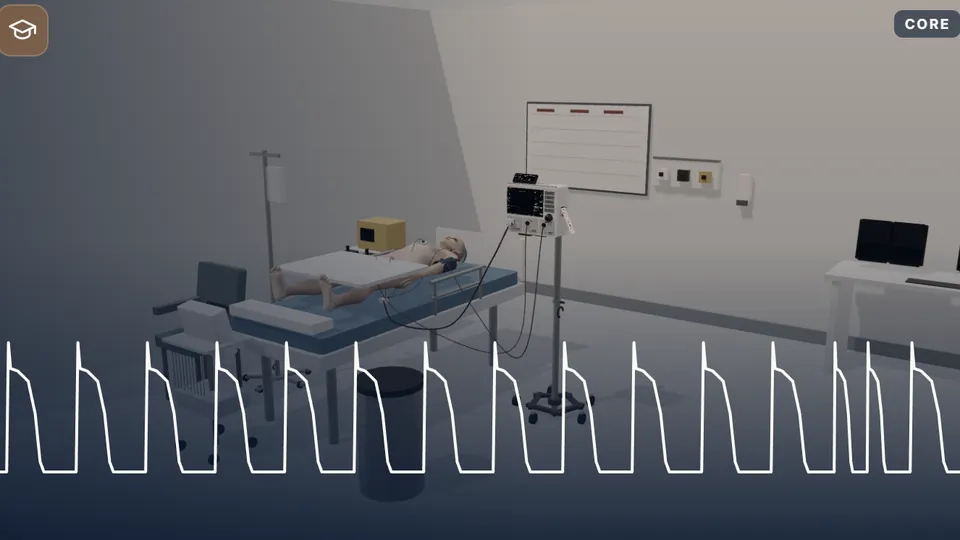
Hospital-Ready Graduate: Device Lab 38, cardiac monitor

Biomedical engineering graduate

Hospital-Ready Graduate

Final-year students and new graduates, and the universities and colleges that teach them.

14 weeks, plus a Foundations week 0 at the easy level · about 4.5 hours a week
EasyMediumHard

Certificate of Completion: Hospital-Ready Graduate

Complete track · $299 · 12 monthsIncluded in every organisation licenceSee the track
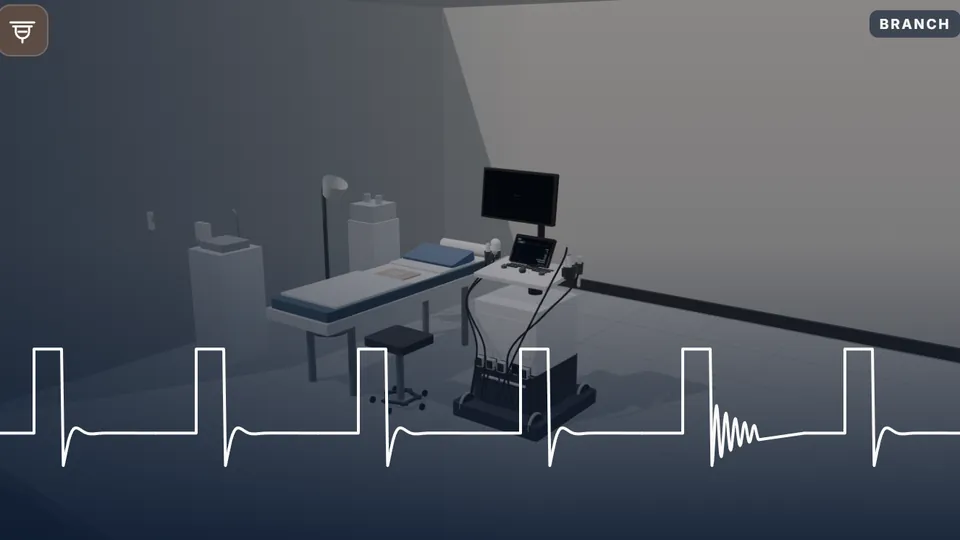
Hospital-Ready Graduate: Clinical Engineering pathway: Device Lab, ultrasound

Branch · Hospital-Ready Graduate

Clinical Engineering pathway

In six weeks a graduate who finished the core can commission theatre and decontamination equipment, verify neonatal devices, hold a supervised night and a major incident, and present the evidence for a trainee clinical engineer post.

6 weeks · about 4 hours a week
EasyMediumHard

Certificate of Completion: Hospital-Ready Graduate, Clinical Engineering pathway branch

Deep Dive · $149 · 12 monthsIncluded in every organisation licenceSee the track

FAQ

Answers before you start.

Anything else, write to the team and we answer directly.

  • Yes. An organisation's licence includes every track, core and branch, with the Platform, Medical City, Essentia, the App and the dashboard. Your organisation enrols you on the track, and it appears under My track; there is nothing extra to buy.