Skip to content

Biomedical engineering graduate · Core track · Resident engineer

Hospital-Ready Graduate

One semester as a resident engineer in Medical City Hospital: learn the core devices from physiology to failure, and leave with a portfolio you can show in an interview.

For: Final-year students and new graduates, and the universities and colleges that teach them.

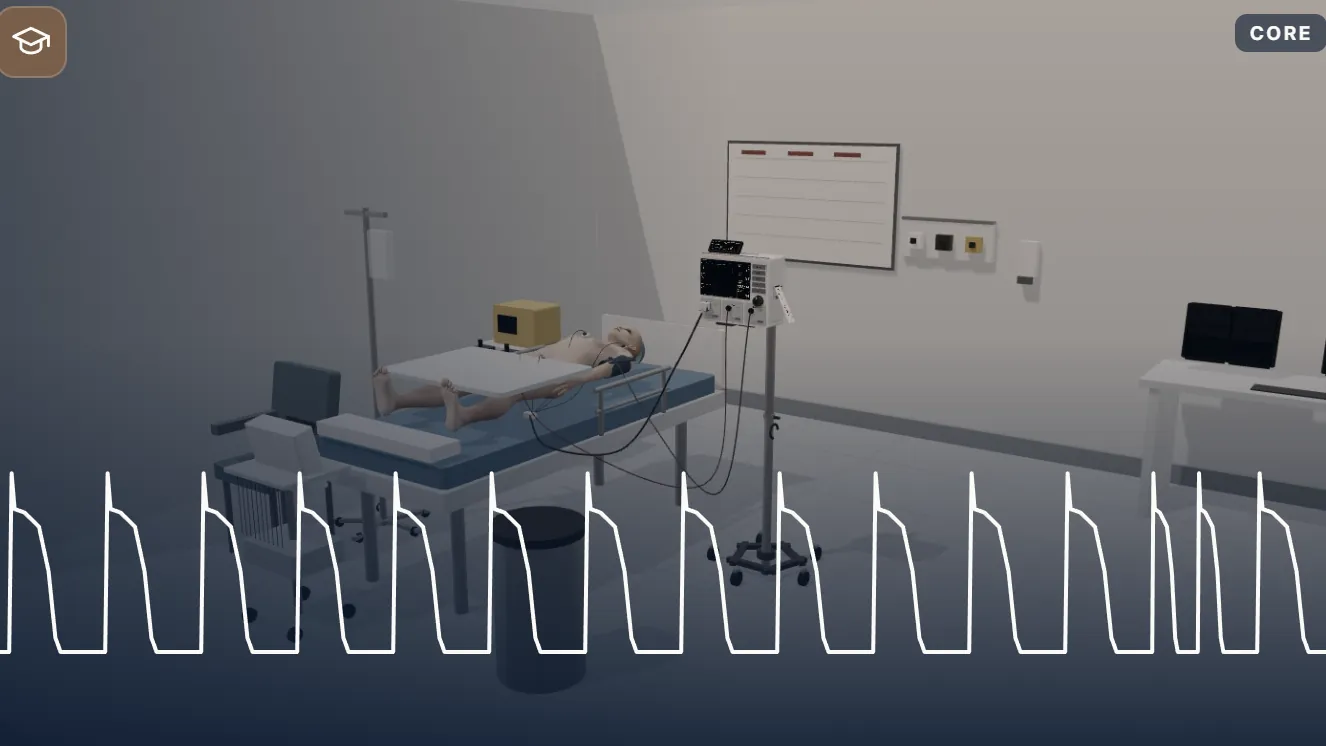
Hospital-Ready Graduate: Device Lab 38, cardiac monitor
Device Lab 38 · cardiac monitor

The arc · 14 weeks, plus a Foundations week 0 at the easy level · Resident engineer

Your mentor, a character in the trackDr Amira HaddadHead of Clinical Engineering
Length
14 weeks, plus a Foundations week 0 at the easy level
Time
About 4.5 hours a week
Levels
Easy, Medium, Hard
Certificate
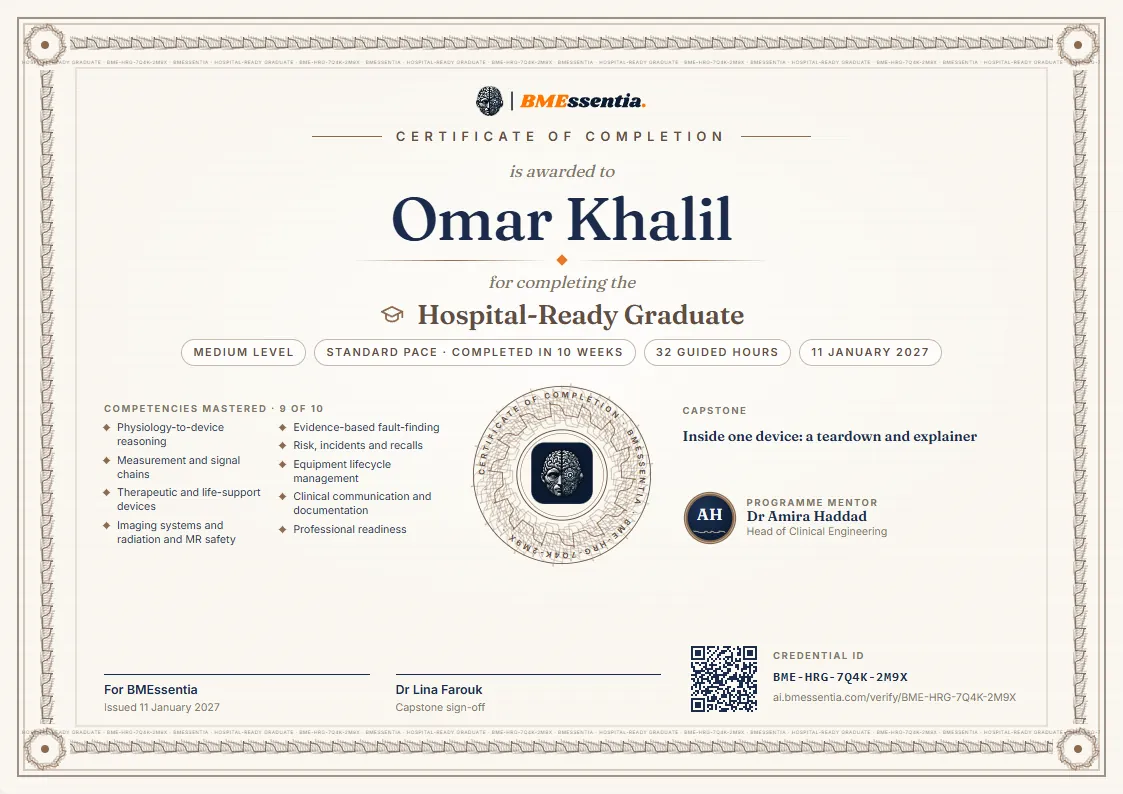
Certificate of Completion
On your own
$299, 12 months

What you'll be able to do

The job, done properly.

  • Explain the core bedside, life-support and imaging devices from the physiology they serve to the way they fail
  • Find a fault with hypotheses and measurements, and prove the fix
  • Run an electrical safety test in IEC 62353 order and explain the installation rules that protect patients
  • Investigate a device incident and write the record a patient safety team uses
  • Commission new equipment, plan maintenance by risk and price a purchase over its whole life
  • Present a portfolio of fourteen real work documents and pass a thirty-minute technical interview

The story

BMEssentia Medical City Hospital, 400 beds. You are this semester's resident engineer in the clinical engineering department.

Dr Amira HaddadHead of Clinical Engineering · your mentor (a character in the track)
“A hospital does not own devices, it owns a fleet that is born, used, maintained, failed, investigated and retired. On day one I want you to see that whole life, because every later week is one stage of it.”

Inside the track

What you actually use, every week.

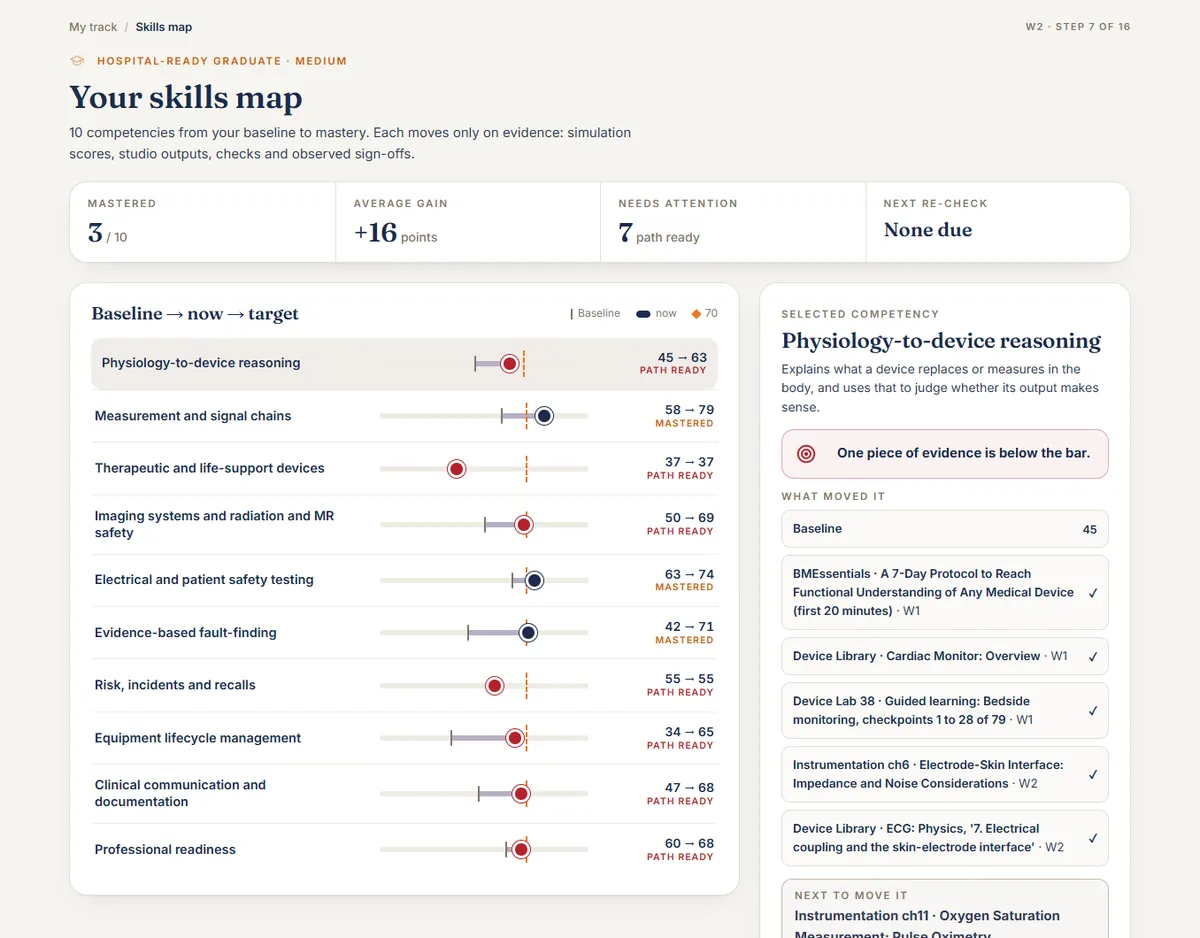
The real screens: My track, a step with your mentor, a simulation, your skills map and the certificate.

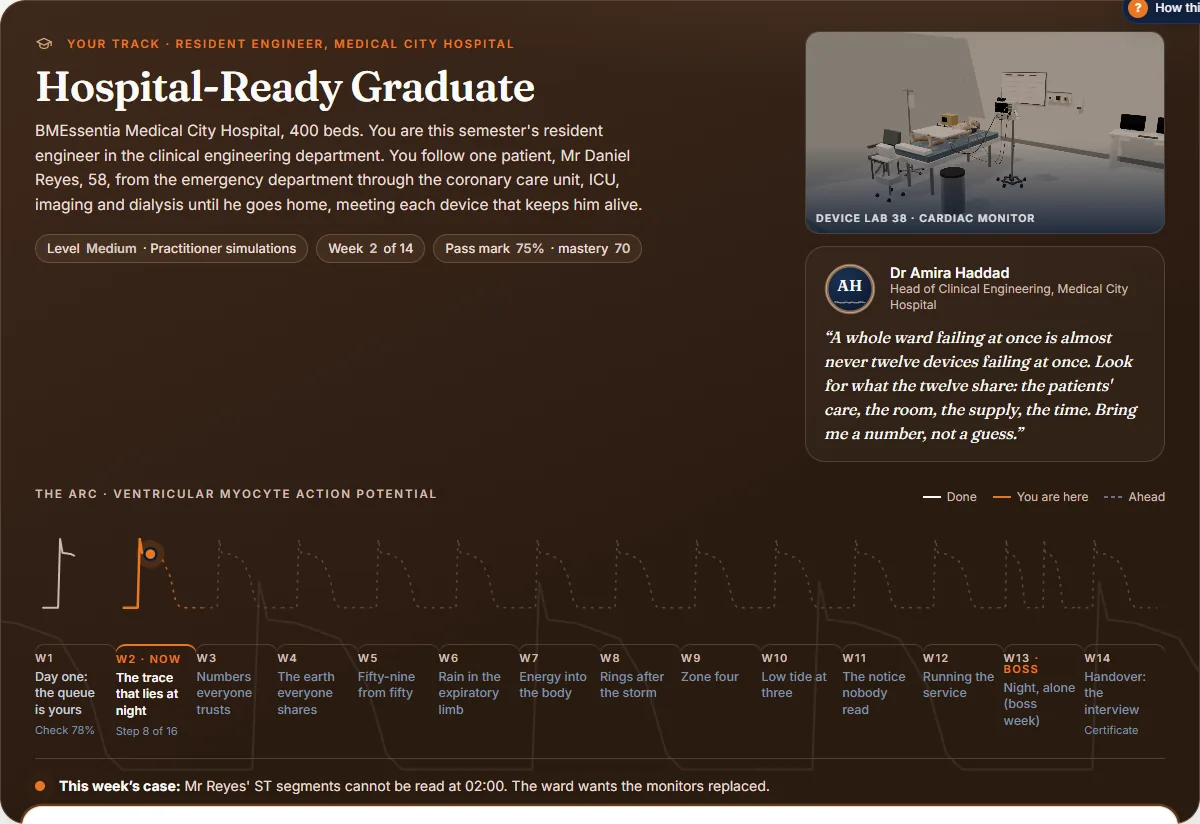
My track
My trackThe arc of 14 weeks, this week's case, your mentor and your next step, in Hospital-Ready Graduate's own colours.
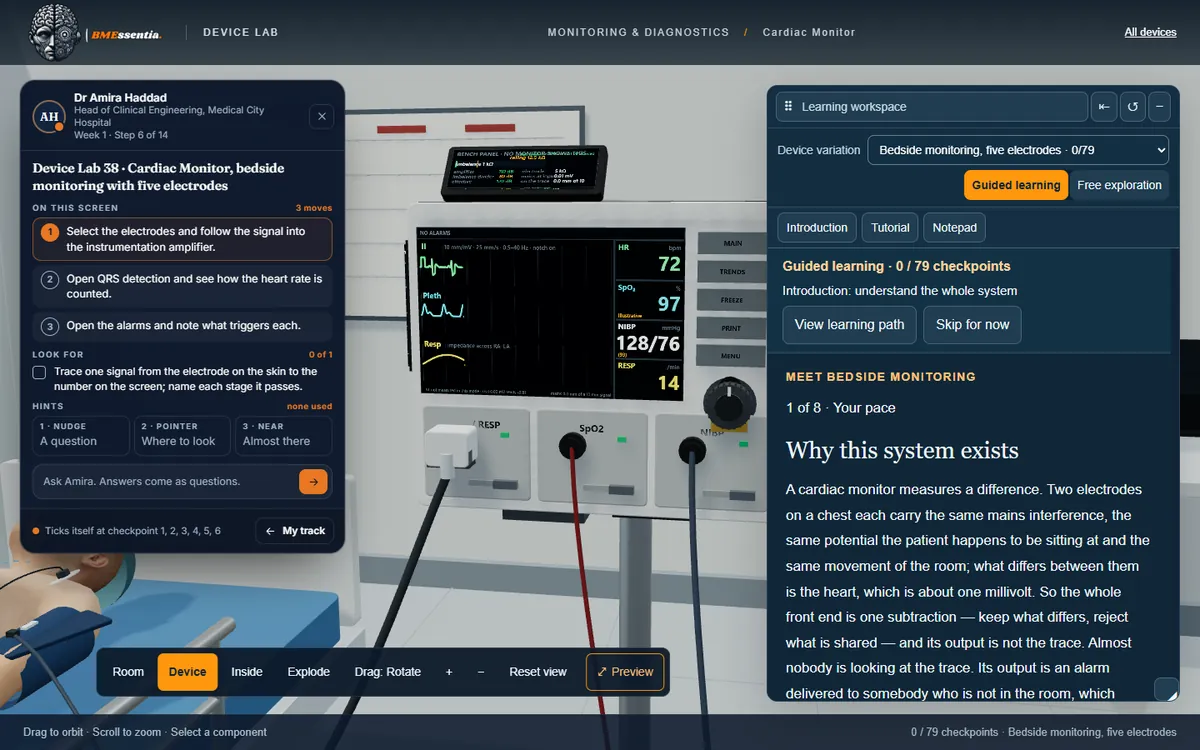
A step with your mentor in the Device Lab
A step with your mentor in the Device LabThe step names what to look at on the real device, with hints that never give the answer away.Shown: Cardiac Monitor with Dr Amira Haddad, this track's mentor
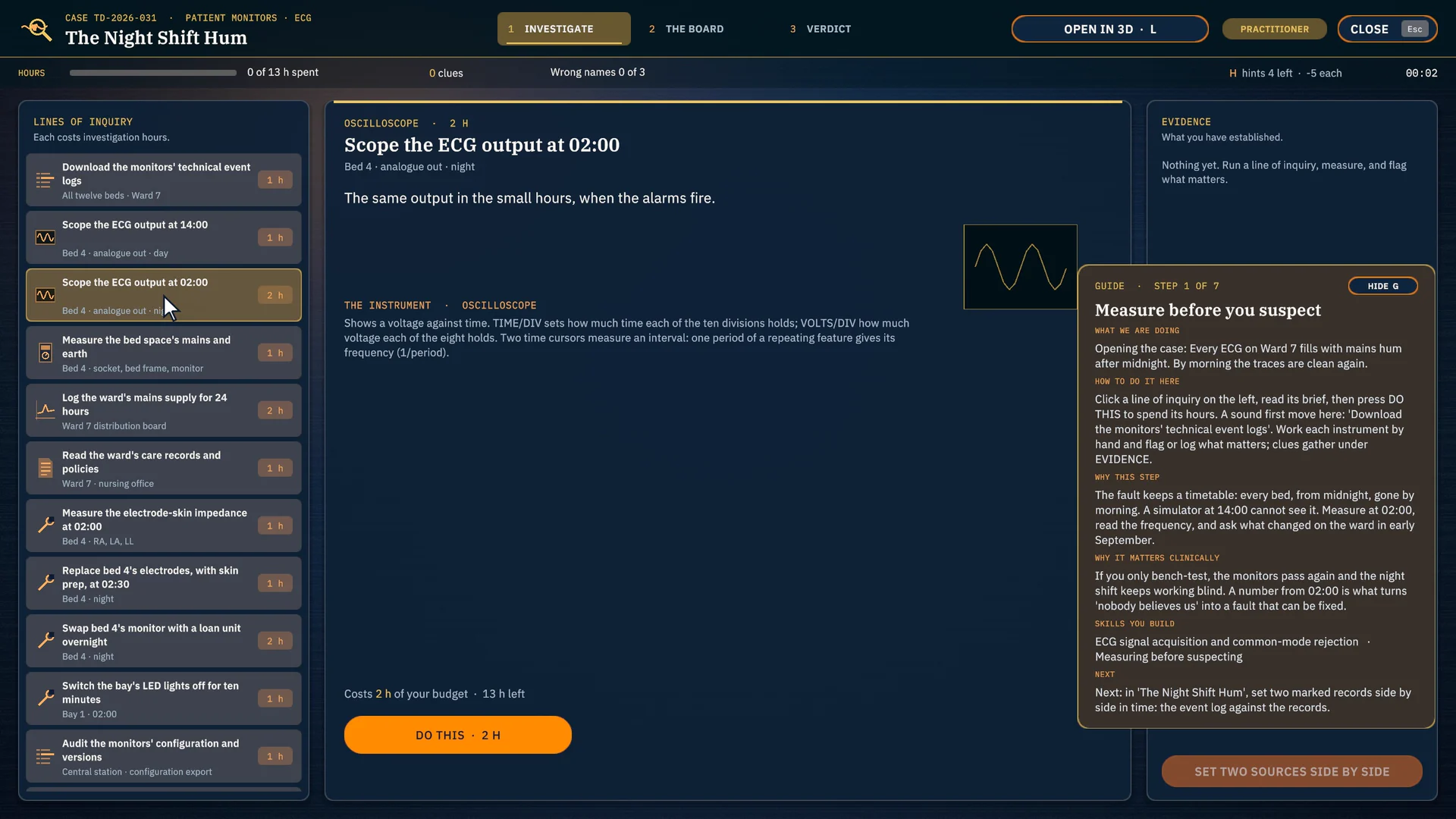
A simulation
A simulationReal hospital work in Medical City, scored and debriefed, at your level.
Your skills map
Your skills mapThis track's own competencies, from your baseline to mastery. They move only on evidence.Shown: a sample learner's progress
The certificate
The certificateA Certificate of Completion in the track's colours, with the work behind it.Shown: a sample for Omar Khalil, a fictional learner

The arc

14 weeks, one running case.

Each week is one working shift: learn, see inside, do, work, think, check, reflect. Open a week to see its real steps.

Your term timetable

  1. Week 1Day one: the queue is yours
  2. Week 2The trace that lies at night
  3. Week 3Numbers everyone trusts
  4. Week 4The earth everyone shares
  5. Week 5Fifty-nine from fifty
  6. Week 6Rain in the expiratory limb
  7. Week 7Energy into the body
  8. Week 8Rings after the storm
  9. Week 9Zone four
  10. Week 10Low tide at three
  11. Week 11The notice nobody read
  12. Week 12Running the service
  13. Week 13Night, alone (boss week)
  14. Week 14Handover: the interview
  1. Week 1Day one: the queue is yours4 h

    Mr Reyes arrives in resus. The cardiac monitor on his bay is the first device you will learn inside out.

    • DoClinical Engineer · The First Call (Day shift)20 min
    • See insideDevice Lab 38 · Cardiac Monitor, bedside monitoring with five electrodes10 min
    • WorkYour one-page device brief: the cardiac monitor15 min
    • LearnBlueprint ch2 · Device Maintenance and Safety: the engineer's role in upkeep, calibration and safety15 min
    • + 10 more steps

    You make: Device brief: the bedside cardiac monitor

  2. Week 2The trace that lies at night5 h

    Mr Reyes' ST segments cannot be read at 02:00. The ward wants the monitors replaced.

    • DoTech Detective · The Night Shift Hum20 min
    • See insideDevice Lab 39 · ECG, an electrode still settling10 min
    • WorkFault hypothesis sheet: Ward 7 night ECG noise15 min
    • LearnInstrumentation ch6 · Electrode-Skin Interface: Impedance and Noise Considerations15 min
    • + 12 more steps

    You make: Fault hypothesis sheet and the evidence that closed it

  3. Week 3Numbers everyone trusts5.7 h

    Mr Reyes' readings disagree with each other. The ward asks whether the monitor can be trusted.

    • DoTech Detective · A Size Too Small20 min
    • See insideDevice Lab 52 · Pulse Oximeter: the ratio of ratios, and the six things it cannot see10 min
    • WorkNurse explainer: when to doubt SpO2 and NIBP15 min
    • LearnInstrumentation ch11 · Oxygen Saturation Measurement: Pulse Oximetry15 min
    • + 14 more steps

    You make: Nurse explainer: when to doubt SpO2 and NIBP

  4. Week 4The earth everyone shares3 h

    Bay 2 has three 'faulty' devices from three vendors, all on Mr Reyes.

    • DoPreventive Maintenance · Ward 4 pump fleet PPM20 min
    • See insideDevice Lab 56 · Infusion Pump: external power connection10 min
    • WorkIEC 62353 recurrent test procedure: volumetric infusion pump15 min
    • LearnClinical Engineering ch11 · Overview of Safety Protocols: Electrical, Radiation, Biological15 min
    • + 12 more steps

    You make: IEC 62353 test procedure and one signed test record

  5. Week 5Fifty-nine from fifty5.2 h

    Mr Reyes' heparin is under-delivering. A second patient on the same floor had a ten-fold overdose.

    • DoTech Detective · Fifty-Nine from Fifty20 min
    • See insideDevice Lab 56 · Infusion Pump: downstream pressure sensing10 min
    • WorkIncident investigation record: the ten-fold heparin infusion20 min
    • LearnTherapeutic Devices ch8 · Components of a Drug Infusion Pump15 min
    • + 15 more steps

    You make: Incident investigation record: the ten-fold heparin infusion

  6. Week 6Rain in the expiratory limb5.1 h

    Mr Reyes is in Bay 3. His ventilator alarms high volume every few hours.

    • DoTech Detective · Rain in the Expiratory Limb20 min
    • See insideDevice Lab 10 · Ventilator: increased circuit resistance10 min
    • WorkAlarm quick-card: recurring high expiratory volume15 min
    • LearnHuman Physiology ch4 · Gas Exchange: the main function of the respiratory system10 min
    • + 14 more steps

    You make: ICU alarm quick-card

  7. Week 7Energy into the body5.2 h

    Cardioversion fails at the bedside; theatre wants an ESU with a history.

    • DoTech Detective · Two Halves, One Patient20 min
    • See insideDevice Lab 19 · Defibrillator: synchronisation and lost-marker protection10 min
    • WorkTheatre teaching sheet: return electrodes15 min
    • LearnTherapeutic Devices ch3 · Detailed Considerations in Defibrillation15 min
    • + 15 more steps

    You make: Theatre teaching sheet: return electrodes, with quiz

  8. Week 8Rings after the storm4.7 h

    Mr Reyes' CT has rings through every slice; the radiologist will not report it.

    • DoTech Detective · Rings After the Storm20 min
    • See insideDevice Lab 4 · CT Scanner: dead detector channel10 min
    • WorkCT artefact atlas page15 min
    • LearnMedical Imaging ch11 · Image Reconstruction in CT15 min
    • + 14 more steps

    You make: CT artefact atlas page

  9. Week 9Zone four4.9 h

    Mr Reyes' cardiac MRI is postponed while the projectile incident is investigated.

    • DoPatient Safety · Zone Four20 min
    • See insideImaging case · MRI-001 Acute ischaemic stroke (DWI, ADC, TOF)10 min
    • WorkMR safety briefing for non-MR staff20 min
    • LearnMRI Physics ch1 · Safety Considerations with MRI Magnets10 min
    • + 16 more steps

    You make: MR safety briefing deck

  10. Week 10Low tide at three4.6 h

    Mr Reyes' afternoon session starts forty minutes late because his machine is in bypass.

    • DoTech Detective · Low Tide at Three20 min
    • See insideDevice Lab 22 · Haemodialysis machine10 min
    • WorkFault analysis: afternoon conductivity bypasses15 min
    • LearnTherapeutic Devices ch5 · How the Hemodialysis Machine Works: A Detailed Breakdown15 min
    • + 13 more steps

    You make: Fault analysis: afternoon conductivity bypasses

  11. Week 11The notice nobody read2.9 h

    Mr Reyes was briefly ventilated on the wrong settings. The family has asked what happened.

    • DoPatient Safety · The Notice Nobody Read20 min
    • See insideDevice Lab 10 · Ventilator: external power lost10 min
    • WorkRoot cause and actions record: the nine seconds20 min
    • LearnClinical Engineering ch10 · Steps in the Medical Device Recall Process15 min
    • + 12 more steps

    You make: Root cause and actions record

  12. Week 12Running the service4.1 h

    Mr Reyes is moving to one of the new ICU bed spaces on Monday, if you sign it off.

    • DoCommissioning · New ICU bed spaces20 min
    • See insideDevice Lab 11 · Anaesthesia Machine: the pre-use check record10 min
    • WorkRequirements and whole-life cost sheet: twelve ECG carts15 min
    • LearnClinical Engineering ch5 · Acceptance Testing for New Equipment15 min
    • + 12 more steps

    You make: Requirements and whole-life cost sheet, and a commissioning checklist

  13. Week 13Night, alone (boss week)3.8 h

    Mr Reyes' bay is one of the three calls. You cannot be in three places.

    • DoClinical Engineer · Night, Alone20 min
    • See insideDevice Lab 10 · Transport turbine ventilator5 min
    • WorkNight log: every job documented to audit standard20 min
    • LearnClinical Engineering ch13 · Strategies for Enhancing Patient Safety10 min
    • + 11 more steps

    You make: Night log: every job documented to audit standard

  14. Week 14Handover: the interview3.5 h

    Mr Reyes' journey through the hospital's devices becomes the case you tell at interview.

    • DoDevice Mastery · Grand Rounds20 min
    • WorkInterview plan, CV lines and six-month plan20 min
    • LearnBMEssentials · The Interview Protocol: How to Prove BME Competence in 30 Minutes (first 20 minutes)20 min
    • ThinkBMEssence · Career Architecture 9: The BME Portfolio Blueprint15 min
    • + 10 more steps

    You make: Interview-ready competency portfolio and presentation

Proof

Only evidence counts.

A step is done when there is evidence: a simulation score, a saved work document, a passed check or a signed observation. Opening a page never ticks anything.

  • Before and afterThe same baseline check on day one and in the final week, scored per competency.
  • Mastery, not attendanceEach competency has a mastery threshold. Below it, the track routes you to the named remediation items and a re-check; a week cannot be ticked complete by opening items alone.
  • The audit packYour weekly work documents and capstones, ready for a supervisor, an employer or an inspector.

The certificate

BMEssentia Certificate of Completion: Hospital-Ready Graduate

It names the track and the level you completed. Your portfolio holds the work behind it.

  • All 14 weeks' required items done at the learner's level
  • At least 8 of 10 competencies mastered (mastery rules above)
  • Final check at or above the level's pass mark
  • Capstone scored 3 or more on every rubric criterion, signed off by the professor (institutions) or AI-assisted rubric review (individuals)
  • Observed sign-offs complete (self-assessed with evidence for individuals)

Inside one device: a teardown and explainer

Choose one device from the semester. Take it apart in the Device Lab and explain it from the physiology it serves to the way it fails, with one real fault traced in a simulation case, its safety tests and its recalls. Deliver it as a ten-minute presentation to an audience of nurses and engineers, recorded.

Evidence it gives: A recorded teaching artefact and a sourced technical file for one device; maps to ABET SO1, SO3 and SO6.

Mr Reyes' hospital: a case portfolio

Write up six of the semester's cases as a professional case portfolio, as a resident engineer would hand to a department: each with the situation, the evidence, the decision, the document produced and what changed. At least one fault, one incident, one acceptance and one maintenance decision.

Evidence it gives: Performed evidence across the equipment lifecycle; usable by the department as anonymised teaching cases.

Interview-ready competency portfolio

Assemble the evidence for each of the ten track competencies, with one drawing that proves system understanding, and pass a thirty-minute mock interview with a professor, a hospital engineer or an employer.

Evidence it gives: Employability evidence a university can report (outcomes achieved, interview readiness); an employer can read it directly.

Three levels

Easy, Medium or Hard.

A baseline check on day one places you, or you choose. The competencies are the same at every level; the support and the pressure change.

Easy

Baseline under 50%, or chosen · simulations at Foundation

Worked examples first, then guided practice. Simulations at Foundation with the coach on. Easy-only Device Mastery routes replace two incident cases; the acceptance, incident and boss extras are hidden.

Medium

Baseline 50% to 74%, or chosen · simulations at Practitioner

The standard semester: Practitioner difficulty, the incident and acceptance cases from week 3, coach available on request.

Hard

Baseline 75% and above, or chosen · simulations at Expert

Independent and interleaved: Expert difficulty, every case, strict thresholds, and a timed boss week.

Ways to get this track

On your own, with a plan, or with your organisation.

Complete track

This track

$299for 12 months

  • The track's lessons, labs and Medical City scenarios
  • The certificate when you finish
  • The track mentor: 100 questions for the track, more with credit top-ups
  • Or the Full family with its 2 Deep Dives: $399 ($597 bought one by one)

General Essentia, the Studios and Design are not included. Subscribe within 30 days and what you paid counts toward your plan.
Premium · Pro

Included in Premium and Pro

$299a year with Premium

  • Premium: 1 active track family at a time, this one or any other
  • Pro: 3 active track families at a time, with heavy AI use
  • Or Premium at $39 a month; one-time tracks cost 25% less with Premium, 40% less with Pro

Organisation licence

Every track for every seat

  • Every track and product, and the dashboard
  • Enrol people or cohorts and follow their progress
  • Seats for a year, an academic year or a semester

Branches

Make it yours with a branch.

Each branch keeps the core track's shape and focuses on one area of work. Each is sold on its own as a Deep Dive, and all of them come in the Full family.

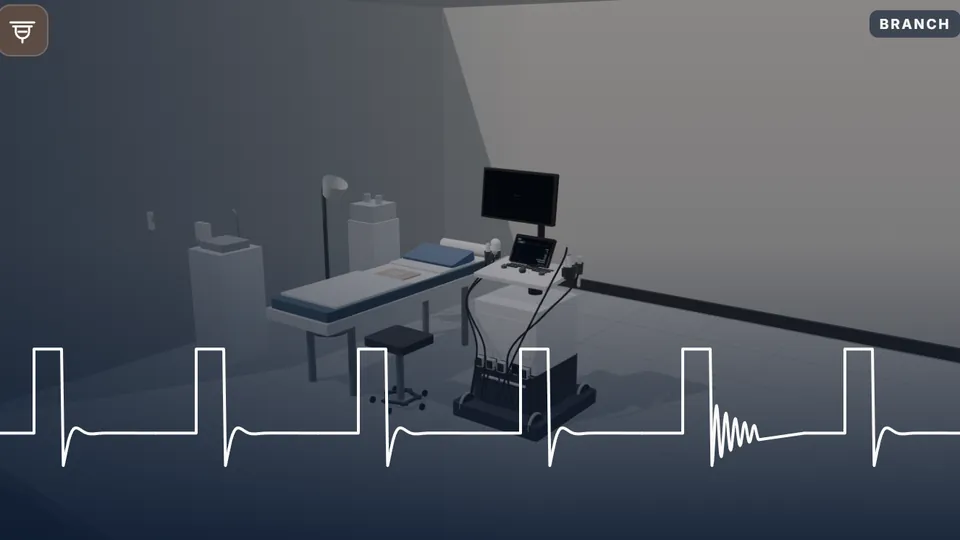
Hospital-Ready Graduate: Clinical Engineering pathway: Device Lab, ultrasound

Branch · Hospital-Ready Graduate

Clinical Engineering pathway

In six weeks a graduate who finished the core can commission theatre and decontamination equipment, verify neonatal devices, hold a supervised night and a major incident, and present the evidence for a trainee clinical engineer post.

6 weeks · about 4 hours a week
EasyMediumHard

Certificate of Completion: Hospital-Ready Graduate, Clinical Engineering pathway branch

Deep Dive · $149 · 12 monthsIncluded in every organisation licenceSee the track
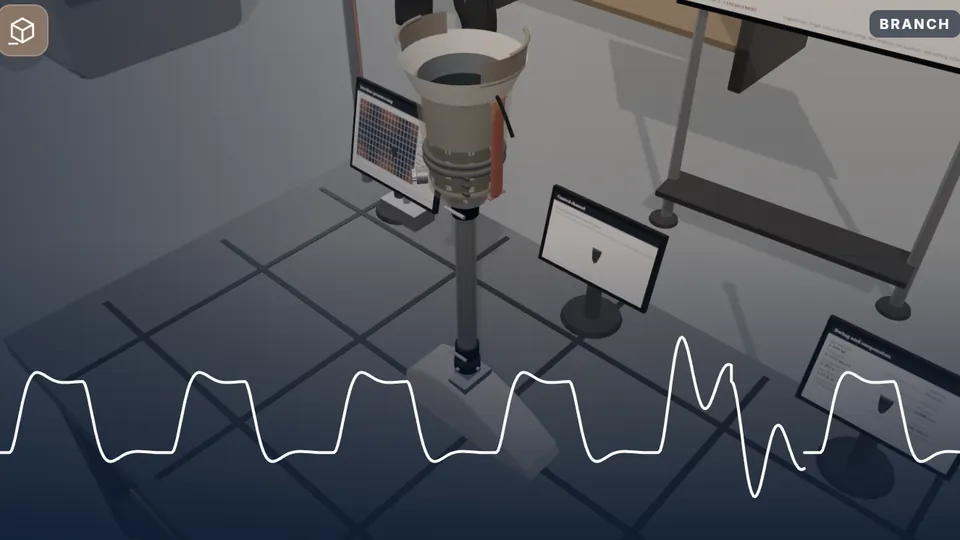
Hospital-Ready Graduate: Medtech Industry pathway: Device Lab, prosthetic limb

Branch · Hospital-Ready Graduate

Medtech Industry pathway

In six weeks a graduate who finished the core can take a clinical problem through user needs, risk, human factors and regulation to a design review, explain its value to a surgeon and a buyer, and present a traced design decision to a device company.

6 weeks · about 3.5 hours a week
EasyMediumHard

Certificate of Completion: Hospital-Ready Graduate, Medtech Industry pathway (R&D, regulatory, sales) branch

Deep Dive · $149 · 12 monthsIncluded in every organisation licenceSee the track

FAQ

Answers before you start.

Anything else, write to the team and we answer directly.

  • Yes. An organisation's licence includes every track, core and branch, with the Platform, Medical City, Essentia, the App and the dashboard. Your organisation enrols you on the track, and it appears under My track; there is nothing extra to buy.