Skip to content

Hospital-Ready GraduateClinical Engineering pathway

Branch · Second term on the rota

Hospital-Ready Graduate:Clinical Engineering pathway

A second hospital semester: commissioning, maintenance planning and your first on-call nights.

For: University BME departments and hospital graduate programmes preparing trainee clinical engineers

Before you start: The Hospital-Ready Graduate core track, or its baseline check at Medium or above

Your mentor, a character in the trackDr Amira HaddadHead of Clinical Engineering
Length
6 weeks
Time
About 4 hours a week
Levels
Easy, Medium, Hard
Certificate
Certificate of Completion
On your own
$149, 12 months
Hospital-Ready Graduate: Clinical Engineering pathway: Device Lab, ultrasound
Device Lab · ultrasound

The arc · 6 weeks · Second term on the rota

What you'll be able to do

The job, done properly.

  • Commission an anaesthesia workstation and a sterile services plant with services first
  • Investigate a reprocessing failure and a neonatal closed-loop failure
  • Hold an on-call night and a flood night with complete records
  • Present an evidence portfolio for a clinical engineering post

The story

Your second term at Medical City Hospital, now on the clinical engineering rota: theatres, sterile services, the neonatal unit, four new graduate colleagues, and your first nights alone.

Dr Amira HaddadHead of Clinical Engineering · your mentor (a character in the track)
“Inspired CO2 above zero in a circle system means CO2 the absorbent did not remove, or exhaled gas that went the wrong way. High fresh gas flow cures both, so that cure tells you nothing.”

Inside the track

What you actually use, every week.

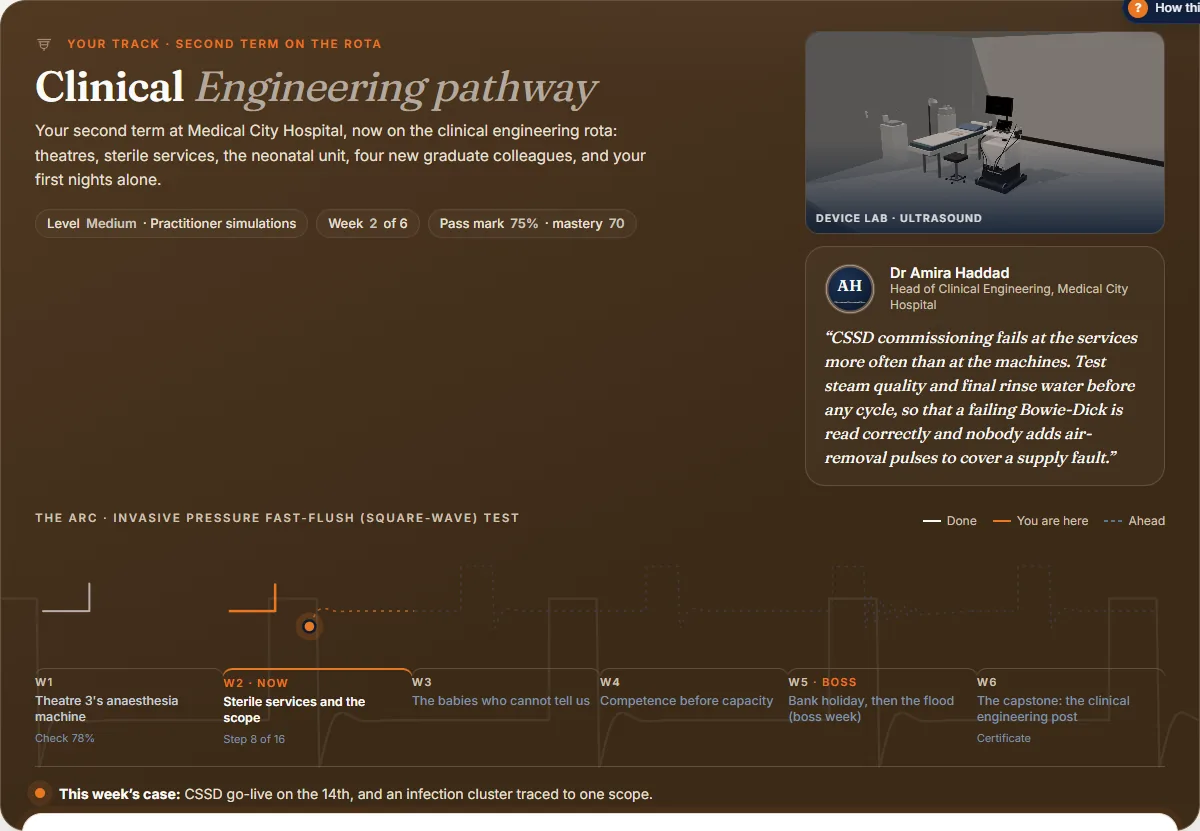
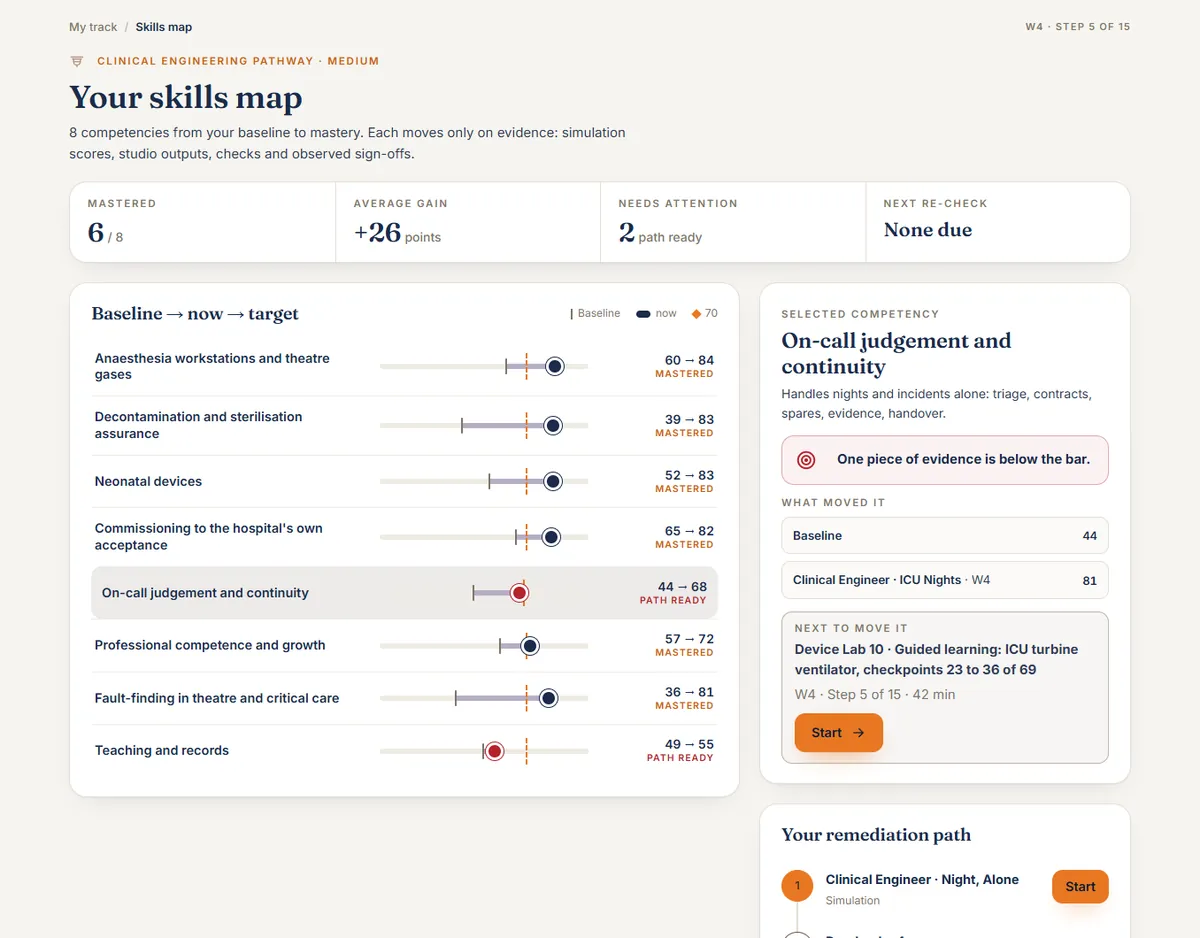
The real screens: My track, a step with your mentor, a simulation, your skills map and the certificate.

My track
My trackThe arc of 6 weeks, this week's case, your mentor and your next step, in Hospital-Ready Graduate: Clinical Engineering pathway's own colours.
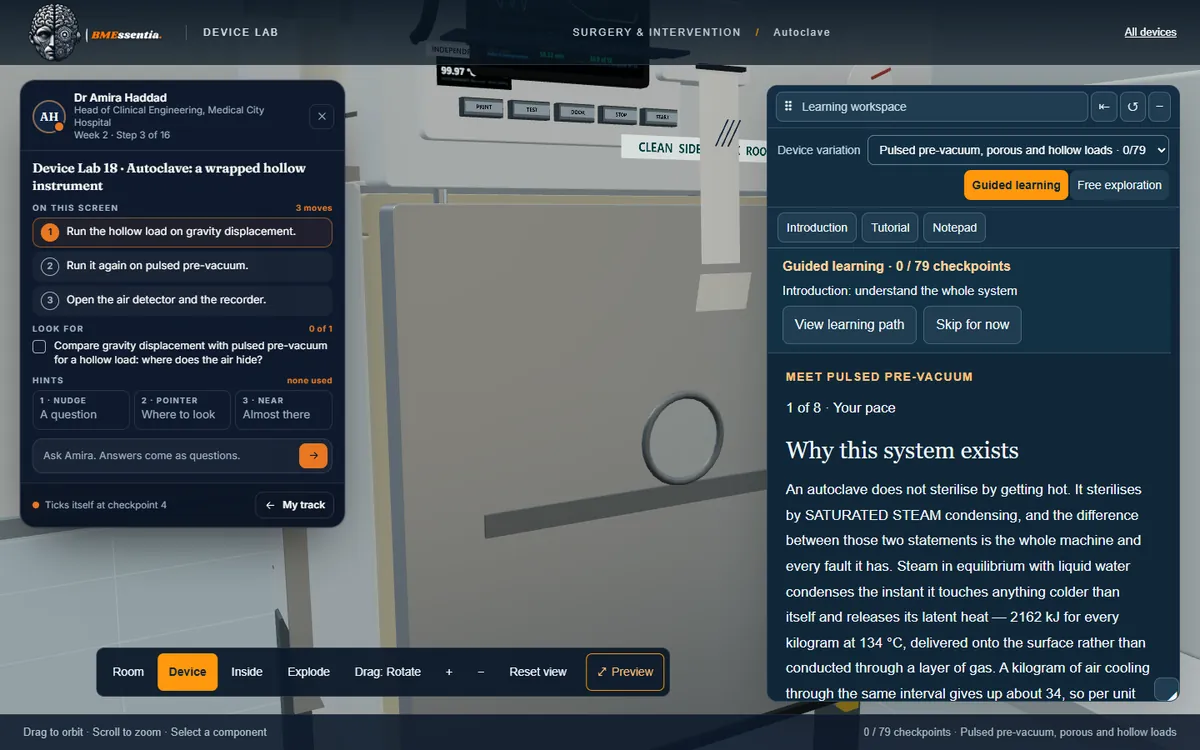
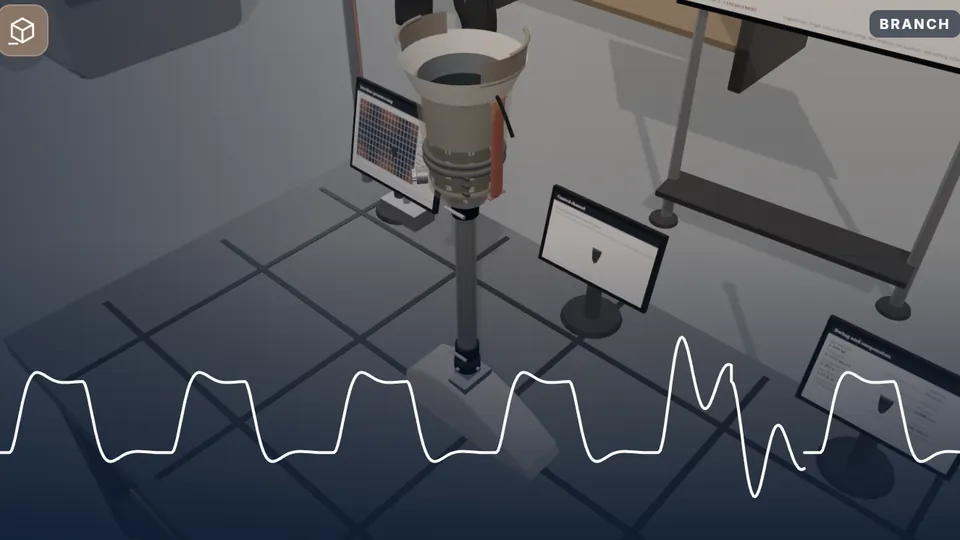
A step with your mentor in the Device Lab
A step with your mentor in the Device LabThe step names what to look at on the real device, with hints that never give the answer away.Shown: Autoclave with Dr Amira Haddad, this track's mentor
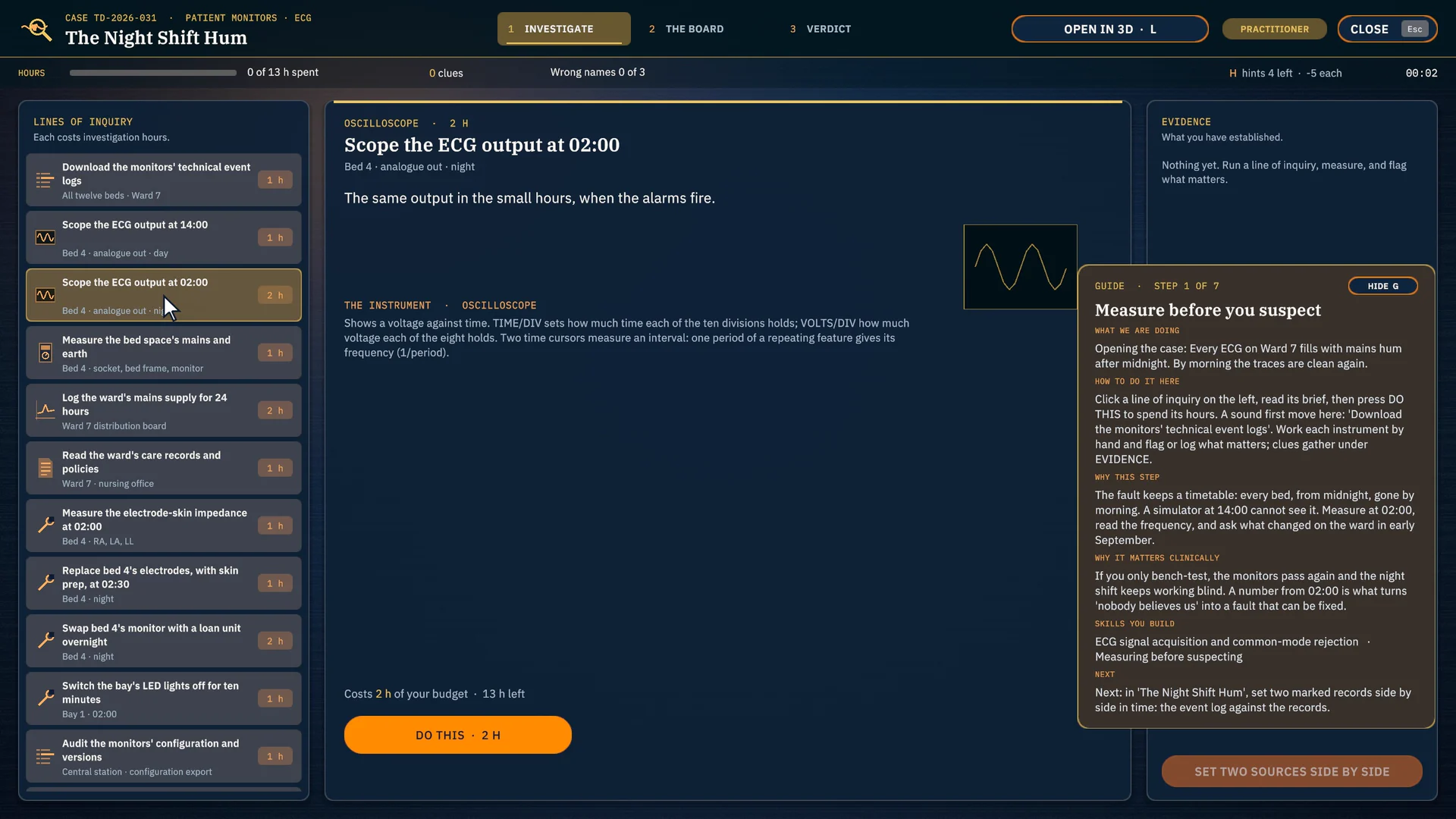
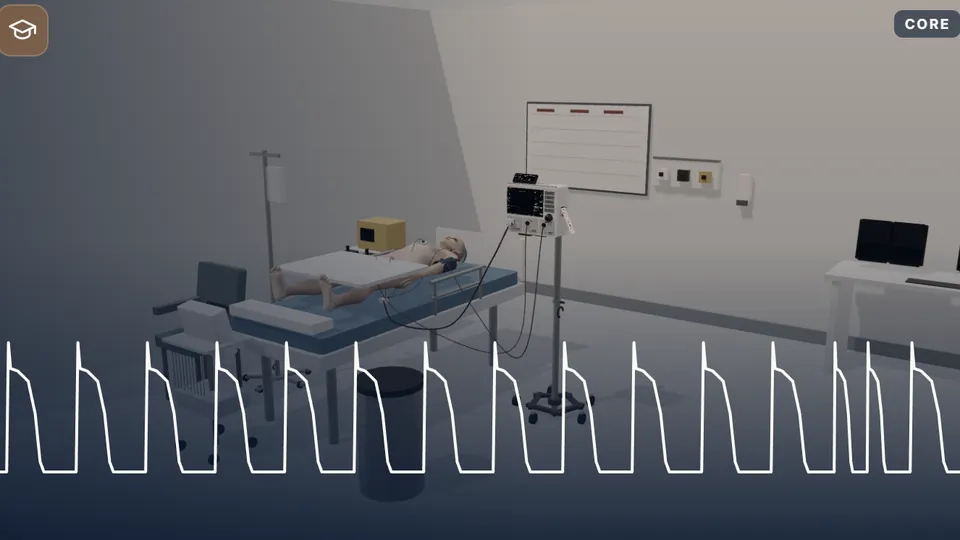
A simulation
A simulationReal hospital work in Medical City, scored and debriefed, at your level.
Your skills map
Your skills mapThis track's own competencies, from your baseline to mastery. They move only on evidence.Shown: a sample learner's progress
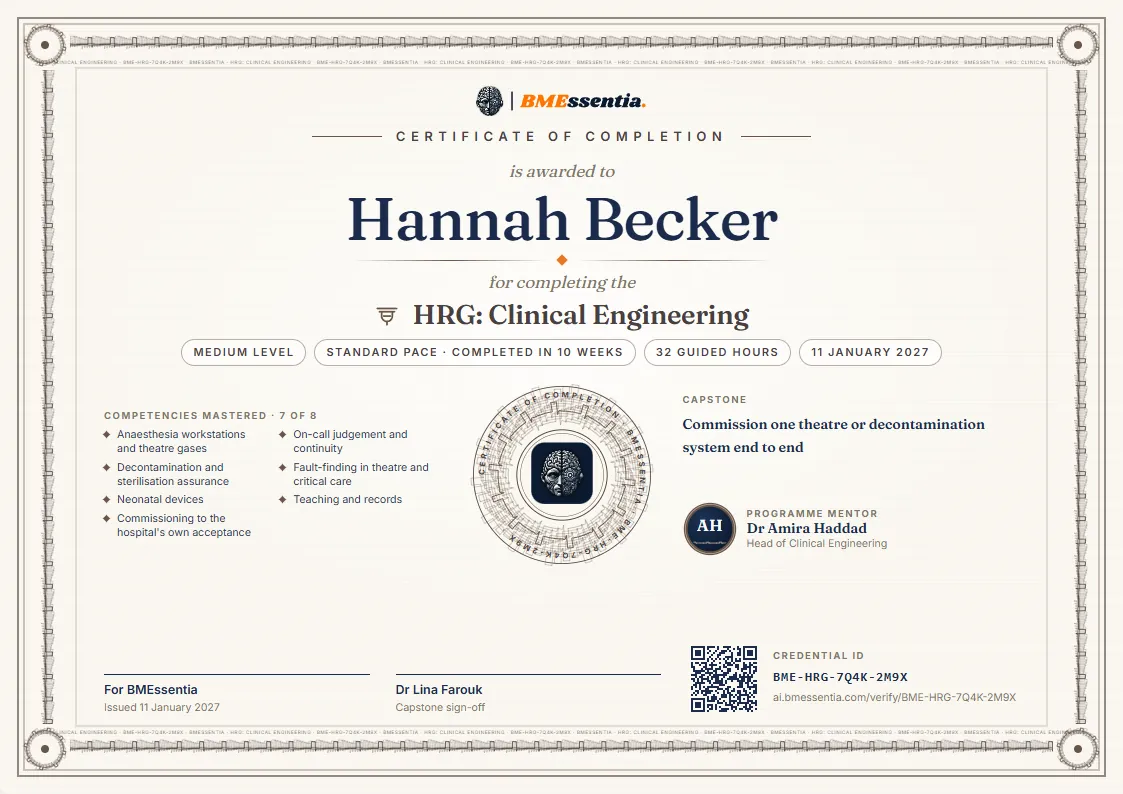
The certificate
The certificateA Certificate of Completion in the track's colours, with the work behind it.Shown: a sample for Hannah Becker, a fictional learner

The arc

6 weeks, one running case.

Each week is one working shift: learn, see inside, do, work, think, check, reflect. Open a week to see its real steps.

Your term timetable

  1. Week 1Theatre 3's anaesthesia machine
  2. Week 2Sterile services and the scope
  3. Week 3The babies who cannot tell us
  4. Week 4Competence before capacity
  5. Week 5Bank holiday, then the flood (boss week)
  6. Week 6The capstone: the clinical engineering post
  1. Week 1Theatre 3's anaesthesia machine4.9 h

    Theatre 3 opens Thursday; Theatre 4 has a machine that lets CO2 back in.

    • DoCommissioning · Theatre 3 anaesthesia machine20 min
    • See insideDevice Lab 11 · Anaesthesia Machine: what a leak test number means10 min
    • WorkAnaesthesia workstation commissioning and performance check20 min
    • LearnDevice Library · Anaesthesia Machine: Safety (the whole section)15 min
    • + 10 more steps

    You make: Anaesthesia workstation commissioning and performance check

  2. Week 2Sterile services and the scope5.1 h

    CSSD go-live on the 14th, and an infection cluster traced to one scope.

    • DoCommissioning · CSSD sterilisers and washers20 min
    • See insideDevice Lab 18 · Autoclave: a wrapped hollow instrument10 min
    • WorkSteriliser revalidation and PPM checklist15 min
    • LearnIllustration · Device Design ch2: sterilisation methods for medical devices5 min
    • + 12 more steps

    You make: Steriliser revalidation and PPM checklist

  3. Week 3The babies who cannot tell us5.2 h

    Which incubators can receive the 24-week twins tomorrow?

    • DoPreventive Maintenance · Neonatal incubators20 min
    • See insideDevice Lab 48 · Infant Incubator: a port open10 min
    • WorkNight-team teaching sheet: skin probes and overheating15 min
    • LearnDevice Library · Infant Incubator: Safety (the whole section)15 min
    • + 11 more steps

    You make: Night-team teaching sheet and the incubator release decisions

  4. Week 4Competence before capacity3.9 h

    Four graduates, one sign-off framework, and your first supervised ICU night.

    • DoOperations Manager · Four new graduates: competence before capacity20 min
    • See insideDevice Lab 10 · ICU ventilator: what a graduate must prove before signing10 min
    • WorkShift handover record15 min
    • LearnClinical Engineering ch8 · TQM and Continuous Quality Improvement (CQI)15 min
    • + 11 more steps

    You make: Shift handover record and personal sign-off plan

  5. Week 5Bank holiday, then the flood (boss week)2.2 h

    Alone on the bank holiday, then the flood night.

    • DoClinical Engineer · Bank Holiday, Alone20 min
    • See insideDevice Lab 18 · Autoclave: pulsed pre-vacuum5 min
    • WorkFlood night handover and equipment status20 min
    • LearnDevice Library · Ventilator: Safety, 'Transport'5 min
    • + 7 more steps

    You make: Flood night handover and equipment status

  6. Week 6The capstone: the clinical engineering post2.7 h

    Your interview for the post.

    • DoDevice Mastery · Neonatal Care20 min
    • WorkApplication, CV lines and first-year plan20 min
    • ThinkBMEssence · Career Architecture 13: Clinical Engineering as a Career15 min
    • CheckWarm-up: retrieval from earlier weeks (spaced)8 min
    • + 7 more steps

    You make: Capstone and application

Proof

Only evidence counts.

A step is done when there is evidence: a simulation score, a saved work document, a passed check or a signed observation. Opening a page never ticks anything.

  • Before and afterThe same baseline check on day one and in the final week, scored per competency.
  • Mastery, not attendanceEach competency has a mastery threshold. Below it, the track routes you to the named remediation items and a re-check; a week cannot be ticked complete by opening items alone.
  • The audit packYour weekly work documents and capstones, ready for a supervisor, an employer or an inspector.

The certificate

BMEssentia Certificate of Completion: Hospital-Ready Graduate, Clinical Engineering pathway branch

It names the track and the level you completed. Your portfolio holds the work behind it.

  • All 6 weeks' required items done at the learner's level
  • At least 7 of 8 competencies mastered
  • Final check at or above the level's pass mark
  • Capstone at 3 or above on every criterion, signed off by the manager or professor (institutions) or AI-assisted rubric review (individuals)

Commission one theatre or decontamination system end to end

Commission an anaesthesia workstation or a steriliser and washer set (real, or the simulation cases with your own documents): services first, every protection proven, findings closed with re-tests, handover conditions.

Evidence it gives: A commissioning file the department can keep.

An on-call portfolio

Document three on-call situations (simulation or real, anonymised): the calls, your triage, the evidence you kept, the contract decisions, the handover, and what you would do differently.

Evidence it gives: Evidence of safe out-of-hours practice.

Trainee clinical engineer application portfolio

Your application for a trainee clinical engineer post: the core and branch artefacts mapped to the post's requirements, one case told properly, and a first-year plan, presented to a panel.

Evidence it gives: Employability evidence for the university.

Three levels

Easy, Medium or Hard.

A baseline check on day one places you, or you choose. The competencies are the same at every level; the support and the pressure change.

Easy

Baseline under 50%, or chosen · simulations at Foundation

Worked examples first; Foundation simulations with the coach; the investigation cases and the hard boss case hidden.

Medium

Baseline 50% to 74%, or chosen · simulations at Practitioner

Practitioner difficulty; the investigation cases shown.

Hard

Baseline 75% and above, or chosen · simulations at Expert

Expert difficulty, all cases, timed boss week.

Ways to get this track

On your own, with a plan, or with your organisation.

Deep Dive

This Deep Dive

$149for 12 months

  • The track's lessons, labs and Medical City scenarios
  • The certificate when you finish
  • The track mentor: 100 questions for the track, more with credit top-ups
  • Or the Hospital-Ready Graduate Full family: $399

General Essentia, the Studios and Design are not included. Subscribe within 30 days and what you paid counts toward your plan.
Premium · Pro

Included in Premium and Pro

$299a year with Premium

  • Premium: 1 active track family at a time, this one or any other
  • Pro: 3 active track families at a time, with heavy AI use
  • Or Premium at $39 a month; one-time tracks cost 25% less with Premium, 40% less with Pro

Organisation licence

Every track for every seat

  • Every track and product, and the dashboard
  • Enrol people or cohorts and follow their progress
  • Seats for a year, an academic year or a semester

More Hospital-Ready Graduate branches

The other branches.

Hospital-Ready Graduate: Device Lab 38, cardiac monitor

Biomedical engineering graduate

Hospital-Ready Graduate

Final-year students and new graduates, and the universities and colleges that teach them.

14 weeks, plus a Foundations week 0 at the easy level · about 4.5 hours a week
EasyMediumHard

Certificate of Completion: Hospital-Ready Graduate

Complete track · $299 · 12 monthsIncluded in every organisation licenceSee the track
Hospital-Ready Graduate: Medtech Industry pathway: Device Lab, prosthetic limb

Branch · Hospital-Ready Graduate

Medtech Industry pathway

In six weeks a graduate who finished the core can take a clinical problem through user needs, risk, human factors and regulation to a design review, explain its value to a surgeon and a buyer, and present a traced design decision to a device company.

6 weeks · about 3.5 hours a week
EasyMediumHard

Certificate of Completion: Hospital-Ready Graduate, Medtech Industry pathway (R&D, regulatory, sales) branch

Deep Dive · $149 · 12 monthsIncluded in every organisation licenceSee the track

FAQ

Answers before you start.

Anything else, write to the team and we answer directly.

  • Yes. An organisation's licence includes every track, core and branch, with the Platform, Medical City, Essentia, the App and the dashboard. Your organisation enrols you on the track, and it appears under My track; there is nothing extra to buy.