Medical City · Simulation 06 of 12
Installation and Commissioning
Accept new equipment: packages, checks and handover.
What you do
Installation & Commissioning
New equipment has to be proved safe before it touches a patient. In this simulation you take a delivery from the loading bay to clinical use: check it against the order, prove the room, test it with real instruments, then register, train and make the go-live call.
Most commissioning failures are not exotic: a wrong gas connector, a short shipment, an untested alarm route, an untrained night shift. Each one reaches a patient if the engineer signs past it. Your signature is the last check.
45 challenges, each at Foundation, Practitioner and Expert level.
How it works
Step by step.
Receive the consignment
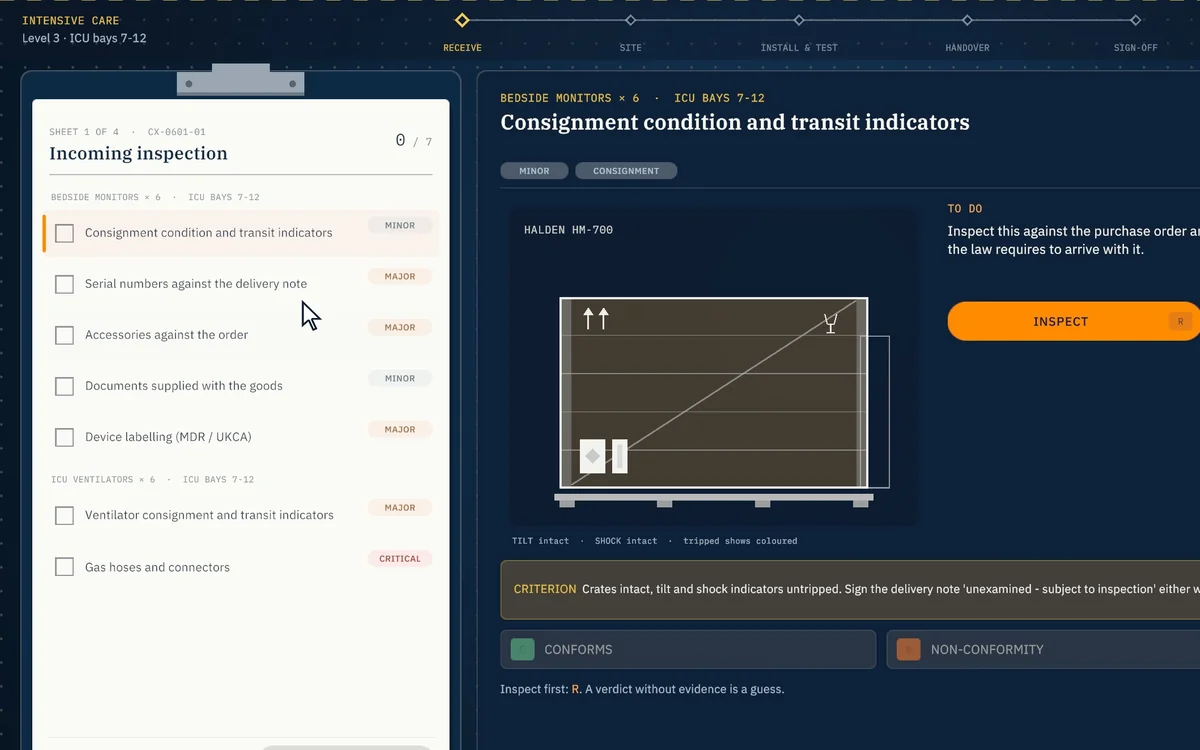
Sheet 1 of 4: at goods-in, check each package against its purchase order - model, quantity, serials, accessories, labels, transit indicators and documents. The delivery note is the vendor's claim; the rating plate and the serial number are the facts.
Prove the site
Sheet 2 of 4: before installation, verify the room - electrical supply, medical gases, water, network, environment, floor and shielding. Infrastructure first, then equipment: a room that is not fit stops everything.
Install and test
Sheet 3 of 4: the equipment is installed; now prove it - electrical safety to IEC 62353, performance, alarms and integration. The instrument gives numbers, not verdicts: you decide against the limit.
Hand over to clinical use
Sheet 4 of 4: register every unit with its risk class and planned maintenance, check training records and user acceptance. Schedule PM from acceptance, at the manufacturer's interval unless the risk says otherwise.
The call: go live, go live in part, or hold
Decide what is safe for patients on the record you made: release everything, release what passed, or hold. Decide on what you recorded, not on what you hope.
Clinical sign-off
The Patient Safety Officer reviews your record and signs the handover or refuses. A signature is a safety claim: only sign what the record supports.
Debrief
Your score, each sheet's percentage, the defects you found and what happened to patients because of anything missed. Infrastructure, then equipment, then integration, then clinical validation - every time.
What it trains
Skills and competencies.
- Inspect deliveries against the purchase order and the law
- Prove a room's power, gases, water, network and shielding
- Run and interpret acceptance and electrical safety tests
- Make and defend a go-live decision
In the BMEssentia competency framework, this simulation builds 15 competencies across Patient & Electrical Safety, Maintenance & Performance Testing, Device Technology & Fault Finding, Clinical Environment & Infrastructure, Procurement & Technology Lifecycle, Regulation, Design & Quality.
- Patient & Electrical Safety
Electrical safety testing
Test medical electrical equipment to IEC 62353 (earth bond, insulation, leakage) and act correctly on borderline and failed results.
- Patient & Electrical Safety
Alarm safety and configuration
Understand alarm priorities, limits, latency and alarm fatigue, and verify that alarms reach the people who must act on them.
- Patient & Electrical Safety
MRI, radiation and laser safety
Work safely in MRI zones, ionising radiation and nuclear medicine areas and laser rooms, following IRR17, IR(ME)R and local rules.
- Patient & Electrical Safety
Decontamination and infection prevention
Make devices safe to handle and reuse: cleaning, disinfection, sterilisation, reprocessing validation and clean to dirty flow.
- Maintenance & Performance Testing
Performance verification and calibration
Prove a device does what its specification says using analysers and simulators, and judge results against tolerance.
- Device Technology & Fault Finding
Device integration and interoperability
Connect devices to central stations, EPR and PACS safely using HL7, DICOM and IEC 80001-1, and validate the data end to end.
- Device Technology & Fault Finding
Medical device cybersecurity
Assess and reduce cyber risk in networked devices: inventory, segmentation, patching, SBOM and incident response.
- Clinical Environment & Infrastructure
Medical electrical installations
Specify and check medical locations, IT systems, earthing, UPS and backup power to IEC 60364-7-710 and HTM 06-01.
- Clinical Environment & Infrastructure
Medical gas systems
Understand medical gas pipelines, outlets, alarms, AGSS and isolation, and keep devices safe during gas work (HTM 02-01).
- Clinical Environment & Infrastructure
Specialised ventilation and room environment
Specify and verify theatre, isolation and clean room ventilation, pressure regimes and temperature to HTM 03-01.
- Procurement & Technology Lifecycle
Commissioning and acceptance testing
Inspect deliveries, check site readiness, test and accept equipment so only safe, complete systems go live.
- Procurement & Technology Lifecycle
Asset management and replacement
Keep an accurate asset register and plan replacement, obsolescence and safe decommissioning over the whole life.
- Regulation, Design & Quality
Medical device regulation
Know how devices reach and stay on the market: classification, UK MDR, EU MDR, FDA pathways, CE and UKCA marking.
- Regulation, Design & Quality
Quality systems and audit
Run document control, internal audit, CAPA and accreditation so the department can prove its work is controlled.
- Regulation, Design & Quality
Equipment governance
Apply rules for loans, off-label use, modifications, in-house devices, trials and third-party access to equipment.
The takeaways
- The delivery note is a claim; the rating plate is the fact.
- A room that is not fit stops everything.
- Numbers, not verdicts: you judge against the limit.
- Training is a go-live criterion.
The challenges
45 training cases.
- 01 New ICU bed spaces
Six bed spaces: monitors, ventilators and the central station
- 02 Theatre 3 anaesthesia machine
The most interlocked device in the hospital, from crate to first list
- 03 Dialysis unit go-live
Water treatment plant and twelve haemodialysis machines
- 04 CT room acceptance
A new 128-slice scanner: radiation survey, QA phantom, the room around it
- 05 MRI handover
A 3 T magnet: helium, shim, RF shielding, safety zones and what goes near it
- 06 Defibrillator fleet roll-out
Every resuscitation trolley, the public AEDs and the theatres - swapped in one week
- 07 Infusion pump fleet swap
240 smart pumps and the drug library that makes them smart
- 08 Hybrid theatre robot
Fourteen crates, a surgical robot, a C-arm and a theatre that has to make them work together
- 09 Neonatal unit incubators
Twelve incubators, phototherapy and the monitors that watch the smallest patients
- 10 Vendor says it's ready - is it?
Theatre 1 comes with a signed vendor certificate.
- 11 Cardiac catheter lab go-live
A new single-plane cath lab: radiation, protection, injector, haemodynamics, the room
- 12 ED resus monitoring
Six resus bays, a central station and alarms routed to the nurses' pagers
- 13 Transport ventilator fleet
Six ventilators for ICU and ED transfers: oxygen, batteries, mounts and the journey
- 14 CSSD sterilisers and washers
Two porous-load sterilisers, three washer-disinfectors and the water and steam behind them
- 15 Endoscopy decontamination unit
Three AERs, drying cabinets, final rinse water and scope-to-patient traceability
- 16 Ultrasound fleet replacement
Eight scanners and their probes across radiology, maternity and cardiology
- 17 Digital radiography room
An old CR room rebuilt as DR: new generator, wireless detectors, the same four walls
- 18 PET-CT suite and hot lab
A new PET-CT, its uptake rooms and a radiopharmacy hot lab - all opening on the same day
- 19 Refurbished SPECT-CT camera
A manufacturer-refurbished SPECT-CT goes into a room that only ever held a gamma camera
- 20 Labour ward CTG and surveillance
Twelve new CTG monitors, wireless transducers and a central station that watches every room
- 21 Point-of-care blood gas network
Four blood gas analysers outside the laboratory, one middleware, and results that go straight to the record
- 22 Community syringe drivers
Forty ambulatory syringe drivers for palliative care at home, where no engineer will ever be in the room
- 23 ECMO service launch
Consoles, heater-coolers, circuits and a transport kit for a new adult ECMO service
- 24 Intra-aortic balloon pumps
Two balloon pumps for the CCU and the cath lab, with helium, triggering and a transport kit
- 25 Heart-lung machines
Two new perfusion consoles for the cardiac theatres, and a heater-cooler nobody wants inside
- 26 Electrophysiology lab
A new EP lab: catheters inside the heart, and a room whose earthing nobody has measured
- 27 Ophthalmic laser suite
A Class 4 retinal laser and a YAG in a converted clinic room, with a clinic booked for Monday
- 28 Eye theatre: phaco platform
A new cataract theatre opens with an ex-demonstration phaco/vitrectomy platform bought at a discount
- 29 Lithotripsy suite
A new shockwave lithotripter with built-in fluoroscopy, in the room the old ultrasound-only one used
- 30 Neurosurgical theatre and IONM
Theatre 7 re-equipped for spine and cranial work: monitoring, drills, navigation, microscope
- 31 Video-EEG telemetry unit
Four epilepsy monitoring beds where seizures are provoked on purpose, and someone must always see them
- 32 Home peritoneal dialysis cyclers
Six APD cyclers going into patients' homes - the home is the room you commission
- 33 Insulin pump and CGM starts
Twelve patients start closed-loop pumps in one month - the devices leave with them
- 34 Postnatal ward phototherapy
LED phototherapy moves from the neonatal unit to the mother's bedside
- 35 Day-surgery anaesthesia
Four new workstations for a day unit built inside the old outpatients block
- 36 New ward bedhead services
Twenty-eight bedheads: gases, suction, power and nurse call before the first patient
- 37 Outpatient benchtop sterilisers
Three benchtop autoclaves for clinics that still reprocess their own instruments
- 38 Lung function laboratory
Spirometers, a body box and gas transfer - the numbers that decide diagnoses
- 39 Audiology booth and audiometers
A new sound booth, a clinical audiometer and a tympanometer, calibrated before clinic
- 40 Neonatal transport system
Incubator, ventilator and monitor on one crash-tested trolley, and the ambulance it rides
- 41 Donated equipment consignment
A container of donated devices from overseas: generous, unlabelled and built for 110 V
- 42 Refurbished C-arm and ultrasound
A second-hand mobile C-arm and ultrasound at half price: what came with them, what did not
- 43 Monitoring network upgrade
A major software release for 120 bedside monitors and the central stations, in one night
- 44 Physiotherapy electrotherapy
Therapeutic ultrasound, interferential, loan TENS and a shortwave diathermy unit
- 45 Centrifuges and blood fridges
Centrifuges and blood bank refrigerators for the new laboratory floor, before the move