المدينة الطبية · مختبر الأجهزة · الجهاز 61 من 69
منظار الأذن
Otoscope
منظار الأذن في مختبر الأجهزة في المدينة الطبية من BMEssentia. افتحه بتقنية ثلاثية الأبعاد تفاعلية، وفكّكه قطعةً قطعة، وتعرّف إلى طريقة عمله، ثم تعلّمه على منصة BMEssentia واسأل إسنشيا عنه.
محتوى مختبر الأجهزة في هذه الصفحة باللغة الإنجليزية، كما هو داخل المدينة الطبية.
- عدد الأجزاء: 10
- عدد التكوينات في مختبر الأجهزة: 2
- يُعرف أيضًا باسم: Auriscope
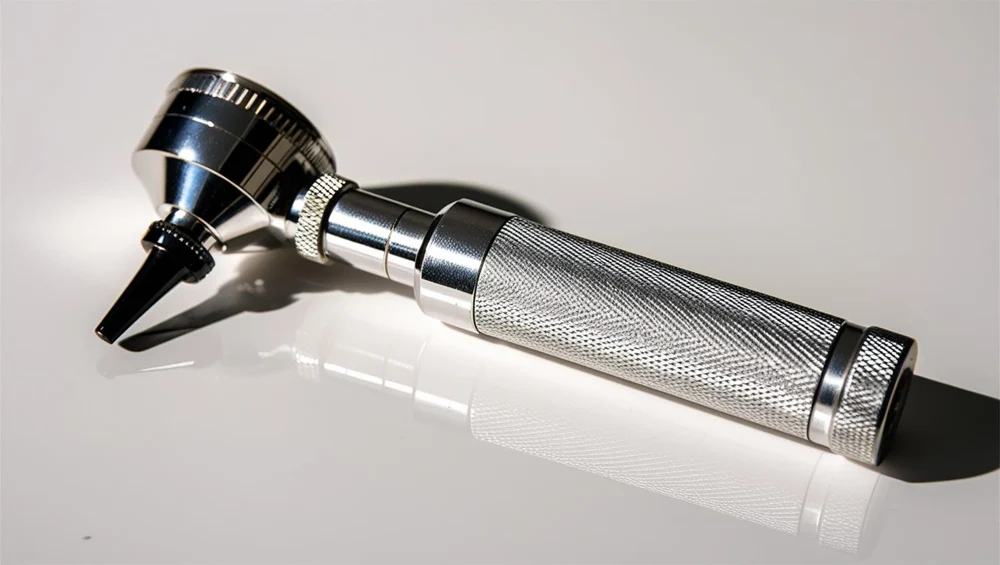
مختبر الأجهزة
Otoscope
A closed head. Glass is sealed into the viewing aperture, an O-ring seals the speculum to its mount, and a port takes a rubber bulb. Squeezing the bulb steps the pressure in a volume made of speculum, canal and instrument, and the membrane answers by moving.
التكوينات
نسخ الجهاز في مختبر الأجهزة.
Sealed pneumatic diagnostic head with insufflation bulb
A closed head. Glass is sealed into the viewing aperture, an O-ring seals the speculum to its mount, and a port takes a rubber bulb. Squeezing the bulb steps the pressure in a volume made of speculum, canal and instrument, and the membrane answers by moving.
Open operating head with swing-aside magnifier
The same handle and the same illumination, with the glass swung aside so an instrument can pass down the speculum under direct view. There is no sealed volume, no port and no bulb.
الأجزاء
قطعةً قطعة.
Rechargeable handle and cell
The handle is a battery and a mechanical datum pretending to be a grip. 5 millimetres across, and the whole 237 millimetre length of the instrument is stacked on top of it: 16 millimetres of end cap, 130 of handle, 14 of collar, 55 of head and 22 of speculum.
Rheostat collar and lamp current control
A knurled ring around the top of the handle that sets the current reaching the emitter. Forty ribs, a single index mark, and a sweep of about 300 degrees between its ends.
LED emitter and collimating optic
A single emitting die, one millimetre square, behind a small collimating optic in a brushed can at the base of the head. Everything the instrument will ever show is limited by what leaves this square millimetre, and the limit is not a brightness, it is a geometry.
Illumination fibre bundle
Nine strands of illumination-grade fibre running 48 millimetres from the emitter can to the ring at the end of the head, gathered in a ferrule and splayed around the observation path. The bundle is how the light gets past the eye without going through it.
Annular illumination exit ring
The open ring at the distal end of the head where the illumination leaves. Outer diameter equal to the speculum bore, inner diameter three quarters of it, and a black shroud behind so that nothing scatters straight back up the observation path.
Diagnostic head shell
5 at its top. It is the part somebody recognises an otoscope by, and on the sealed configuration it is also a wall of the volume being pressurised.
Sealed viewing lens and retaining ring
A flat disc of glass 22 millimetres across, held by a chromed retaining ring against a rubber gasket. On this configuration it is not an optic in any interesting sense.
Coaxial observation stop
75. Two and a half tenths of a millimetre separate the two, and that gap is the entire glare strategy of the sealed head.
Speculum bayonet mount and seating taper
The bayonet at the far end of the head where the tip goes on. 5 millimetres across, and a quarter turn.
Head-to-speculum O-ring
3 millimetre section, sitting in a groove at the base of the speculum mount. It is the smallest component in the sealed configuration and it is the boundary between the instrument's volume and the atmosphere at the joint the user makes and unmakes every single time.
ملاحظات الطُّرز