Medical City · Simulation 02 of 12
Room Builder
Fit out a clinical room to the standards: clearances, power, gases, hand hygiene.
What you do
Room Builder: plan, equip and validate a clinical room
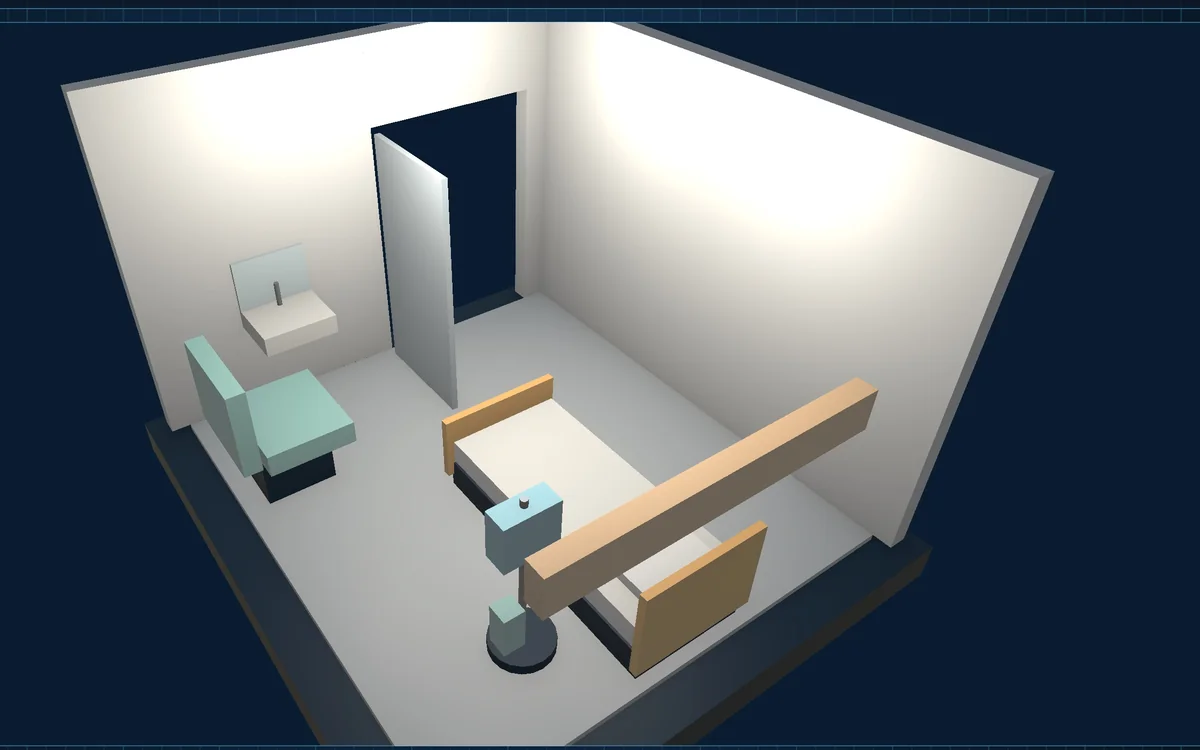
You take a client's brief for a real clinical room, fill a scaled plan from a catalogue of real equipment and services, and defend it against the checks an estates engineer, an infection-control nurse and a safety adviser would make.
Rooms outlive the equipment in them by decades. A door too narrow for a bed, a ventilator on an ordinary socket or a basin splashing the patient is built in for twenty years. Catching it on the plan costs nothing; on site it costs weeks and money; in use it can cost a life.
41 challenges, each at Foundation, Practitioner and Expert level.
How it works
Step by step.
Place the brief's equipment
Bring in every item the client's brief lists - the patient's bed or chair and the devices that treat and monitor them. Start from the brief, not from the catalogue: every item must answer a line of it.
Power, gases and data
Give every device what it needs: sockets and power, IT-isolated sockets and a UPS in group 2 rooms, oxygen, air and suction outlets, data and nurse call. Count the plugs and the outlets before you count the money.
Arrange clearances, access and hygiene
Lay the room out: working space round each patient, the head end open where airways are managed, a door the bed passes, a basin by the door and rub at the point of care. Space is a clinical requirement, not a nicety.
Validate against the standards
Run the checks and fix every one that blocks sign-off, then the ones that cost points. Fix the cause each check names, not just the symptom.
Walk through the room
See the room as the staff will: sight lines from the door, routes round the bed, what hangs over the patient. Stand where the nurse stands before you sign.
Debrief and expert review
Read your score and stars, what was good, and what an expert would change. Every expert note is a rule you can reuse in the next room.
What it trains
Skills and competencies.
- Reading a clinical brief as a list of requirements
- Sizing power, gas and data services for a room
- Laying out clearances, access and hand hygiene
- Defending a design against the standards
In the BMEssentia competency framework, this simulation builds 8 competencies across Patient & Electrical Safety, Clinical Environment & Infrastructure, Procurement & Technology Lifecycle.
- Patient & Electrical Safety
MRI, radiation and laser safety
Work safely in MRI zones, ionising radiation and nuclear medicine areas and laser rooms, following IRR17, IR(ME)R and local rules.
- Patient & Electrical Safety
Decontamination and infection prevention
Make devices safe to handle and reuse: cleaning, disinfection, sterilisation, reprocessing validation and clean to dirty flow.
- Clinical Environment & Infrastructure
Clinical space planning
Plan rooms, adjacencies and journeys so staff, patients and equipment flow safely, using HBN and FGI guidance.
- Clinical Environment & Infrastructure
Medical electrical installations
Specify and check medical locations, IT systems, earthing, UPS and backup power to IEC 60364-7-710 and HTM 06-01.
- Clinical Environment & Infrastructure
Medical gas systems
Understand medical gas pipelines, outlets, alarms, AGSS and isolation, and keep devices safe during gas work (HTM 02-01).
- Clinical Environment & Infrastructure
Specialised ventilation and room environment
Specify and verify theatre, isolation and clean room ventilation, pressure regimes and temperature to HTM 03-01.
- Procurement & Technology Lifecycle
Clinical needs and specification
Turn clinical needs into a clear, testable specification with mandatory and scored requirements.
- Procurement & Technology Lifecycle
Capital projects and budgets
Set budgets with contingency, manage programme and scope change, and report cost honestly on capital projects.
The takeaways
- The brief is the specification: every item answers a line of it.
- Services decide whether the devices can work safely.
- Clearances, doors and hand hygiene are clinical requirements.
The challenges
41 training cases.
- 01 Acute Ward Single RoomFoundation
We are converting an old office into a single room for an acute medical patient - someone who might deteriorate overnight.
- 02 Emergency Majors CubicleFoundation
Majors sees chest pain, sepsis and falls all night.
- 03 Pulmonary Function LaboratoryFoundation
Full lung function: spirometry, gas transfer and body plethysmography, plus bronchial challenge tests that can provoke real bronchospasm.
- 04 Haemodialysis BayFoundation
Two new haemodialysis stations for our evening session.
- 05 Paediatric Ward CubicleFoundation
A cubicle for a child with bronchiolitis or a line infection - and a parent who will not leave their side, so they need somewhere to sleep.
- 06 Chemotherapy Day Unit BayFoundation
Three treatment chairs for day-case chemotherapy.
- 07 Dental SurgeryFoundation
A dental surgery for adult patients.
- 08 Sleep Laboratory BedroomFoundation
An overnight polysomnography bedroom.
- 09 Post-Anaesthesia Recovery BayIntermediate
Two recovery spaces next to theatres.
- 10 Airborne Isolation RoomIntermediate
A negative-pressure room for open tuberculosis and measles.
- 11 ECT Treatment RoomIntermediate
Electroconvulsive therapy under brief general anaesthesia, three mornings a week.
- 12 Cardiac Stress Testing RoomIntermediate
Exercise tolerance tests on a treadmill, eight a day.
- 13 Apheresis BayIntermediate
Two apheresis stations for stem-cell collections and plasma exchange.
- 14 ICU Bed SpaceIntermediate
A single ICU room for a ventilated patient.
- 15 Transplant Protective Isolation RoomIntermediate
After conditioning, my transplant patients have no neutrophils for weeks.
- 16 Labour and Birth RoomIntermediate
A birth room where a woman labours for hours and her baby might need resuscitating in the first minute.
- 17 Endoscope Decontamination RoomIntermediate
Every scope from the procedure rooms comes here.
- 18 Bariatric Ward RoomIntermediate
A room for patients up to 300 kg.
- 19 Neonatal Intensive Care RoomIntermediate
Two intensive care cots in one room with a lovely big window - which is exactly my worry.
- 20 Endoscopy Procedure RoomIntermediate
Gastroscopy and colonoscopy under sedation, twenty patients a list.
- 21 Coronary Care Unit RoomIntermediate
A coronary care room for a patient in cardiogenic shock after a heart attack: intra-aortic balloon pump, inotropes on syringe drivers, continuous monitoring.
- 22 Breast Imaging RoomIntermediate
A digital tomosynthesis room for screening and symptomatic patients.
- 23 General Operating TheatreAdvanced
A general surgical theatre for laparoscopic and open cases.
- 24 Nuclear Medicine Gamma Camera RoomAdvanced
A dual-head SPECT camera for bone scans and myocardial perfusion.
- 25 General Radiography RoomAdvanced
A general X-ray room for chest, skeletal and trolley work - ninety patients a day.
- 26 Emergency Resuscitation BayAdvanced
A resuscitation bay for cardiac arrests and major trauma.
- 27 CT Scanner RoomAdvanced
A new CT room for the emergency department.
- 28 ERCP Fluoroscopy SuiteAdvanced
ERCP for gallstones in the bile duct and malignant strictures - an endoscope and fluoroscopy at the same time, on a patient lying prone under anaesthetic.
- 29 ECMO Intensive Care RoomAdvanced
A room for patients on veno-venous ECMO: the circuit is their lungs.
- 30 Obstetric TheatreAdvanced
Category 1 caesarean sections - decision to delivery in thirty minutes, sometimes less.
- 31 Ophthalmic TheatreAdvanced
Cataract and retinal surgery.
- 32 Cardiac Catheterisation LabAdvanced
A cath lab for primary PCI around the clock.
- 33 Burns Intensive Care RoomAdvanced
A patient with 50% burns has lost the skin that keeps heat in and bacteria out.
- 34 Orthopaedic Laminar-Flow TheatreAdvanced
Hip and knee replacements, where one bacterium on an implant means a revision a year later.
- 35 MRI Suite: Magnet RoomExpert
We are installing a magnet that is never switched off.
- 36 Radiotherapy Linac BunkerExpert
A new linear accelerator for 10 MV treatments.
- 37 Robotic Surgery TheatreExpert
Robotic prostatectomy and colorectal work.
- 38 Cardiac Electrophysiology LabExpert
Ablation for atrial fibrillation and ventricular tachycardia.
- 39 Hybrid Operating TheatreExpert
Valve implants through a catheter, with the chest open if it goes wrong - in one room.
- 40 3 T Research MRI with AnaesthesiaExpert
A 3 T research magnet - and our protocols include ventilated ICU patients and anaesthetised children.
- 41 Cardiac Surgery TheatreExpert
Coronary bypass and valve surgery on cardiopulmonary bypass.