Medical City · Simulation 03 of 12
Clinical Engineer Campaign
Run a shift: triage the calls, loans and spares, fix what matters first.
What you do
The on-call shift
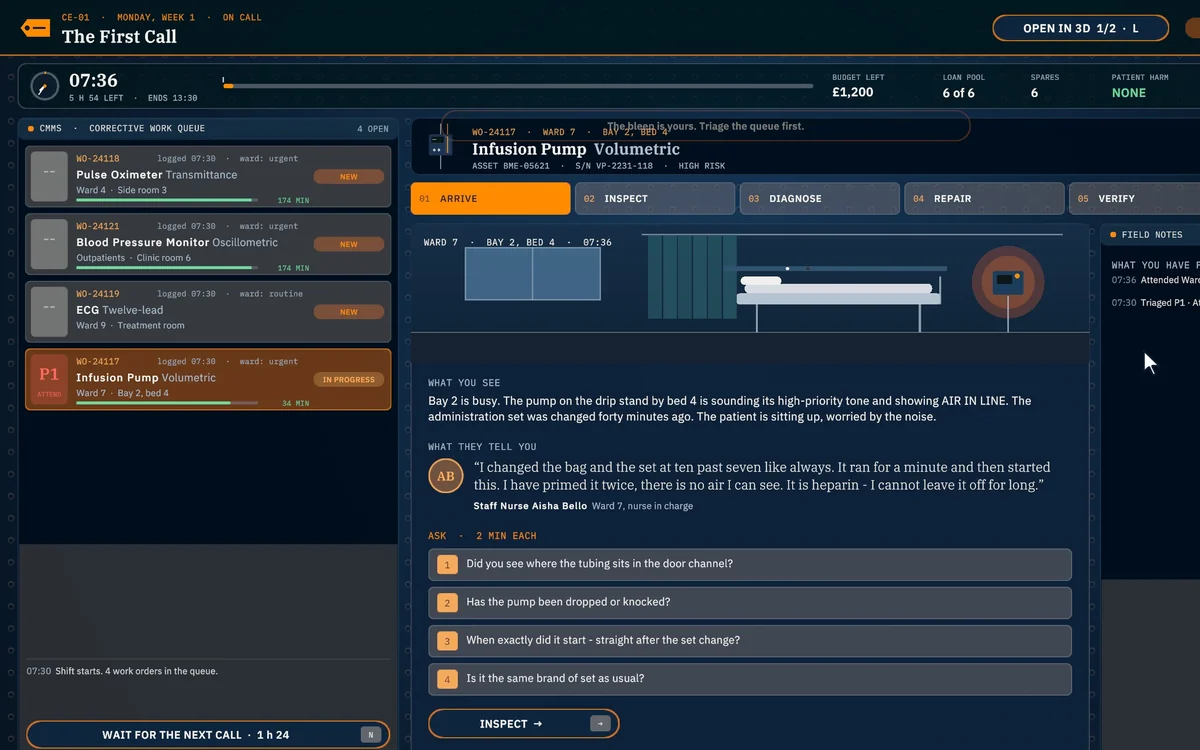
This challenge is a corrective-maintenance shift as the on-call clinical engineer. Every call is a patient before it is a device: you rank the queue by risk, cover patients first, then work each fault properly from the bedside to the bench to the record.
Most breakdown calls are use, accessories or the room, not the device. Getting the order right protects patients; finding the real cause stops the same call coming back; and a record that stands is what lets the next engineer, the hospital and the regulator act on what you found.
Your role: the on-call clinical engineer.
40 challenges, each at Foundation, Practitioner and Expert level.
How it works
Step by step.
Triage the queue by patient risk
Ranking every call by what happens to the patient if nobody comes, not by how loudly it was logged. The ward's label is a feeling; patient risk is a fact you establish.
Phone first
Calling the ward to ask and to instruct before walking anywhere. Ask the question that splits the problem in two.
Answer the emergency
An emergency call interrupts whatever you were doing: a patient needs cover now. The loan is the treatment; the diagnosis can wait.
Arrive and ask
Reading the scene and taking a history at the bedside before touching the device. Start with what changed just before it started.
Inspect safely
Decontaminating before hands-on work, tagging faulty or unproven devices, and running the checks. Clean before you touch; tag before you leave it.
Diagnose from evidence
Choosing the cause on the fault tree: use, accessory, device or environment. Diagnose from evidence, not from the first idea.
Repair within your means
Choosing the repair, within the shift's time, spares, budget and vendor contracts. No part on the shelf: hold it, order it, cover the patient.
Verify on the bench
Proving it safe with IEC 62353 and proving it works against its specification. Know the class and applied part before judging the number.
Close the record
Outcome, fault code, incident reporting and the return note. If you touched it, document it.
Hand over
Ending the shift: open work orders pass to the next engineer as they stand. Close the urgent calls first; hand over the rest clearly.
Debrief
Reading the score and every call set against the expert's path. Compare your path with the expert's, call by call.
What it trains
Skills and competencies.
- Triage a work-order queue by patient risk
- Find the cause: use, accessory, device or environment
- Make devices safe: decontamination, quarantine, IEC 62353
- Write records and incident reports that stand
In the BMEssentia competency framework, this simulation builds 23 competencies across Patient & Electrical Safety, Maintenance & Performance Testing, Device Technology & Fault Finding, Procurement & Technology Lifecycle, Regulation, Design & Quality, Incident Investigation & Learning, Leadership & Professional Practice.
- Patient & Electrical Safety
Electrical safety testing
Test medical electrical equipment to IEC 62353 (earth bond, insulation, leakage) and act correctly on borderline and failed results.
- Patient & Electrical Safety
Alarm safety and configuration
Understand alarm priorities, limits, latency and alarm fatigue, and verify that alarms reach the people who must act on them.
- Patient & Electrical Safety
MRI, radiation and laser safety
Work safely in MRI zones, ionising radiation and nuclear medicine areas and laser rooms, following IRR17, IR(ME)R and local rules.
- Patient & Electrical Safety
Decontamination and infection prevention
Make devices safe to handle and reuse: cleaning, disinfection, sterilisation, reprocessing validation and clean to dirty flow.
- Patient & Electrical Safety
Electromagnetic compatibility
Recognise, measure and control electromagnetic interference between devices, building services and radio sources (IEC 60601-1-2).
- Maintenance & Performance Testing
Risk-based maintenance planning
Set planned preventive maintenance intervals and priorities by device risk, failure history and manufacturer advice.
- Maintenance & Performance Testing
Performance verification and calibration
Prove a device does what its specification says using analysers and simulators, and judge results against tolerance.
- Maintenance & Performance Testing
Service records and documentation
Keep complete, honest and timely CMMS records, job sheets and device tags so every action can be traced and trusted.
- Device Technology & Fault Finding
Device operating principles
Explain how a device turns physics and physiology into a clinical number or therapy, and where its limits come from.
- Device Technology & Fault Finding
Systematic fault diagnosis
Separate device faults from user, accessory, consumable and environmental causes, then test one hypothesis at a time.
- Device Technology & Fault Finding
Device integration and interoperability
Connect devices to central stations, EPR and PACS safely using HL7, DICOM and IEC 80001-1, and validate the data end to end.
- Procurement & Technology Lifecycle
Vendor and service contracts
Manage warranties, service contracts, uptime terms and supplier performance, and enforce them with evidence.
- Procurement & Technology Lifecycle
Commissioning and acceptance testing
Inspect deliveries, check site readiness, test and accept equipment so only safe, complete systems go live.
- Procurement & Technology Lifecycle
Asset management and replacement
Keep an accurate asset register and plan replacement, obsolescence and safe decommissioning over the whole life.
- Regulation, Design & Quality
Usability and human factors
Design and assess devices, training and workflows so that use errors are hard to make (IEC 62366-1).
- Regulation, Design & Quality
Equipment governance
Apply rules for loans, off-label use, modifications, in-house devices, trials and third-party access to equipment.
- Incident Investigation & Learning
Evidence preservation
Quarantine devices, secure logs and consumables, and keep chain of custody so evidence stays trustworthy.
- Incident Investigation & Learning
Root cause analysis
Build timelines and find root and contributing causes with 5 Whys, fishbone and barrier analysis in a just culture.
- Incident Investigation & Learning
Vigilance, recalls and reporting
Report adverse incidents, act on field safety notices and recalls, and meet duty of candour obligations.
- Leadership & Professional Practice
Risk-based prioritisation
Order work, people and spares by clinical risk, secure the patient first and decide well under time pressure.
- Leadership & Professional Practice
Communicating with clinicians and patients
Explain engineering findings in plain words, respect clinical boundaries and communicate openly with patients.
- Leadership & Professional Practice
Professional ethics and integrity
Act with honesty and independence: declare conflicts, refuse to falsify records and speak up when safety is at risk.
- Leadership & Professional Practice
Training, mentoring and reflective practice
Develop yourself and others: reflect on performance, train users, mentor juniors and transfer knowledge.
The takeaways
- Every call is a patient before it is a device.
- Most faults are use, accessories or the room.
- A device that powers up has passed nothing: measure it.
- The record and the report are how the next patient is protected.
The challenges
40 training cases.
- 01 The First Call
Your first day shift on the work-order queue
- 02 The Pump Round
A day of infusion devices on oncology, surgical and medical wards
- 03 Resus Ready
Emergency Department and resuscitation equipment, all day
- 04 ICU Nights
Alone on call overnight: ventilators, drivers and monitors on intensive care
- 05 The Theatre List
A theatres day shift, with patients asleep behind every call
- 06 Dialysis Day
The renal unit on a full day, every chair with a patient on treatment
- 07 The Neonatal Unit
A night alone on call, and most of the calls come from the smallest patients
- 08 Cardiology Day
CCU, the cath lab and cardiac investigations: where a millimetre is a diagnosis
- 09 Labour Ward and Imaging
Two patients in every bed, point-of-care numbers, and a scanner you are not allowed to open
- 10 Night, Alone
Twelve hours, the whole hospital, and nobody on site above you
- 11 Saturday in the ED
A weekend day shift in the Emergency Department, with stores shut until Monday
- 12 The Children's Ward
A paediatric day shift, where every volume is small and every error is large
- 13 The Day Surgery List
A day surgery unit with a full theatre list and no slack in it
- 14 Sterile Services
Steam, records and the loads nobody can see inside
- 15 Endoscopy Unit
Scopes, stacks and sedation on a full list day
- 16 Stones and Scopes
A urology day: shock waves, fluoroscopy and a saline that was not
- 17 The Imaging Floor
CT, MRI, X-ray and ultrasound: most of it under contract, all of it yours to triage
- 18 Cardiac Theatres
Bypass, balloon pumps and ECMO: the equipment that keeps a heart's job going while it stops
- 19 ECMO Night
Critical care overnight: three patients on ECMO, and every alarm means something
- 20 Clinics and Diagnostics
Outpatient clinics, the lung function lab and cardiac physiology
- 21 The Point-of-Care Round
Glucose, gases and the small devices that decide big treatments
- 22 Community and Home
Equipment in patients' homes, where most fixes travel down a phone line
- 23 The Stroke Pathway
Hyperacute stroke unit and neurophysiology, where every call runs against a clock
- 24 The Robot List
A robotic theatres day, inside the vendor's contract
- 25 Trauma Theatres
Orthopaedic trauma theatres: metal, X-rays and steam
- 26 Labour Ward, Night
The delivery suite on call: two patients behind every device, and nobody above you on site
- 27 Transport Saturday
The neonatal unit and its transport service on a weekend day, with you as the only engineer on site
- 28 Respiratory HDU
A day on the respiratory high-dependency unit, where every patient is minutes of supply away from trouble
- 29 Cath Lab Day
Two labs, a balloon pump and a list that does not stop
- 30 Renal Weekend
A Saturday on the renal unit with nobody senior on site
- 31 Oncology Day Unit
Thirty chairs, cytotoxic drugs and devices that patients take home
- 32 The Elderly Wards
Falls, frailty and the readings that are wrong for a reason
- 33 Mental Health and ECT
An ECT list, an acute unit, and kit that must be safe in a ligature-aware building
- 34 Major Incident
An ordinary Friday queue, then the call every hospital rehearses
- 35 Mains Failure
The incoming supply fails before the shift starts, and every restart has a story
- 36 The Network Day
IT replaced the core switches overnight, and every call is blamed on the network
- 37 Bank Holiday, Alone
One engineer on site, the shelf you can see, and no vendor engineers until Tuesday
- 38 The Rural Night
A small hospital, fifty minutes from the nearest spare, and one of everything
- 39 Burns and Flaps
A regional burns unit, a free-flap list, and rooms kept at thirty degrees
- 40 Field Safety Notice
Two manufacturer notices, every ward's serial numbers, and the normal queue
Standards