المدينة الطبية · مختبر الأجهزة · الجهاز 67 من 69
التحفيز الكهربائي العصبي عبر الجلد
TENS
التحفيز الكهربائي العصبي عبر الجلد في مختبر الأجهزة في المدينة الطبية من BMEssentia. افتحه بتقنية ثلاثية الأبعاد تفاعلية، وفكّكه قطعةً قطعة، وتعرّف إلى طريقة عمله، ثم تعلّمه على منصة BMEssentia واسأل إسنشيا عنه.
محتوى مختبر الأجهزة في هذه الصفحة باللغة الإنجليزية، كما هو داخل المدينة الطبية.
- عدد الأجزاء: 10
- عدد التكوينات في مختبر الأجهزة: 2
- يُعرف أيضًا باسم: Tens Unit, Transcutaneous Electrical Nerve Stimulation
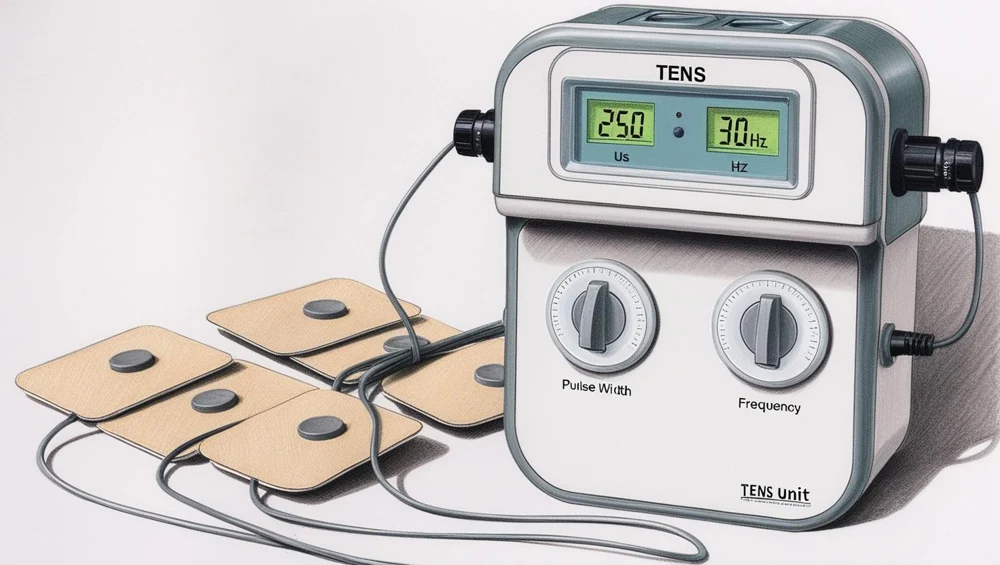
مختبر الأجهزة
TENS
A step-up converter holds a compliance rail and a regulated sink pulls a set current through whatever the contact turns out to be. Charge per phase is the amplitude times the pulse width, exactly, so both controls are charge controls and the delivered dose is the same on any skin. What changes with the contact is the VOLTAGE the stage has to produce, and the current density, and neither of those is measured.
التكوينات
نسخ الجهاز في مختبر الأجهزة.
Constant-current output stage, biphasic symmetric, two channels
A step-up converter holds a compliance rail and a regulated sink pulls a set current through whatever the contact turns out to be. Charge per phase is the amplitude times the pulse width, exactly, so both controls are charge controls and the delivered dose is the same on any skin. What changes with the contact is the VOLTAGE the stage has to produce, and the current density, and neither of those is measured.
Constant-voltage output stage, biphasic symmetric, two channels
A regulated voltage is applied across the pair and the contact decides the current. The skin is capacitive, so the current is a spike that decays inside the first fraction of the pulse: the charge that gets through is very nearly the contact capacitance times the voltage, and the capacitance is proportional to the contact area.
كيف يعمل
استكشفه في مختبر الأجهزة.
Take three quarters of the contact away and change no setting at all
This is the device, and it takes one slider to show it. 25.
Find out where on a pad the current actually goes in
Ask where the current crosses and the intuition says evenly. It is not close to even, and the arithmetic is exact for an equipotential disc on a resistive half-space: the local density is one over twice the square root of one minus the squared radius fraction, as a multiple of the mean.
Account for the charge that does not cancel
A biphasic waveform sends charge one way and then sends it back. It sends it back imperfectly, because the two phases are produced by hardware with a tolerance, and the residue is exact: the mismatch times the amplitude times the width times the rate.
Double the pulse width on each configuration and compare
Both machines have a pulse-width control. On one of them it is the charge control and on the other it is very nearly inert, and the difference is not a design preference, it falls out of the interface time constant.
Move the pads apart and watch a depth and a density trade
Two contacts separated by a distance put a pattern into the tissue, and on the perpendicular bisector it is closed form: the density goes as the separation over the three-halves power of a quarter of the separation squared plus the depth squared.
الأجزاء
قطعةً قطعة.
Nine-volt primary cell and compartment
5 millimetres, with two studs of deliberately different diameters on one end. The asymmetry is the whole of how it cannot be fitted backwards: there is no electronics anywhere in the handset doing that job, it is done by two pieces of brass being different sizes.
Step-up converter and compliance rail
A twelve-millimetre transformer with six visible windings, a switching device beside it and a small reservoir capacitor, occupying one end of the board. It turns nine volts into a rail of sixty, and that rail is not a specification about the output, it is a specification about how bad the contact is allowed to get.
Timing core and pulse generator
A seven-millimetre package with a crystal beside it, and it is the part that makes the waveform a waveform. It decides when each phase starts, how long it lasts, and how exactly the second phase mirrors the first.
Amplitude control
One key on the fascia, marked up and down, stepping in milliamps from zero to eighty. It is the only control on this device that anybody moves during use, and it is the only actuator on the only feedback loop the whole system has.
Pulse width control
A key marked in microseconds, from fifty to three hundred. On one of these two configurations it is the second charge control and on the other it does very nearly nothing, and the fascia is identical on both.
Pulse rate control
A key marked in hertz, from two to a hundred and fifty. Of the three settings on this device it is the one with the least effect on any single pulse and the most effect on what an hour adds up to, which makes it the one most often misread.
Series direct-current blocking capacitor
Two ten-microfarad capacitors on the board, one in series with each channel’s output. They are the only parts in the handset whose entire job is to make a number zero, and the number is the charge the waveform failed to cancel.
Inter-channel isolation gap
Three millimetres of bare board between two copper regions, with nothing in it. It is the only component on this device that is defined by the absence of anything, and the absence is what it is for.
Output jack sockets
5-millimetre sockets on the top edge of the case, fourteen millimetres apart, each bringing one channel out on two conductors. They are the boundary of everything the handset can control: on this side of them the current is regulated to a milliamp, and on the other side of them nothing is measured at all.
Lead wire and strain relief
2 millimetres over the insulation, with a moulded relief where it leaves the plug. It is the longest part of the device and the part that moves most, which is the usual reason it is the part that fails.
Next