Skip to content

Specialist track · Signals from the brain

Neurotechnology

EEG, EMG, evoked potentials and neurostimulation: the signals and what spoils them.

For: Hospitals with clinical neurophysiology, neurosurgery, stroke and rehabilitation services; device companies and distributors in neurodiagnostics and neuromodulation; universities teaching neuro-engineering

Your mentor, a character in the trackDr Sami RahalConsultant Clinical Neurophysiologist

The arc · 10 weeks · Signals from the brain

Length
10 weeks
Time
About 6 hours a week
Levels
Easy, Medium, Hard
Certificate
Certificate of Completion
On your own
$299, 12 months

What you'll be able to do

The job, done properly.

  • Explain neural signal origins and sizes
  • Support the recording chain from electrode to display
  • Support intraoperative monitoring and its alert response
  • Explain and support transcranial Doppler
  • Explain stimulation by charge, area and time
  • Recognise artefacts and false reassurance

The story

You join the Clinical Neurophysiology department at Medical City Hospital as its clinical engineering specialist. You follow Leila Nasser, 34, through video-EEG telemetry for drug-resistant epilepsy towards a VNS decision, alongside the department's spinal monitoring, nerve conduction clinic and the stroke unit's Doppler service.

Dr Sami RahalConsultant Clinical Neurophysiologist · your mentor (a character in the track)
“Neurophysiology equipment lives at the edge of measurability: scalp EEG is tens of microvolts, cortical evoked potentials less than two. The physiology tells you how small the signal is; the engineering tells you what drowns it.”

Inside the track

What you actually use, every week.

The real screens: My track, a step with your mentor, a simulation, your skills map and the certificate.

My track
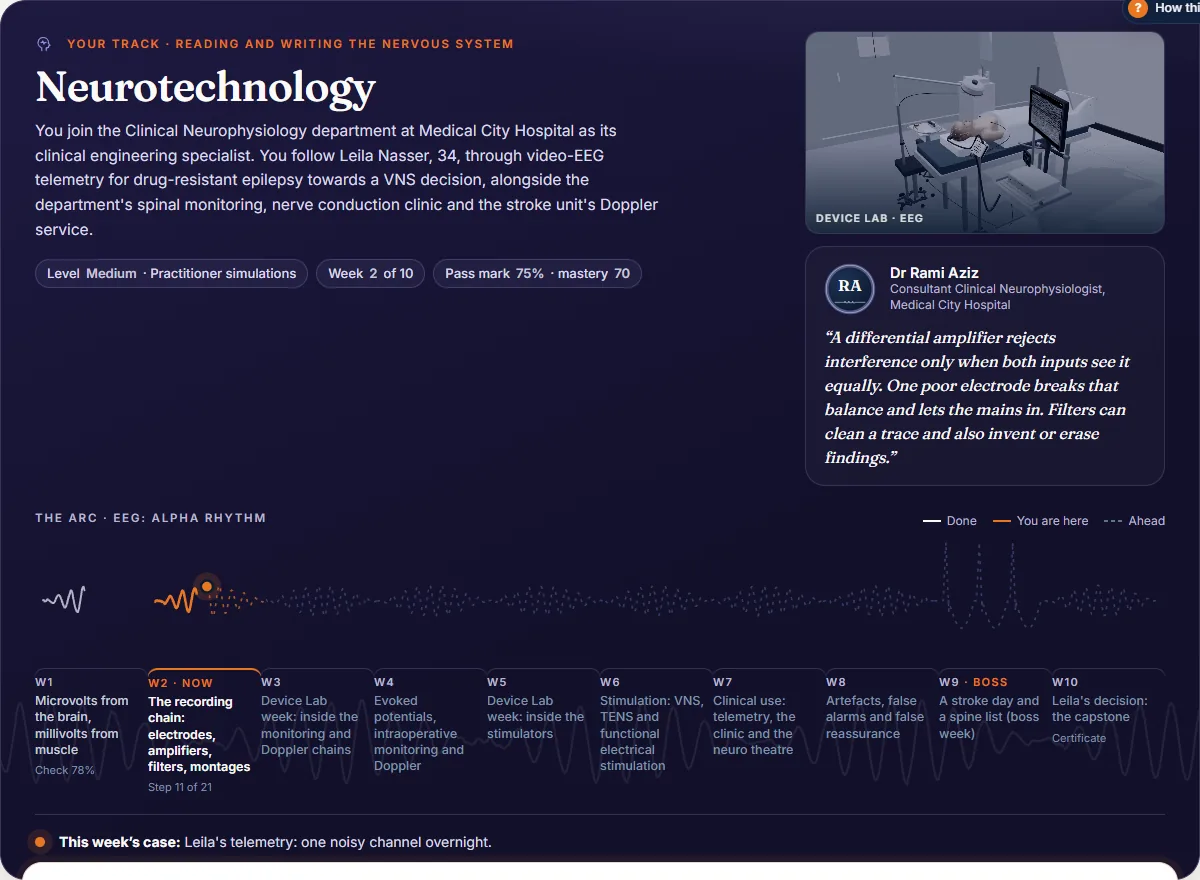
My trackThe arc of 10 weeks, this week's case, your mentor and your next step, in Neurotechnology's own colours.
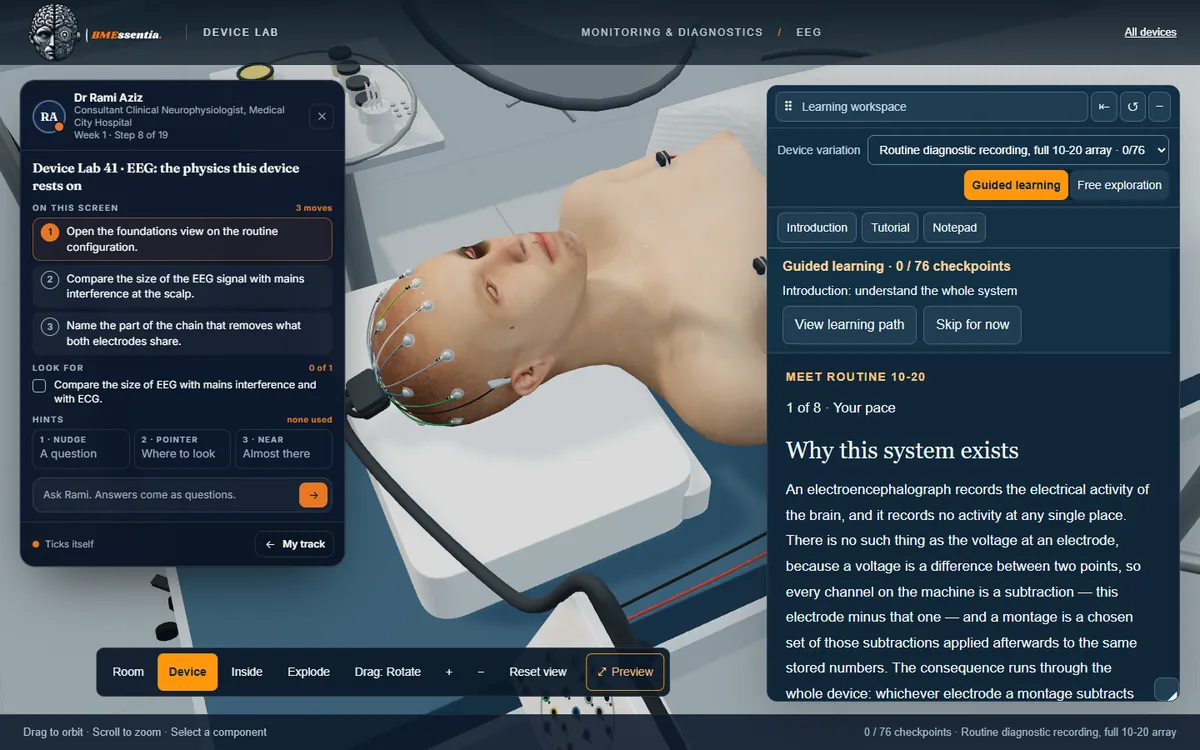
A step with your mentor in the Device Lab
A step with your mentor in the Device LabThe step names what to look at on the real device, with hints that never give the answer away.Shown: EEG with Dr Rami Aziz, this track's mentor
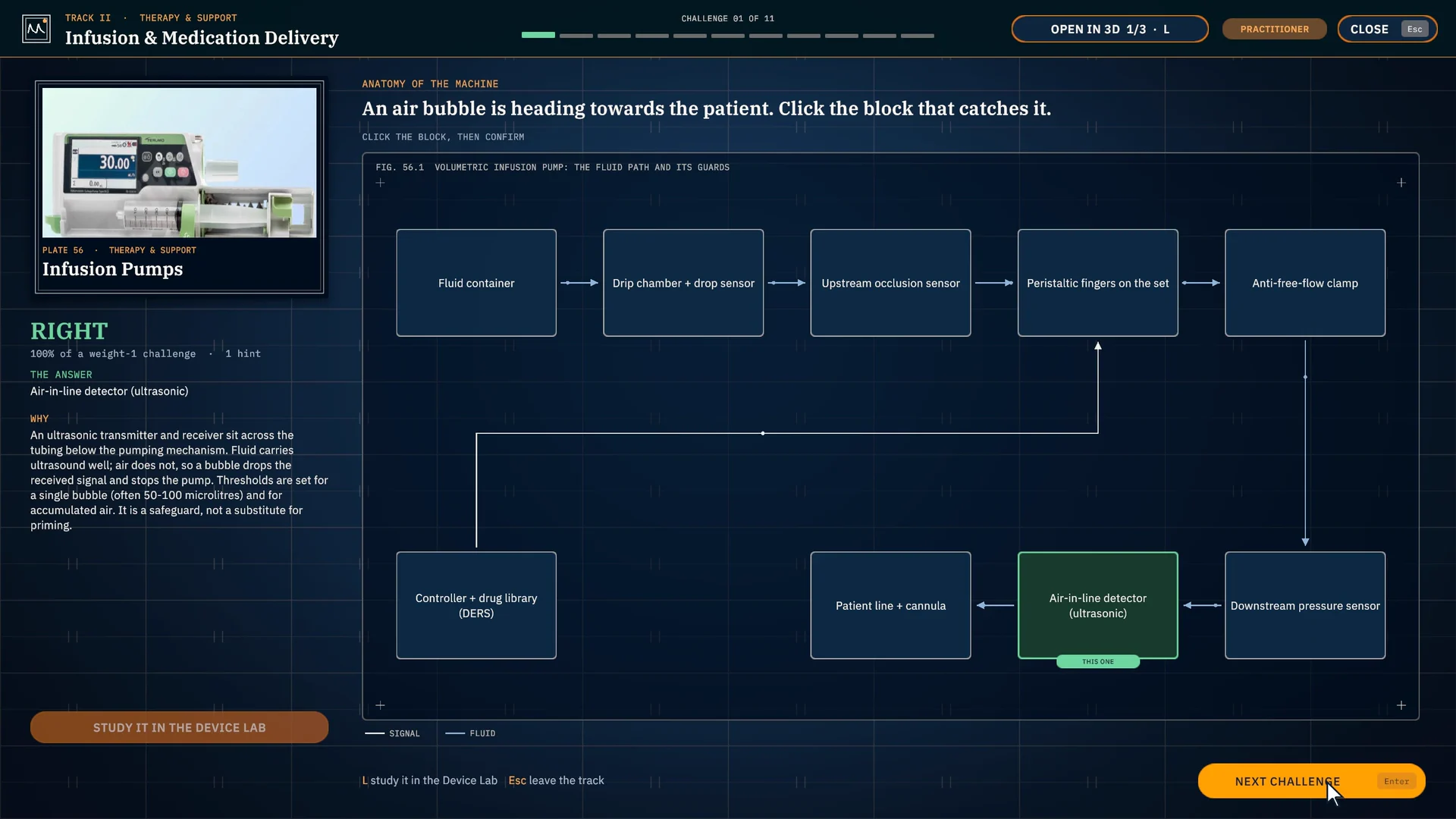
A simulation
A simulationReal hospital work in Medical City, scored and debriefed, at your level.
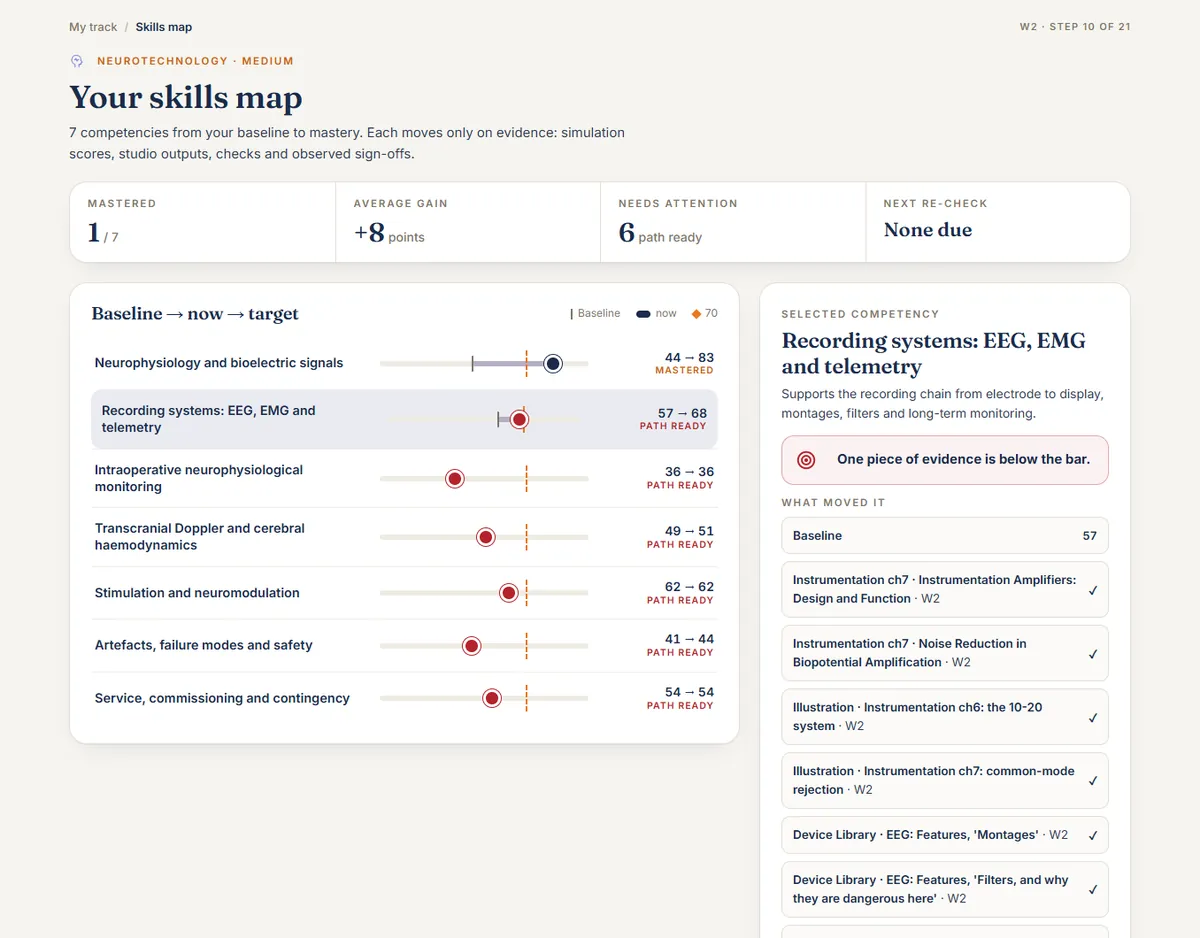
Your skills map
Your skills mapThis track's own competencies, from your baseline to mastery. They move only on evidence.Shown: a sample learner's progress
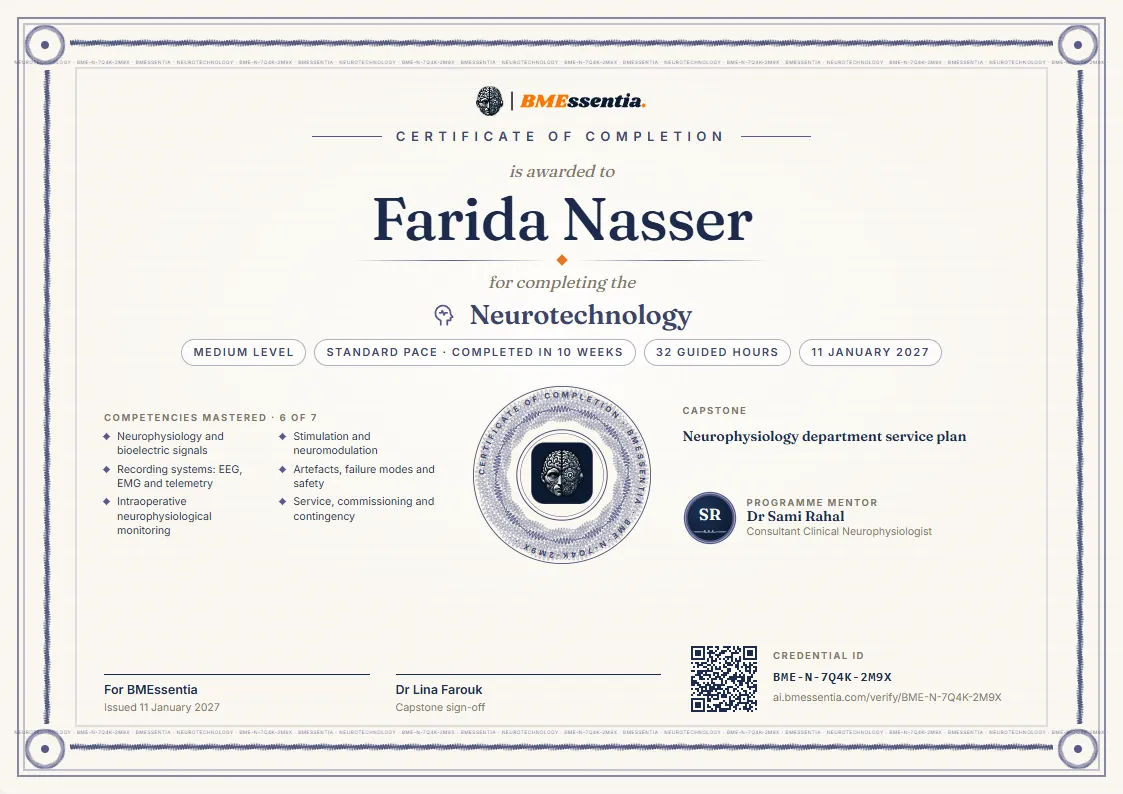
The certificate
The certificateA Certificate of Completion in the track's colours, with the work behind it.Shown: a sample for Farida Nasser, a fictional learner

The arc

10 weeks, one running case.

Each week is one working shift: learn, see inside, do, work, think, check, reflect. Open a week to see its real steps.

The arc, week by week

  1. Week 1Microvolts from the brain, millivolts from muscle
  2. Week 2The recording chain: electrodes, amplifiers, filters, montages
  3. Week 3Device Lab week: inside the monitoring and Doppler chains
  4. Week 4Evoked potentials, intraoperative monitoring and Doppler
  5. Week 5Device Lab week: inside the stimulators
  6. Week 6Stimulation: VNS, TENS and functional electrical stimulation
  7. Week 7Clinical use: telemetry, the clinic and the neuro theatre
  8. Week 8Artefacts, false alarms and false reassurance
  9. Week 9A stroke day and a spine list (boss week)
  10. Week 10Leila's decision: the capstone
  1. Week 1Microvolts from the brain, millivolts from muscle6.2 h

    Leila's telemetry admission and the department's week ahead.

    • DoDevice Mastery · Signal sizes and conduction20 min
    • See insideDevice Lab 41 · EEG: the physics this device rests on10 min
    • WorkSignal origins and sizes brief15 min
    • LearnHuman Physiology ch2 · Neurons: The Basic Building Blocks of the Nervous System15 min
    • + 15 more steps

    You make: Signal origins and sizes brief

  2. Week 2The recording chain: electrodes, amplifiers, filters, montages6.3 h

    Leila's telemetry: one noisy channel overnight.

    • DoDevice Mastery · The EEG chain20 min
    • See insideDevice Lab 41 · EEG: bipolar chains10 min
    • WorkRecording chain teaching sheet15 min
    • LearnInstrumentation ch6 · Electrode-Skin Interface: Impedance and Noise15 min
    • + 17 more steps

    You make: Recording chain teaching sheet

  3. Week 3Device Lab week: inside the monitoring and Doppler chains6.5 h

    The spinal monitoring set-up and Mr Khalil's Doppler, learned on the bench first.

    • See insideDevice Lab 14 · Guided learning: Averaged sensory, checkpoints 1 to 32 of 7796 min
    • WorkMonitoring and Doppler chain sheet15 min
    • CheckWarm-up: retrieval from earlier weeks (spaced)8 min
    • ReflectReflect5 min
    • + 5 more steps

    You make: Monitoring and Doppler chain sheet

  4. Week 4Evoked potentials, intraoperative monitoring and Doppler3.9 h

    Thursday's spinal monitoring set-up, and Mr Khalil's Doppler velocities.

    • DoDevice Mastery · Averaging, trains and Doppler20 min
    • See insideDevice Lab 14 · IONM: averaged and single-recording channels10 min
    • WorkSpinal monitoring team briefing15 min
    • LearnNeuro-Engineering ch2 · Signal Acquisition15 min
    • + 16 more steps

    You make: Spinal monitoring team briefing

  5. Week 5Device Lab week: inside the stimulators7.8 h

    Leila's VNS decision and the TENS burn, learned on the bench first.

    • See insideDevice Lab 67 · Guided learning: Constant current, checkpoints 1 to 36 of 81108 min
    • WorkStimulator dose and limit sheet15 min
    • CheckWarm-up: retrieval from earlier weeks (spaced)8 min
    • ReflectReflect5 min
    • + 6 more steps

    You make: Stimulator dose and limit sheet

  6. Week 6Stimulation: VNS, TENS and functional electrical stimulation3.5 h

    Leila's VNS decision, a TENS burn and a stroke rehabilitation request.

    • DoDevice Mastery · TENS and VNS20 min
    • See insideDevice Lab 67 · TENS: a pad corner has lifted10 min
    • WorkLoan TENS user sheet15 min
    • LearnNeuro-Engineering ch5 · Electrical Stimulation Techniques15 min
    • + 15 more steps

    You make: Loan TENS user sheet

  7. Week 7Clinical use: telemetry, the clinic and the neuro theatre5 h

    Telemetry out of sync, a new theatre IONM system, and the stroke unit's broken photic cable.

    • DoCommissioning · Video-EEG telemetry unit20 min
    • See insideDevice Lab 41 · EEG: continuous monitoring, reduced array10 min
    • WorkTelemetry bed set-up and daily check15 min
    • LearnInstrumentation ch5 · Clinical Applications: ECG, EEG, EMG10 min
    • + 16 more steps

    You make: Telemetry bed set-up and daily check

  8. Week 8Artefacts, false alarms and false reassurance6.5 h

    Vanished MEPs, a waking patient who is not waking, and a false-negative recall.

    • DoDevice Mastery · Artefacts, anaesthesia and alerts20 min
    • See insideDevice Lab 14 · IONM: electrosurgery running, sweeps thrown away10 min
    • WorkIONM alert response card15 min
    • LearnInstrumentation ch6 · Electrode Maintenance and Calibration10 min
    • + 18 more steps

    You make: IONM alert response card

  9. Week 9A stroke day and a spine list (boss week)6.2 h

    The busiest day of the department's year.

    • DoClinical Engineer · Stroke and neuro pathway20 min
    • See insideDevice Lab 37 · TCD: middle cerebral artery, main stem5 min
    • WorkService record and spares note15 min
    • LearnNeuro-Engineering ch14 · Clinical Applications of Neuro-Imaging10 min
    • + 10 more steps

    You make: Service record and spares note

  10. Week 10Leila's decision: the capstone5.7 h

    Leila's journey through the department, and the department's review.

    • DoDevice Mastery · Grand Rounds20 min
    • See insideDevice Lab 37 · Guided learning: Hand-held, checkpoints 44 to 76 of 7699 min
    • WorkCapstone presentation20 min
    • LearnNeuro-Engineering ch9 · Challenges and Future Trends in Wearable Neurotechnology10 min
    • + 9 more steps

    You make: Capstone presentation and sign-off

Proof

Only evidence counts.

A step is done when there is evidence: a simulation score, a saved work document, a passed check or a signed observation. Opening a page never ticks anything.

  • Before and afterThe same baseline check on day one and in the final week, scored per competency.
  • Mastery, not attendanceEach competency has a mastery threshold. Below it, the track routes you to the named remediation items and a re-check; a week cannot be ticked complete by opening items alone.
  • The audit packYour weekly work documents and capstones, ready for a supervisor, an employer or an inspector.

The certificate

BMEssentia Certificate of Completion: Neurotechnology

It names the track and the level you completed. Your portfolio holds the work behind it.

  • All 10 weeks' required items done at the learner's level
  • At least 6 of 7 competencies mastered
  • Final check at or above the level's pass mark
  • The six core Guided learning journeys completed from the introduction through the last case or workshop review (routine EEG, surface nerve conduction, averaged sensory monitoring, hand-held TCD, constant-current TENS, primary-cell VNS); variants and perspectives available
  • Capstone at 3 or above on every criterion, signed off by the manager or professor (institutions) or AI-assisted rubric review (individuals)

Neurophysiology department service plan

For a neurophysiology department (real or Medical City's), the plan that keeps it safe and working: commissioning evidence, recurrent safety tests, electrode and consumable management, alarm path tests, spares for single points of failure and records.

Evidence it gives: Service evidence for a neurophysiology department.

IONM programme file

For a spinal or neurosurgical monitoring service: the equipment and its commissioning, the set-up, the anaesthetic requirements, alert criteria and the rehearsed response, bite protection, documentation and one case run through it.

Evidence it gives: A monitoring programme a surgical team can rely on.

A recorded teaching session for technologists

Design and deliver a 20-minute session on one system: signal origin, the chain, artefacts and failure signatures, safety, with a check and per-person sign-off.

Evidence it gives: Per-person training evidence.

Three levels

Easy, Medium or Hard.

A baseline check on day one places you, or you choose. The competencies are the same at every level; the support and the pressure change.

Easy

Baseline under 50%, or chosen · simulations at Foundation

Worked examples first; Foundation simulations with the coach on; extra and Hard-only cases hidden.

Medium

Baseline 50% to 74%, or chosen · simulations at Practitioner

Practitioner difficulty; the montage, Doppler, electrotherapy, depth-monitor and interleaved cases shown.

Hard

Baseline 75% and above, or chosen · simulations at Expert

Expert difficulty, every case, timed boss week.

Ways to get this track

On your own, with a plan, or with your organisation.

One-time

This track

$299for 12 months

  • The track's lessons, labs and Medical City scenarios
  • The certificate when you finish
  • The track mentor: 100 questions for the track, more with credit top-ups

General Essentia, the Studios and Design are not included. Subscribe within 30 days and what you paid counts toward your plan.

Premium · Pro

Included in Premium and Pro

$299a year with Premium

  • Premium: 1 active track family at a time, this one or any other
  • Pro: 3 active track families at a time, with heavy AI use
  • Or Premium at $39 a month; one-time tracks cost 25% less with Premium, 40% less with Pro

Organisation licence

Every track for every seat

  • Every track and product, and the dashboard
  • Enrol people or cohorts and follow their progress
  • Seats for a year, an academic year or a semester

FAQ

Answers before you start.

Anything else, write to the team and we answer directly.

  • Yes. An organisation's licence includes every track, core and branch, with the Platform, Medical City, Essentia, the App and the dashboard. Your organisation enrols you on the track, and it appears under My track; there is nothing extra to buy.