Skip to content

Specialist track · Inside the body

Implantables, Prosthetics & Bionics

Pacemakers, implantable defibrillators, cochlear implants, smart knees and myoelectric hands.

For: Hospitals with cardiac device, cochlear, neuromodulation, neurosurgery, orthopaedic and prosthetic services; device companies and distributors in implants and prosthetics; universities teaching biomaterials and rehabilitation engineering

Your mentor, a character in the trackDr Tomás ReyesImplant and Prosthetics Clinical Scientist

The arc · 11 weeks · Inside the body

Length
11 weeks
Time
About 6.5 hours a week
Levels
Easy, Medium, Hard
Certificate
Certificate of Completion
On your own
$299, 12 months

What you'll be able to do

The job, done properly.

  • Explain the tissue-device interface for each implant family
  • Read pacemaker and ICD behaviour as sensing and therapy decisions
  • Explain cochlear implant, VNS and shunt settings and measurements
  • Explain load, wear and fixation of orthopaedic constructs
  • Explain sockets and control of prosthetic limbs
  • Plan MRI and surgery safely for whole implant systems

The story

You join the Implant and Bionics Service at Medical City Hospital, which follows patients with cardiac devices, cochlear implants, neuromodulators, shunts, joint replacements and prosthetic limbs. You follow one Thursday clinic list for eleven weeks: Mr Rahman's new pacemaker, two-year-old Sara's cochlear implant, Mrs Saleh's VNS, baby Adam's shunt, Mrs Karim's painful hip and Daniel Mansour's prosthetic limbs.

Dr Tomás ReyesImplant and Prosthetics Clinical Scientist · your mentor (a character in the track)
“An implant is a permanent negotiation with tissue. Bone remodels around load, the heart scars around a lead tip, the body walls off whatever it cannot digest.”

Inside the track

What you actually use, every week.

The real screens: My track, a step with your mentor, a simulation, your skills map and the certificate.

My track
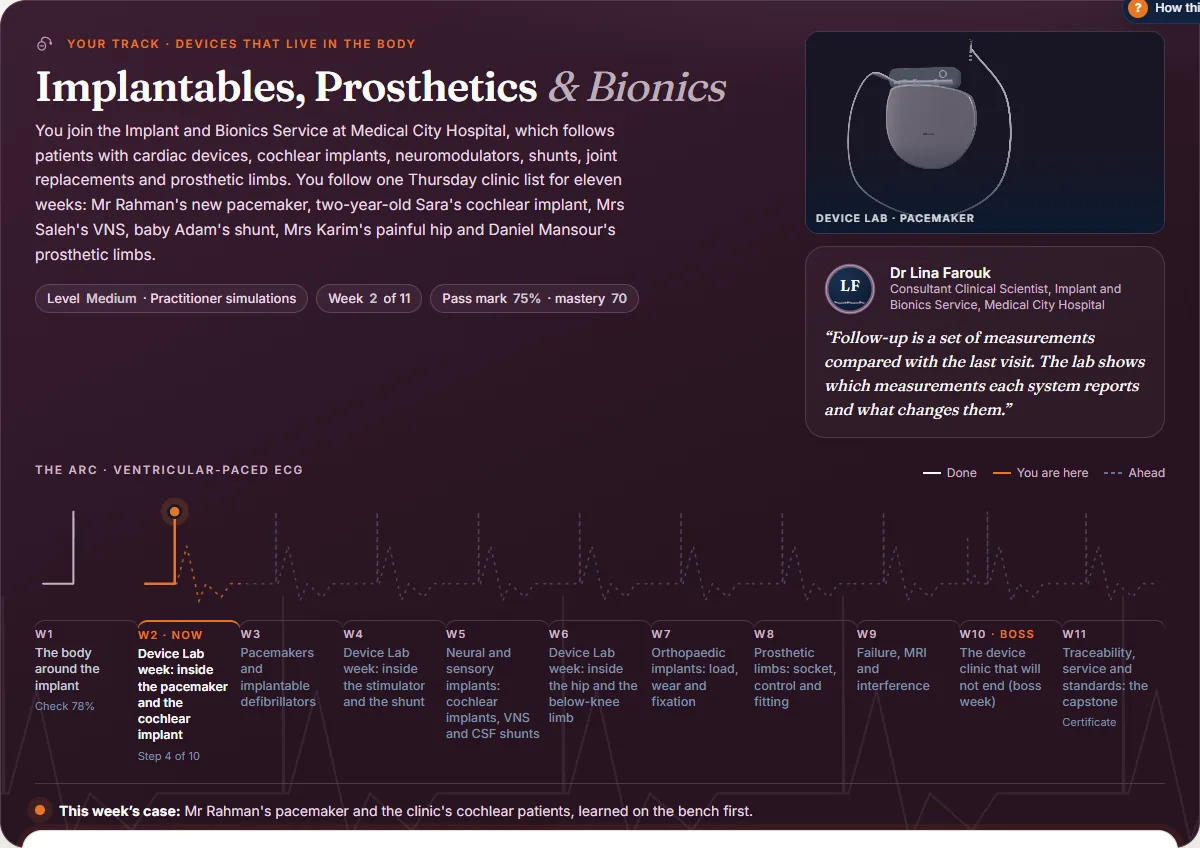
My trackThe arc of 11 weeks, this week's case, your mentor and your next step, in Implantables, Prosthetics & Bionics's own colours.
A step with your mentor in the Device Lab
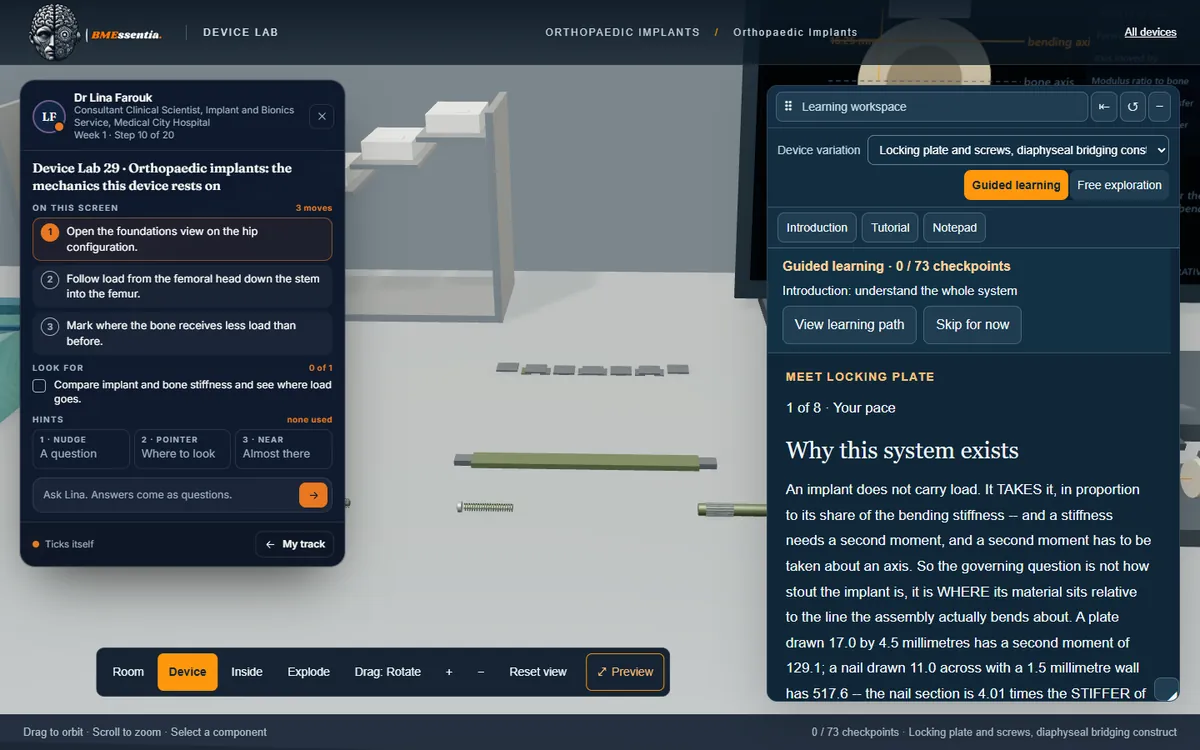
A step with your mentor in the Device LabThe step names what to look at on the real device, with hints that never give the answer away.Shown: Orthopedic Implants with Dr Lina Farouk, this track's mentor
A simulation
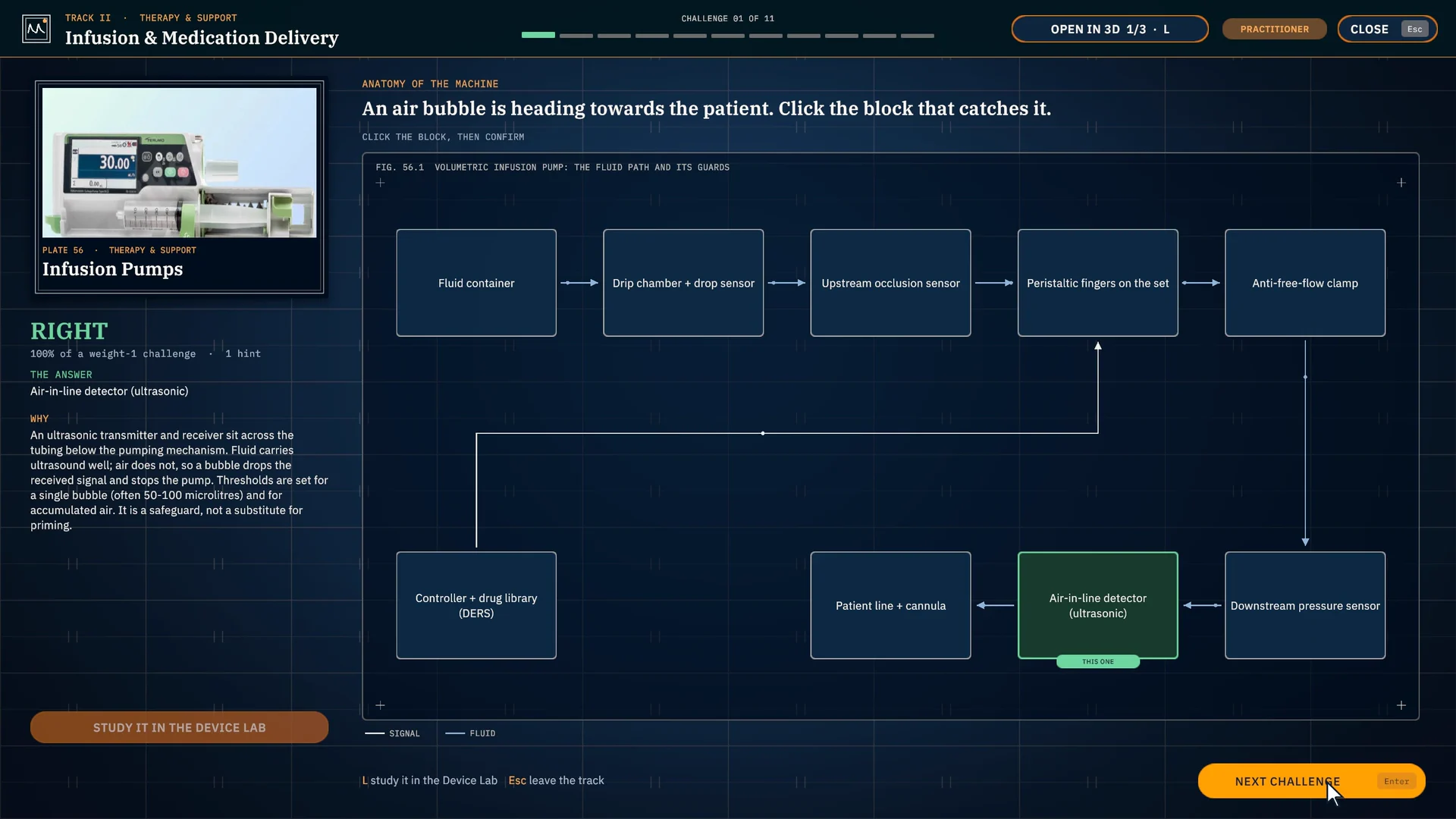
A simulationReal hospital work in Medical City, scored and debriefed, at your level.
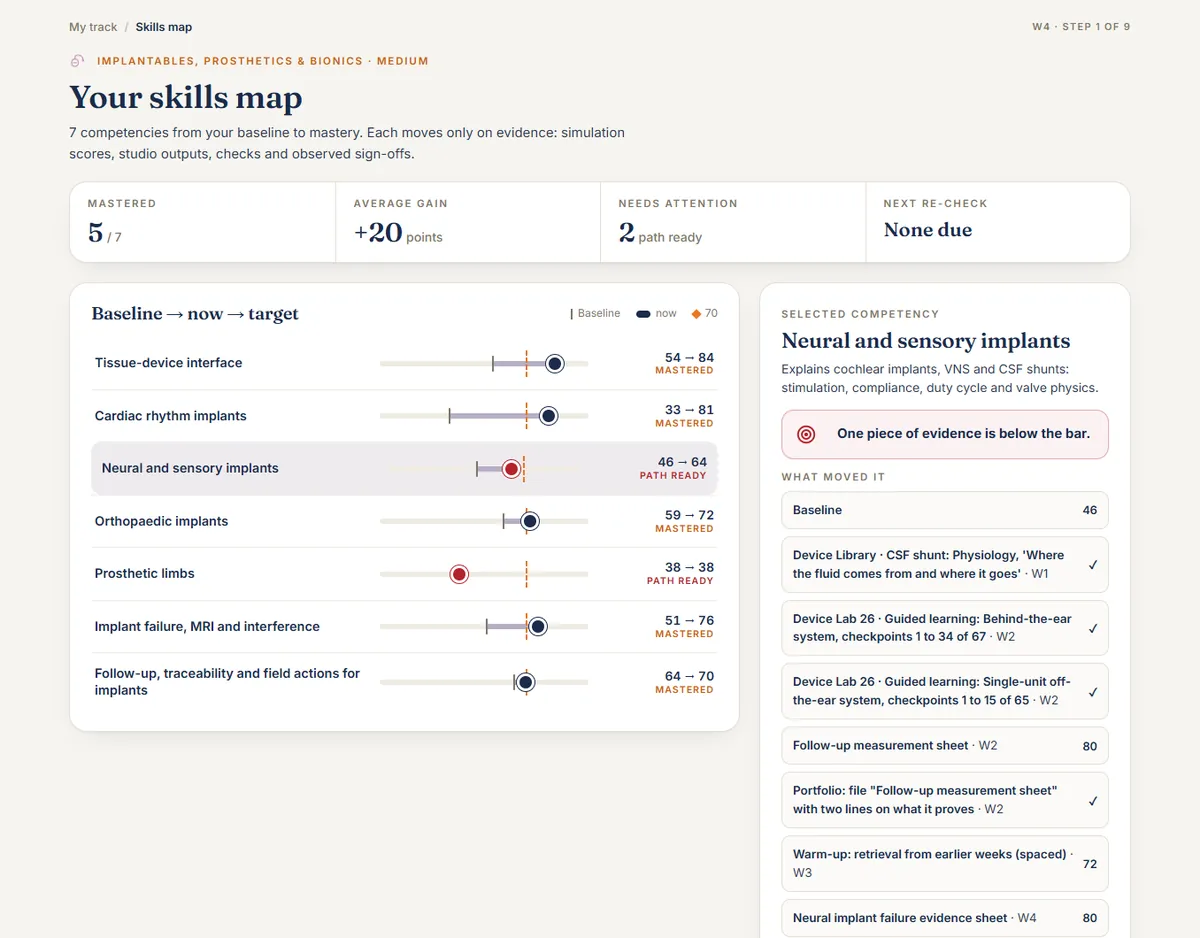
Your skills map
Your skills mapThis track's own competencies, from your baseline to mastery. They move only on evidence.Shown: a sample learner's progress
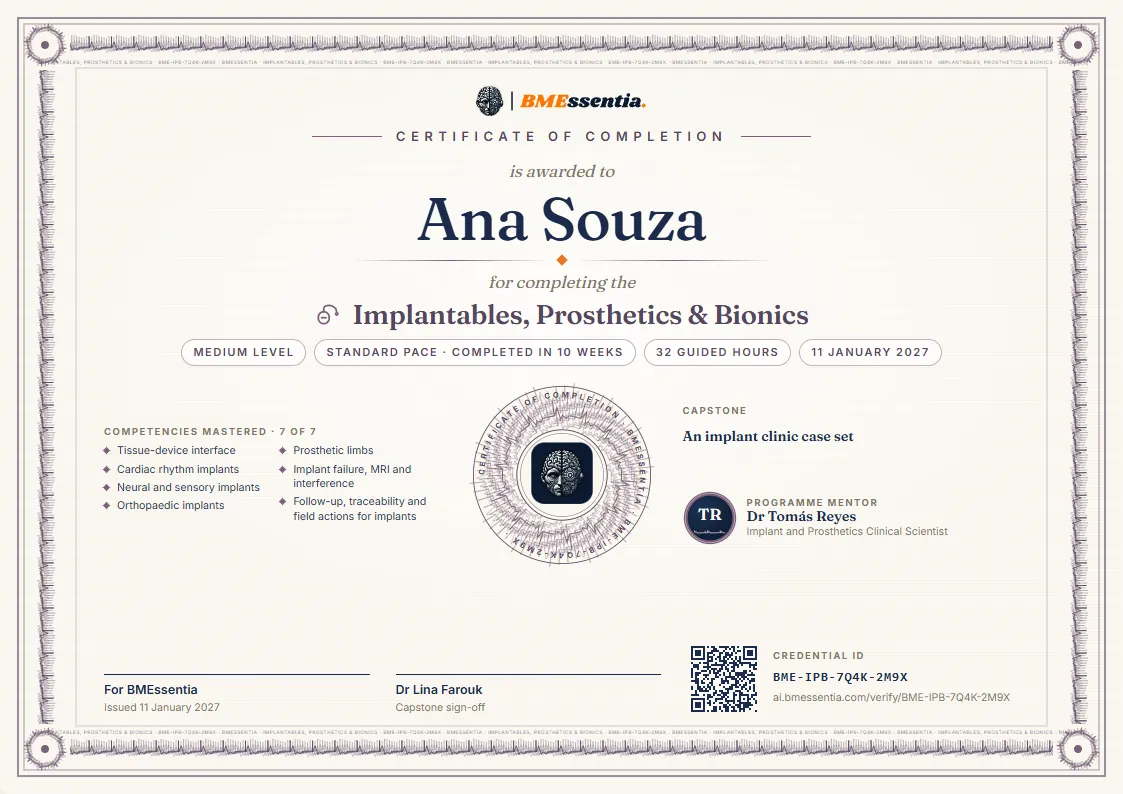
The certificate
The certificateA Certificate of Completion in the track's colours, with the work behind it.Shown: a sample for Ana Souza, a fictional learner

The arc

11 weeks, one running case.

Each week is one working shift: learn, see inside, do, work, think, check, reflect. Open a week to see its real steps.

The arc, week by week

  1. Week 1The body around the implant
  2. Week 2Device Lab week: inside the pacemaker and the cochlear implant
  3. Week 3Pacemakers and implantable defibrillators
  4. Week 4Device Lab week: inside the stimulator and the shunt
  5. Week 5Neural and sensory implants: cochlear implants, VNS and CSF shunts
  6. Week 6Device Lab week: inside the hip and the below-knee limb
  7. Week 7Orthopaedic implants: load, wear and fixation
  8. Week 8Prosthetic limbs: socket, control and fitting
  9. Week 9Failure, MRI and interference
  10. Week 10The device clinic that will not end (boss week)
  11. Week 11Traceability, service and standards: the capstone
  1. Week 1The body around the implant5 h

    The Thursday clinic list: six patients, six device families, one question each: what is the body doing to the device, and the device to the body?

    • DoDevice Mastery · Implants: tissue and materials20 min
    • See insideDevice Lab 29 · Orthopaedic implants: the mechanics this device rests on10 min
    • WorkTissue-device interface brief15 min
    • LearnHuman Physiology ch11 · Bone Structure and Remodeling15 min
    • + 16 more steps

    You make: Tissue-device interface brief

  2. Week 2Device Lab week: inside the pacemaker and the cochlear implant7.6 h

    Mr Rahman's pacemaker and the clinic's cochlear patients, learned on the bench first.

    • See insideDevice Lab 24 · Guided learning: Single-chamber transvenous pacemaker, checkpoints 1 to 18 of 6754 min
    • WorkFollow-up measurement sheet15 min
    • CheckCheck: tissue and materials (interleaved)8 min
    • ReflectReflect5 min
    • + 6 more steps

    You make: Follow-up measurement sheet

  3. Week 3Pacemakers and implantable defibrillators3.8 h

    Mr Rahman's new pacemaker paces on his own beats; an ICD patient wonders why he was not shocked.

    • DoDevice Mastery · Pacing and sensing20 min
    • See insideDevice Lab 24 · Pacemaker: real events missed10 min
    • WorkPacing malfunction teaching sheet15 min
    • LearnTherapeutic Devices ch2 · Lead Wire System and Insulation15 min
    • + 16 more steps

    You make: Pacing malfunction teaching sheet

  4. Week 4Device Lab week: inside the stimulator and the shunt8 h

    The Thursday neural clinic, learned on the bench first.

    • See insideDevice Lab 25 · Guided learning: Primary cell, checkpoints 1 to 26 of 6478 min
    • WorkNeural implant failure evidence sheet15 min
    • CheckCheck: pacing and sensing (interleaved)8 min
    • ReflectReflect5 min
    • + 5 more steps

    You make: Neural implant failure evidence sheet

  5. Week 5Neural and sensory implants: cochlear implants, VNS and CSF shunts4.4 h

    Sara's cochlear switch-on, Mrs Saleh's hoarse voice and Adam's valve after MRI.

    • DoDevice Mastery · Cochlear implants and VNS20 min
    • See insideDevice Lab 26 · Cochlear implant: two ways to wear the same implant10 min
    • WorkCochlear implant parent information sheet15 min
    • LearnTherapeutic Devices ch10 · Cochlear Implants: Mechanism of Action15 min
    • + 19 more steps

    You make: Cochlear implant parent information sheet

  6. Week 6Device Lab week: inside the hip and the below-knee limb15.3 h

    The orthopaedic list and the prosthetic clinic, learned on the bench first.

    • See insideDevice Lab 29 · Guided learning: Total hip, checkpoints 1 to 41 of 74123 min
    • WorkLoad path sheet15 min
    • CheckCheck: neural implants (interleaved)8 min
    • ReflectReflect5 min
    • + 12 more steps

    You make: Load path sheet

  7. Week 7Orthopaedic implants: load, wear and fixation3.9 h

    Mrs Karim's painful metal-on-metal hip and the week's theatre list.

    • DoDevice Mastery · Wear, loosening and metalwork20 min
    • See insideDevice Lab 29 · Orthopaedic implants: compare all six constructs10 min
    • WorkOrthopaedic construct guide20 min
    • LearnTherapeutic Devices ch11 · Orthopedic Implants15 min
    • + 16 more steps

    You make: Orthopaedic construct guide

  8. Week 8Prosthetic limbs: socket, control and fitting5.2 h

    Daniel's loose socket in the afternoon, and his myoelectric assessment.

    • DoDevice Mastery · Sockets, control and fail-safe20 min
    • See insideDevice Lab 30 · Prosthetic limb: the interface10 min
    • WorkProsthesis user handover sheet15 min
    • LearnRehabilitation Engineering ch3 · Types of Prosthetics15 min
    • + 16 more steps

    You make: Prosthesis user handover sheet

  9. Week 9Failure, MRI and interference9.2 h

    The MRI list, four shocks on the stairs, a high lead impedance and an implant recall.

    • DoDevice Mastery · MRI, diathermy and interference with cardiac implants20 min
    • See insideDevice Lab 24 · Pacemaker: noise inhibits demand output10 min
    • WorkMRI and surgery pathway for active implants20 min
    • LearnBiomaterials ch12 · Infection Associated with Biomaterials10 min
    • + 19 more steps

    You make: MRI and surgery pathway for active implants

  10. Week 10The device clinic that will not end (boss week)3.9 h

    A Thursday when every implant on the list needs you.

    • DoTech Detective · Spikes Without Beats20 min
    • See insideDevice Lab 24 · Pacemaker: pulse without capture5 min
    • WorkLoss of capture incident record15 min
    • LearnNeuro-Engineering ch4 · Challenges in Neural Implants10 min
    • + 8 more steps

    You make: Loss of capture incident record

  11. Week 11Traceability, service and standards: the capstone3.7 h

    The Thursday list, eleven weeks later, reviewed.

    • DoDevice Mastery · Grand Rounds20 min
    • See insideDevice Lab 30 · Guided learning: Transtibial, checkpoints 38 to 70 of 7099 min
    • WorkCapstone presentation20 min
    • LearnTherapeutic Devices ch11 · Advancements in Orthopedic Implants and Prosthetics10 min
    • + 6 more steps

    You make: Capstone presentation and sign-off

Proof

Only evidence counts.

A step is done when there is evidence: a simulation score, a saved work document, a passed check or a signed observation. Opening a page never ticks anything.

  • Before and afterThe same baseline check on day one and in the final week, scored per competency.
  • Mastery, not attendanceEach competency has a mastery threshold. Below it, the track routes you to the named remediation items and a re-check; a week cannot be ticked complete by opening items alone.
  • The audit packYour weekly work documents and capstones, ready for a supervisor, an employer or an inspector.

The certificate

BMEssentia Certificate of Completion: Implantables, Prosthetics & Bionics

It names the track and the level you completed. Your portfolio holds the work behind it.

  • All 11 weeks' required items done at the learner's level
  • At least 6 of 7 competencies mastered
  • Final check at or above the level's pass mark
  • The seven core Guided learning journeys completed from the introduction through the last case or workshop review (dual-chamber pacemaker, transvenous ICD, behind-the-ear cochlear implant, primary-cell VNS, fixed-valve shunt, total hip, transtibial prosthesis); variants and perspectives available
  • Capstone at 3 or above on every criterion, signed off by the manager or professor (institutions) or AI-assisted rubric review (individuals)

An implant clinic case set

For six patients (the Thursday list or real anonymised patients), one per device family: the tissue story, the device mechanism and settings, the follow-up measurements and their meaning, the failures met and how they were recognised, and the traceability record.

Evidence it gives: Whole-service understanding of implants.

The MRI and surgery pathway in use

Implement and test the hospital pathway for patients with active implants having MRI or surgery: identification, whole-system conditions, programming, monitoring, restoration, sign-offs; run three real or simulated patients through it and record the result.

Evidence it gives: A tested safety pathway for implant patients.

A recorded teaching session for the clinic team

Design and deliver a 20-minute session on one implant family: tissue, mechanism, follow-up measurements, failure signs and MRI or surgery precautions, with a check and per-person sign-off.

Evidence it gives: Per-person training evidence on implants.

Three levels

Easy, Medium or Hard.

A baseline check on day one places you, or you choose. The competencies are the same at every level; the support and the pressure change.

Easy

Baseline under 50%, or chosen · simulations at Foundation

Worked examples first; Foundation simulations with the coach on; extra and Hard-only cases hidden.

Medium

Baseline 50% to 74%, or chosen · simulations at Practitioner

Practitioner difficulty; the temporary pacing, VNS and shunt, rehabilitation robot, neural MRI and cardiology day cases shown.

Hard

Baseline 75% and above, or chosen · simulations at Expert

Expert difficulty, every case, timed boss week.

Ways to get this track

On your own, with a plan, or with your organisation.

One-time

This track

$299for 12 months

  • The track's lessons, labs and Medical City scenarios
  • The certificate when you finish
  • The track mentor: 100 questions for the track, more with credit top-ups

General Essentia, the Studios and Design are not included. Subscribe within 30 days and what you paid counts toward your plan.

Premium · Pro

Included in Premium and Pro

$299a year with Premium

  • Premium: 1 active track family at a time, this one or any other
  • Pro: 3 active track families at a time, with heavy AI use
  • Or Premium at $39 a month; one-time tracks cost 25% less with Premium, 40% less with Pro

Organisation licence

Every track for every seat

  • Every track and product, and the dashboard
  • Enrol people or cohorts and follow their progress
  • Seats for a year, an academic year or a semester

FAQ

Answers before you start.

Anything else, write to the team and we answer directly.

  • Yes. An organisation's licence includes every track, core and branch, with the Platform, Medical City, Essentia, the App and the dashboard. Your organisation enrols you on the track, and it appears under My track; there is nothing extra to buy.