Skip to content

Hospital planner or final-year student · Core track · From brief to first patient

Design & Equip a Hospital

One project joins every product: design a department, specify and buy its devices, commission them in the Device Lab and Medical City, then run it in the simulations.

For: Final-year biomedical engineering students (as a capstone project) and the planners who design and equip hospital departments.

Design & Equip a Hospital: BMEssentia Design, ICU dollhouse
BMEssentia Design · ICU dollhouse

The arc · 12 weeks · From brief to first patient

Your mentor, a character in the trackHuda KarimDirector of Capital Projects and Clinical Engineering
Length
12 weeks
Time
About 3.5 hours a week
Levels
Easy, Medium, Hard
Certificate
Certificate of Completion
On your own
$499, 12 months

What you'll be able to do

The job, done properly.

  • Turn a clinical brief into journeys, adjacencies and a plan in BMEssentia Design
  • Write room data sheets from the devices outward: gases, protected power, the patient environment, isolation and alarm routes
  • Build a costed equipment list and device-room requirements matrix from the Device Library
  • Specify integration: network, central station, alarm distribution, record, downtime
  • Write a tender specification, a whole-life cost model and a defensible award
  • Accept and commission equipment and services before the first patient

The story

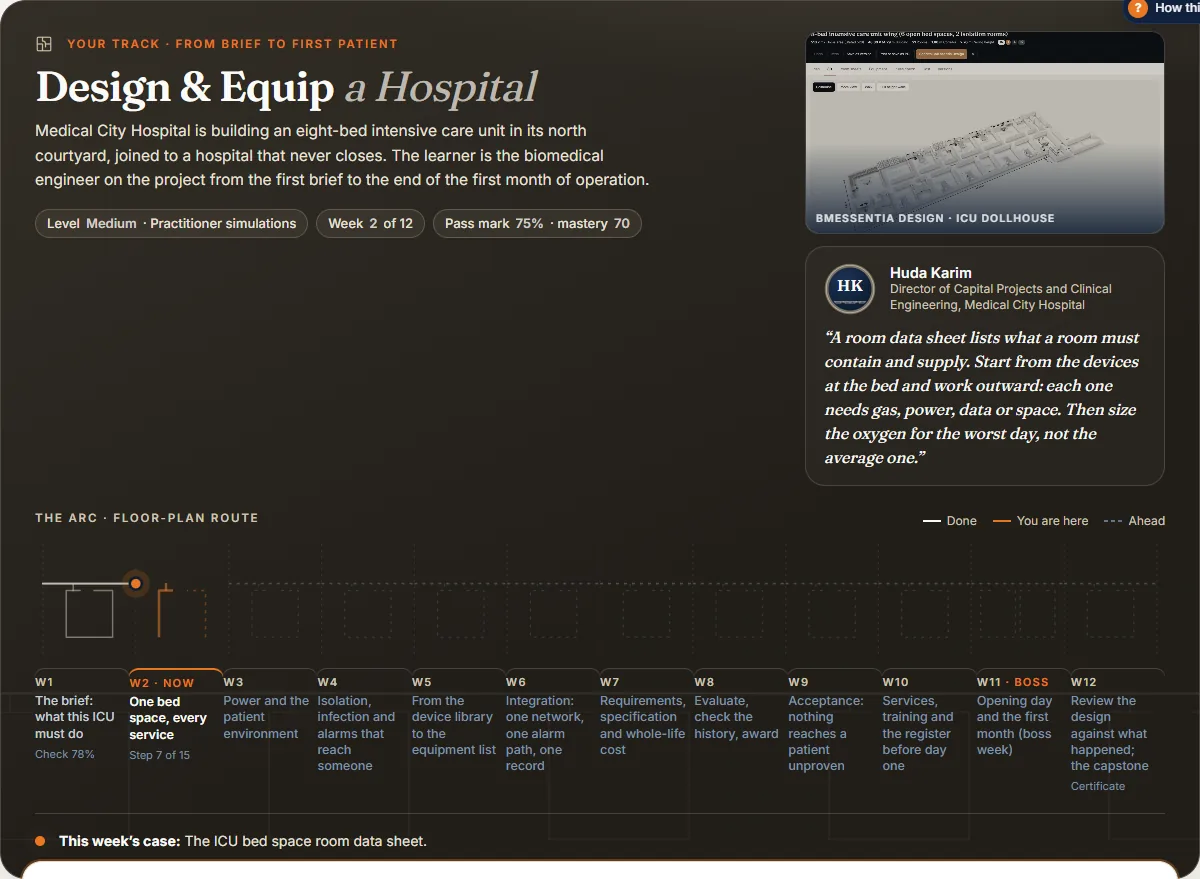
Medical City Hospital is building an eight-bed intensive care unit in its north courtyard, joined to a hospital that never closes. The learner is the biomedical engineer on the project from the first brief to the end of the first month of operation.

Huda KarimDirector of Capital Projects and Clinical Engineering · your mentor (a character in the track)
“Patients reach an ICU from theatres, from resus and from the wards, often ventilated. Draw those journeys first; the rooms follow.”

Inside the track

What you actually use, every week.

The real screens: My track, a step with your mentor, a simulation, your skills map and the certificate.

My track
My trackThe arc of 12 weeks, this week's case, your mentor and your next step, in Design & Equip a Hospital's own colours.
A step with your mentor in the Device Lab
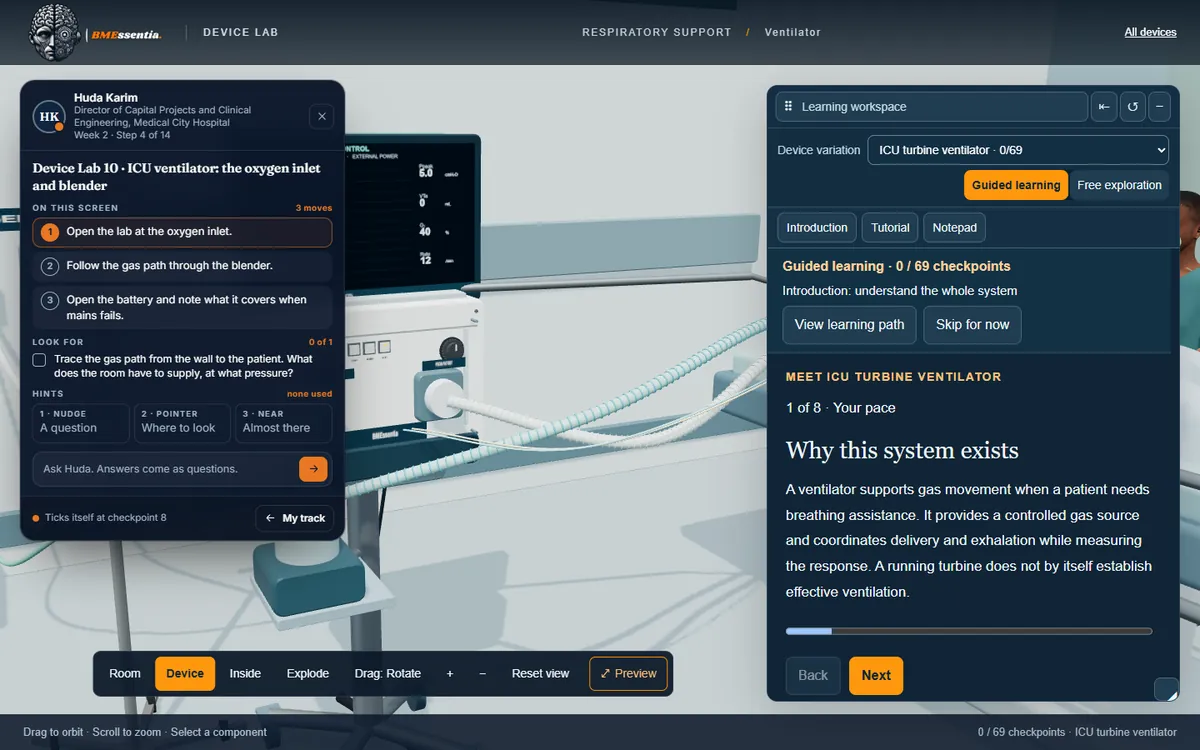
A step with your mentor in the Device LabThe step names what to look at on the real device, with hints that never give the answer away.Shown: Ventilator with Huda Karim, this track's mentor
A simulation
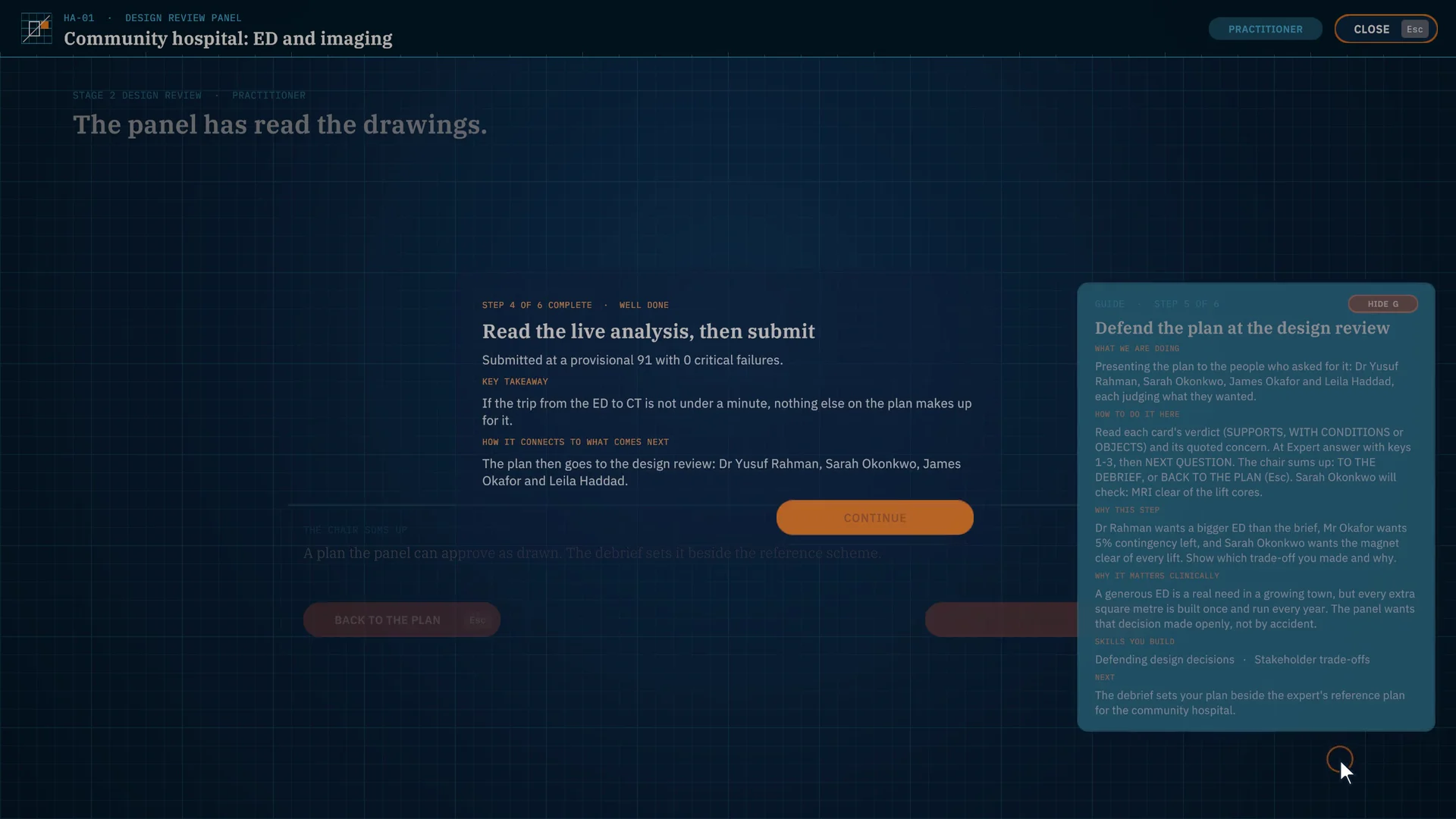
A simulationReal hospital work in Medical City, scored and debriefed, at your level.
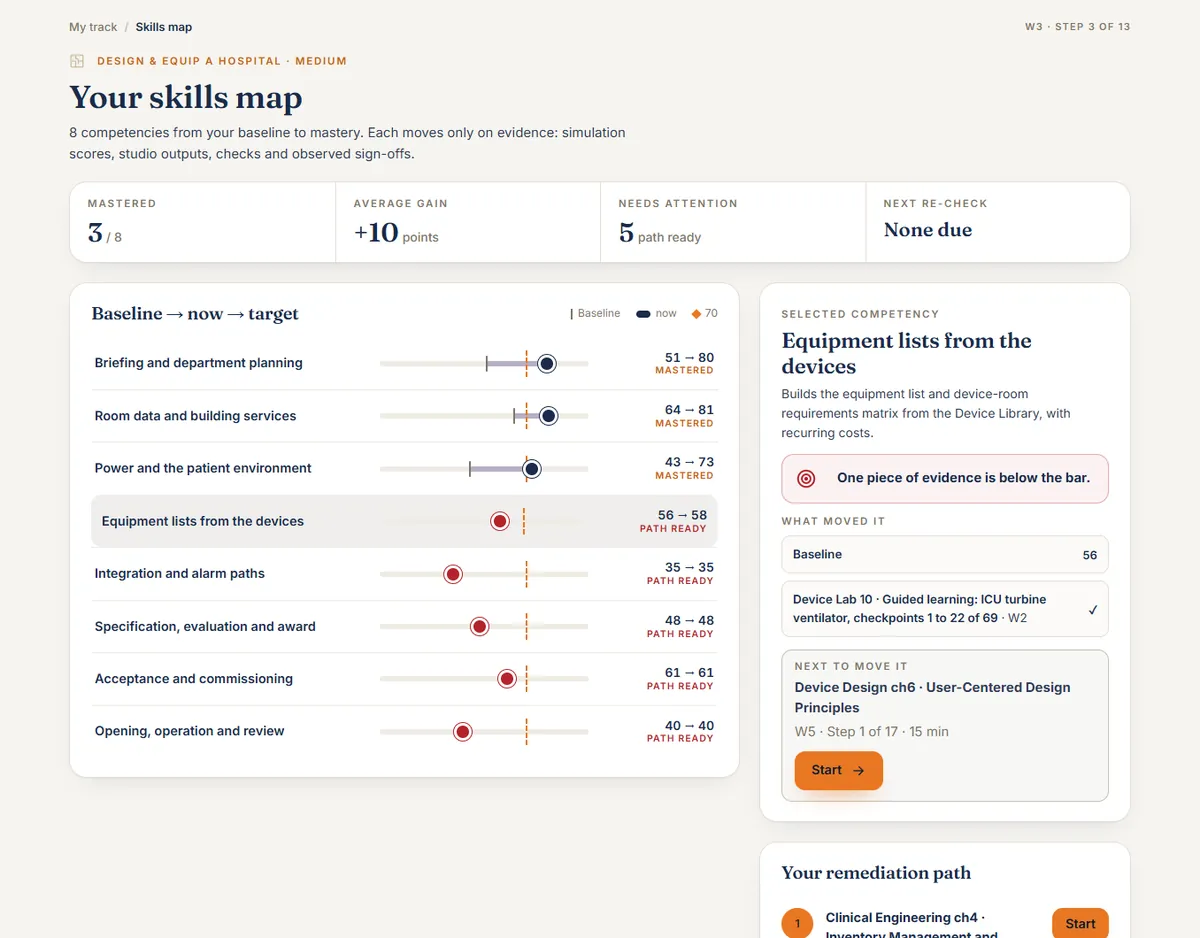
Your skills map
Your skills mapThis track's own competencies, from your baseline to mastery. They move only on evidence.Shown: a sample learner's progress
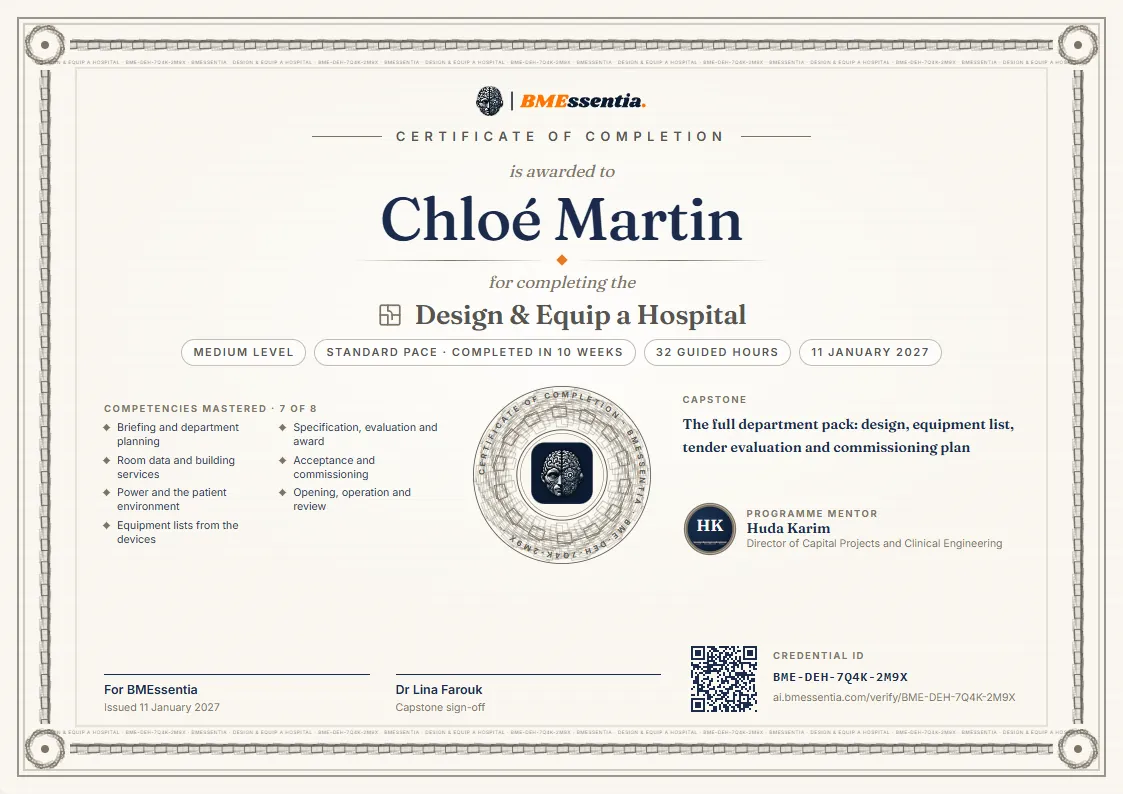
The certificate
The certificateA Certificate of Completion in the track's colours, with the work behind it.Shown: a sample for Chloé Martin, a fictional learner

The arc

12 weeks, one running case.

Each week is one working shift: learn, see inside, do, work, think, check, reflect. Open a week to see its real steps.

From brief to first patient

  1. Week 1The brief: what this ICU must do
  2. Week 2One bed space, every service
  3. Week 3Power and the patient environment
  4. Week 4Isolation, infection and alarms that reach someone
  5. Week 5From the device library to the equipment list
  6. Week 6Integration: one network, one alarm path, one record
  7. Week 7Requirements, specification and whole-life cost
  8. Week 8Evaluate, check the history, award
  9. Week 9Acceptance: nothing reaches a patient unproven
  10. Week 10Services, training and the register before day one
  11. Week 11Opening day and the first month (boss week)
  12. Week 12Review the design against what happened; the capstone
  1. Week 1The brief: what this ICU must do2.8 h

    The eight-bed ICU: the brief and the first plan.

    • DoHospital Architect · New ICU wing on a live site20 min
    • WorkBMEssentia Design · the 8-bed ICU template: the first plan20 min
    • LearnDevice Design ch1 · Design Considerations15 min
    • ThinkBMEssentials · How to Prove You Understand an Entire System Using a Single Drawing15 min
    • + 9 more steps

    You make: ICU brief and schedule of accommodation

  2. Week 2One bed space, every service4 h

    The ICU bed space room data sheet.

    • DoRoom Builder · ICU bed space (Level 3 critical care)20 min
    • See insideDevice Lab 10 · Guided learning: ICU turbine ventilator, checkpoints 1 to 22 of 6966 min
    • WorkBMEssentia Design · the bed space room data in the plan15 min
    • LearnClinical Engineering ch11 · Overview of Safety Protocols: Electrical, Radiation, Biological15 min
    • + 11 more steps

    You make: ICU bed space room data sheet

  3. Week 3Power and the patient environment3.9 h

    The ICU's power, earthing and medical electrical systems.

    • DoTech Detective · Three devices, one earth20 min
    • See insideDevice Lab 38 · Guided learning: Bedside monitoring, checkpoints 1 to 28 of 7984 min
    • LearnClinical Engineering ch2 · Safety Standards for Medical Devices15 min
    • ThinkStandard · IEC 60364-7-710: electrical installations in medical locations10 min
    • + 10 more steps

    You make: Bed space electrical brief and socket schedule

  4. Week 4Isolation, infection and alarms that reach someone2.3 h

    The two isolation rooms and the ICU's alarm path.

    • DoRoom Builder · Airborne infection isolation room with lobby20 min
    • WorkBMEssentia Design · the isolation rooms, lobbies and sightlines15 min
    • LearnClinical Engineering ch11 · Implementing Safety Protocols in Clinical Environments10 min
    • ThinkStandard · HTM 03-01: specialised ventilation for healthcare premises (UK example)10 min
    • + 8 more steps

    You make: Isolation room data sheet and ICU alarm path

  5. Week 5From the device library to the equipment list4.3 h

    The ICU equipment list and device-room requirements matrix.

    • See insideDevice Lab 56 · Guided learning: Volumetric infusion pump, checkpoints 1 to 23 of 7369 min
    • WorkBMEssentia Design · the ICU equipment list and cost range20 min
    • LearnDevice Design ch6 · User-Centered Design Principles15 min
    • ThinkModel note · Getinge Servo-u: what a real ICU ventilator needs from the room10 min
    • + 13 more steps

    You make: Device-room requirements matrix and equipment list

  6. Week 6Integration: one network, one alarm path, one record2.5 h

    The ICU integration requirements.

    • DoPatient Safety · When the network went dark20 min
    • See insideDevice Lab 38 · Bedside monitor: network, alarms and trace10 min
    • WorkICU integration requirements20 min
    • LearnIllustration · Clinical Engineering ch9: health information systems and standards5 min
    • + 9 more steps

    You make: ICU integration requirements

  7. Week 7Requirements, specification and whole-life cost2.7 h

    The ICU monitoring and ventilation tender specification.

    • DoProcurement · Patient monitoring network20 min
    • WorkSpecification test against two real models20 min
    • LearnClinical Engineering ch3 · The Process of Acquiring New Medical Technologies15 min
    • ThinkBMEssence · The Medical Device Tender Process: How Hospital Procurement Works and How Engineers Navigate It15 min
    • + 9 more steps

    You make: Tender specification and whole-life cost model

  8. Week 8Evaluate, check the history, award2.4 h

    The ICU ventilator evaluation and award.

    • DoProcurement · ICU ventilators: evaluation and award20 min
    • WorkEvaluation matrix and award recommendation20 min
    • LearnClinical Engineering ch3 · Value Analysis and Cost Comparison Techniques15 min
    • ThinkFDA recall Z-2525-2026 · Ventec VOCSN: backup battery and loss-of-power alarm10 min
    • + 8 more steps

    You make: Evaluation matrix and award recommendation

  9. Week 9Acceptance: nothing reaches a patient unproven5.6 h

    Acceptance of the ICU's monitors, central station and ventilators.

    • DoCommissioning · Six ICU bed spaces: monitors, ventilators and the central station25 min
    • See insideDevice Lab 10 · Guided learning: ICU turbine ventilator, checkpoints 23 to 36 of 6942 min
    • WorkInstallation and commissioning record15 min
    • LearnClinical Engineering ch5 · Acceptance Testing for New Equipment15 min
    • + 12 more steps

    You make: Installation and commissioning record

  10. Week 10Services, training and the register before day one2.7 h

    The ICU's services handover, PM programme, training and register.

    • DoCommissioning · New ward: gases, suction, power and nurse call at every bedhead25 min
    • WorkPlanned maintenance set-up for the ICU ventilators15 min
    • LearnClinical Engineering ch4 · Setting Up a Medical Instrumentation Program15 min
    • ThinkStandard · HTM 02-01: acceptance, the quality controller and the authorised person (UK example)10 min
    • + 9 more steps

    You make: Handover pack: gases accepted, PM set up, training recorded, register complete

  11. Week 11Opening day and the first month (boss week)3.2 h

    Opening day, the move and the first nights.

    • DoMaster Challenge · Opening day of the new wing20 min
    • See insideDevice Lab 10 · Guided learning: Transport turbine ventilator, checkpoints 27 to 36 of 6930 min
    • WorkOpening readiness and first-month brief15 min
    • LearnDevice Library · Ventilator: Safety, 'Transport'5 min
    • + 9 more steps

    You make: Opening readiness and first-month brief

  12. Week 12Review the design against what happened; the capstone2.6 h

    The post-occupancy review and the capstone.

    • WorkPost-occupancy review20 min
    • LearnClinical Engineering ch13 · Case Studies on Patient Safety Failures and Successes15 min
    • CheckWarm-up: retrieval from earlier weeks (spaced)8 min
    • Your organisationYour organisation's design standards: final check of the capstone10 min
    • + 7 more steps

    You make: Capstone

Proof

Only evidence counts.

A step is done when there is evidence: a simulation score, a saved work document, a passed check or a signed observation. Opening a page never ticks anything.

  • Before and afterThe same baseline check on day one and in the final week, scored per competency.
  • Mastery, not attendanceEach competency has a mastery threshold. Below it, the track routes you to the named remediation items and a re-check; a week cannot be ticked complete by opening items alone.
  • The audit packYour weekly work documents and capstones, ready for a supervisor, an employer or an inspector.

The certificate

BMEssentia Certificate of Completion: Design & Equip a Hospital

It names the track and the level you completed. Your portfolio holds the work behind it.

  • All 12 weeks' required items done at the learner's level
  • At least 7 of 8 competencies mastered
  • Final check at or above the level's pass mark
  • Capstone at 3 or above on every criterion, signed off by the manager or professor (institutions) or AI-assisted rubric review (individuals)

The full department pack: design, equipment list, tender evaluation and commissioning plan

For the ICU (or a dialysis unit, or a real department of the learner's own project): the Design plan with its journeys and rules, room data sheets for the key rooms, the device-room requirements matrix and costed equipment list, the integration requirements, the tender specification with its evaluation and award, and the acceptance and commissioning plan, with a recorded Design walk-through.

Evidence it gives: Planning rework avoided and commissioning non-conformities closed before go-live, on the learner's real projects.

Device-led room data sheets for five critical rooms

Room data sheets for five device-dense rooms (for example an ICU bed space, an isolation room with lobby, an ECMO room, a dialysis bay and an endoscope decontamination room), written from the devices outward, with services counts, the electrical group, airflow, alarm routes and the sign-offs each needs.

Evidence it gives: Specification evidence for estates and infection prevention.

A commissioning and opening plan

Plan the acceptance, handover, move and opening of a new department: acceptance tests per device type with baselines, services acceptance and the signatures it needs, register and training before go-live, bed readiness criteria, the move with every device counted, and the first-month review.

Evidence it gives: Occupation readiness and commissioning evidence.

Three levels

Easy, Medium or Hard.

A baseline check on day one places you, or you choose. The competencies are the same at every level; the support and the pressure change.

Easy

Baseline under 50%, or chosen · simulations at Foundation

Worked examples first; Foundation difficulty with the coach; the harder cases hidden; boss week untimed.

Medium

Baseline 50% to 74%, or chosen · simulations at Practitioner

Practitioner difficulty; the oxygen surge, white socket, oximeter and eight-seconds cases shown; boss week with a target time.

Hard

Baseline 75% and above, or chosen · simulations at Expert

Expert difficulty: every case including the ECMO room, the monitoring upgrade, crossed gases and the early opening; timed boss week.

Ways to get this track

On your own, with a plan, or with your organisation.

Complete track

This track

$499for 12 months

  • The track's lessons, labs and Medical City scenarios
  • The certificate when you finish
  • The track mentor: 100 questions for the track, more with credit top-ups

General Essentia, the Studios and Design are not included. Subscribe within 30 days and what you paid counts toward your plan.

Premium · Pro

Included in Premium and Pro

$299a year with Premium

  • Premium: 1 active track family at a time, this one or any other
  • Pro: 3 active track families at a time, with heavy AI use
  • Or Premium at $39 a month; one-time tracks cost 25% less with Premium, 40% less with Pro

Organisation licence

Every track for every seat

  • Every track and product, and the dashboard
  • Enrol people or cohorts and follow their progress
  • Seats for a year, an academic year or a semester

FAQ

Answers before you start.

Anything else, write to the team and we answer directly.

  • Yes. An organisation's licence includes every track, core and branch, with the Platform, Medical City, Essentia, the App and the dashboard. Your organisation enrols you on the track, and it appears under My track; there is nothing extra to buy.