Skip to content

Specialist track · When a machine is the organ

Artificial Organs & Life Support

Dialysis, ECMO, heart-lung machines and ventricular assist: how each replaces an organ, and how it fails.

For: Hospitals with cardiac surgery, critical care and renal services; device companies and distributors in perfusion, ECMO, dialysis and ventilation; universities teaching artificial organs

Your mentor, a character in the trackDr Omar SalehLead Clinical Perfusionist and ECMO Coordinator

The arc · 10 weeks · When a machine is the organ

Length
10 weeks
Time
About 5.5 hours a week
Levels
Easy, Medium, Hard
Certificate
Certificate of Completion
On your own
$299, 12 months

What you'll be able to do

The job, done properly.

  • Explain heart, lung and kidney work in the quantities the machines control
  • Explain bypass and ECMO circuits component by component
  • Explain dialysis dose, balance and pressures, and balloon pump timing
  • Know indications and the 'wrong answer' cases for each machine
  • Recognise failure signatures and act in safe order
  • Keep life-support systems safe in service against their particular standards

The story

You are the clinical engineering specialist for life support at Medical City Hospital, working with the cardiothoracic, critical care and renal teams. Over ten weeks you follow one patient, Mr Karim Haddad, from cardiogenic shock through bypass, a balloon pump, ECMO, ventilation and dialysis, home to peritoneal dialysis.

Dr Omar SalehLead Clinical Perfusionist and ECMO Coordinator · your mentor (a character in the track)
“Every setting on a life-support machine is a physiological quantity in disguise: flow is cardiac output, sweep is ventilation, ultrafiltration is the kidney's water balance. Read the patient in those terms and the machines stop being black boxes.”

Inside the track

What you actually use, every week.

The real screens: My track, a step with your mentor, a simulation, your skills map and the certificate.

My track
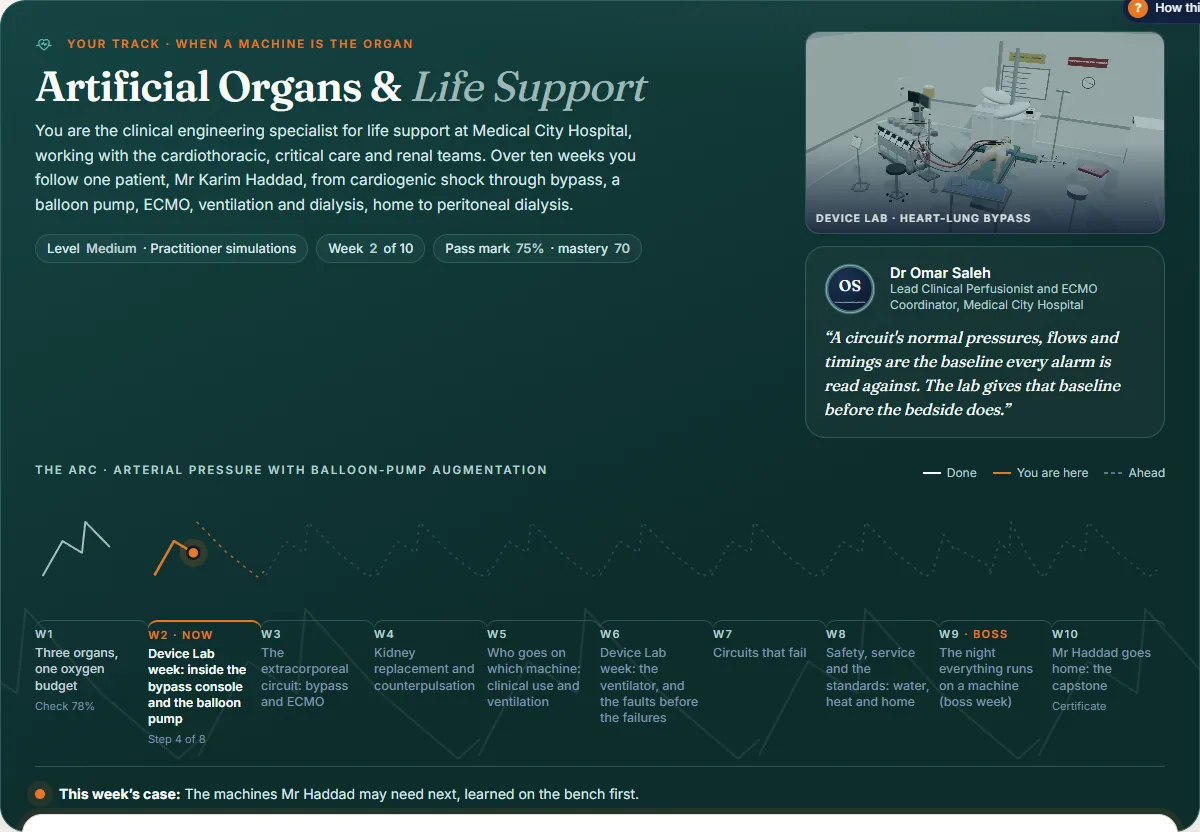
My trackThe arc of 10 weeks, this week's case, your mentor and your next step, in Artificial Organs & Life Support's own colours.
A step with your mentor in the Device Lab
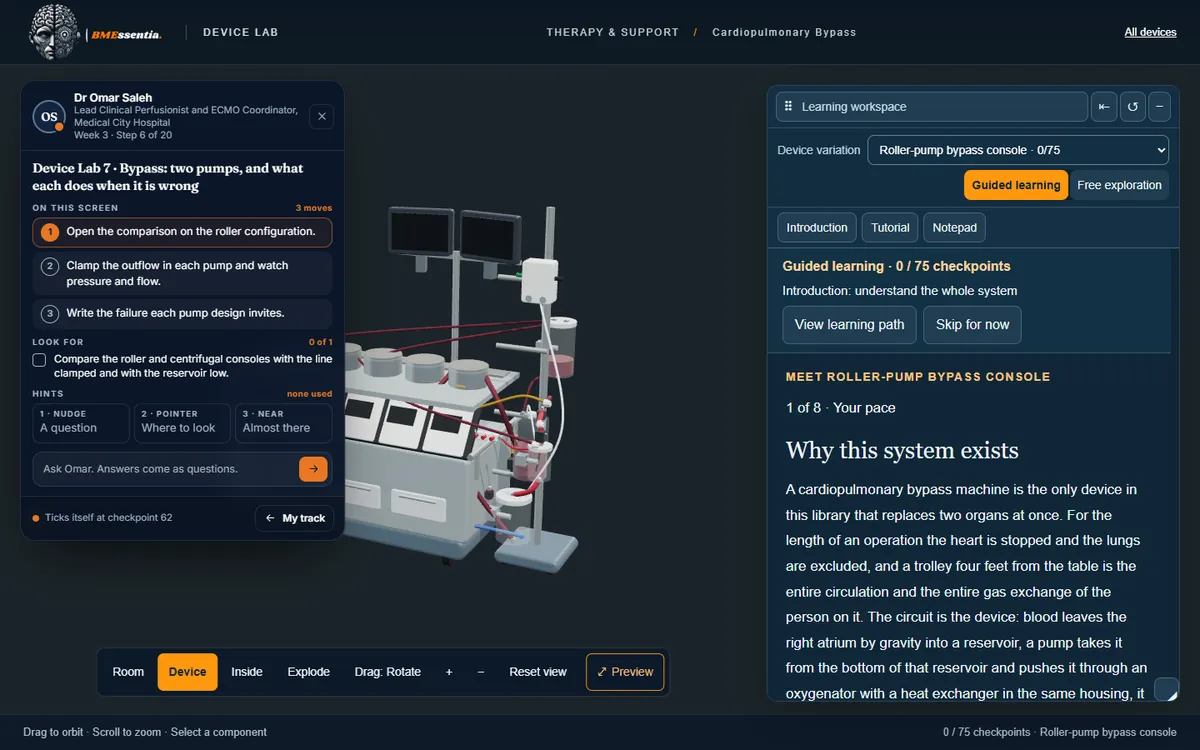
A step with your mentor in the Device LabThe step names what to look at on the real device, with hints that never give the answer away.Shown: Cardiopulmonary Bypass with Dr Omar Saleh, this track's mentor
A simulation
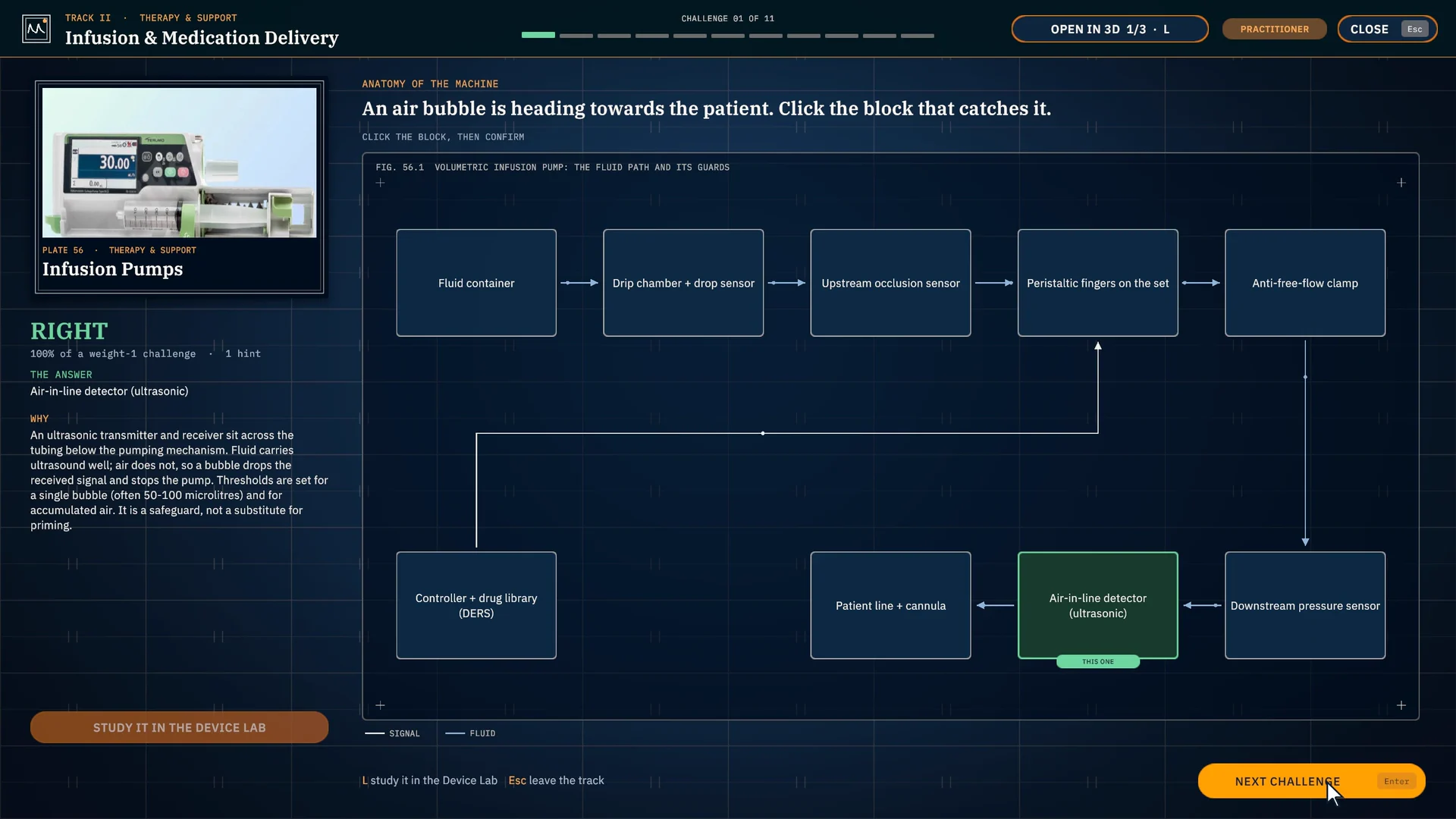
A simulationReal hospital work in Medical City, scored and debriefed, at your level.
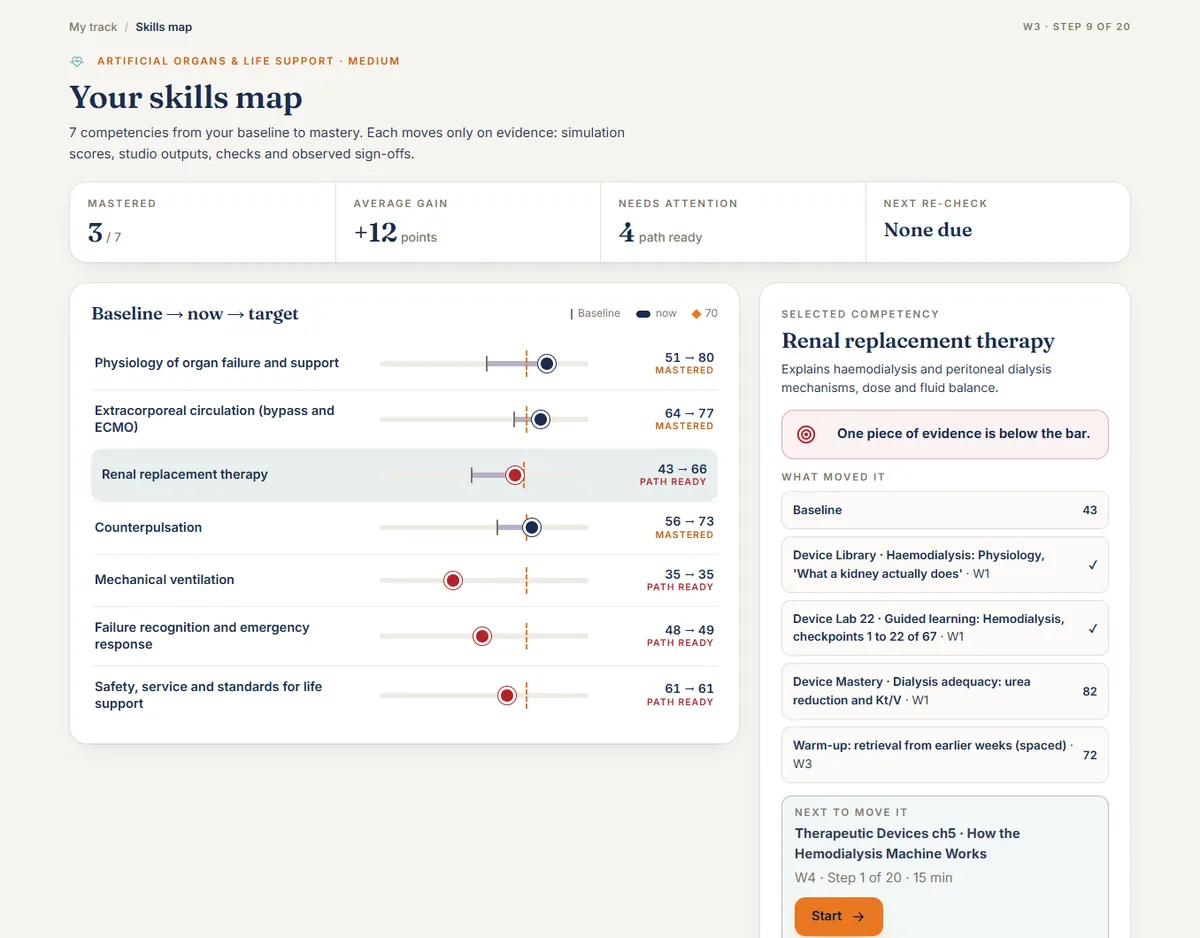
Your skills map
Your skills mapThis track's own competencies, from your baseline to mastery. They move only on evidence.Shown: a sample learner's progress
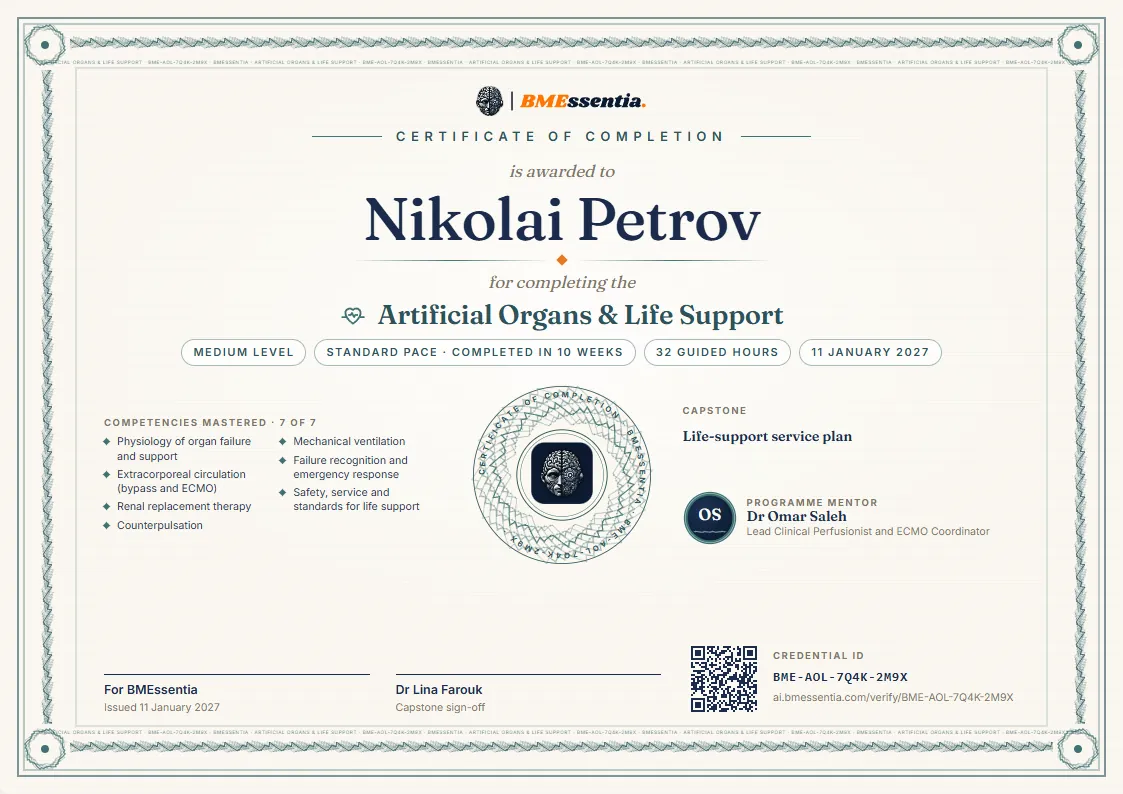
The certificate
The certificateA Certificate of Completion in the track's colours, with the work behind it.Shown: a sample for Nikolai Petrov, a fictional learner

The arc

10 weeks, one running case.

Each week is one working shift: learn, see inside, do, work, think, check, reflect. Open a week to see its real steps.

The arc, week by week

  1. Week 1Three organs, one oxygen budget
  2. Week 2Device Lab week: inside the bypass console and the balloon pump
  3. Week 3The extracorporeal circuit: bypass and ECMO
  4. Week 4Kidney replacement and counterpulsation
  5. Week 5Who goes on which machine: clinical use and ventilation
  6. Week 6Device Lab week: the ventilator, and the faults before the failures
  7. Week 7Circuits that fail
  8. Week 8Safety, service and the standards: water, heat and home
  9. Week 9The night everything runs on a machine (boss week)
  10. Week 10Mr Haddad goes home: the capstone
  1. Week 1Three organs, one oxygen budget4.6 h

    Mr Haddad in cardiogenic shock: which organ fails first, and what each machine would have to do.

    • DoDevice Mastery · ECMO and bypass: the physiology numbers20 min
    • See insideDevice Lab 9 · IABP: the physics this device rests on10 min
    • WorkOne-page physiology-to-machine explainer15 min
    • LearnHuman Physiology ch3 · The Circulatory Process: How Blood Moves Through the Body15 min
    • + 14 more steps

    You make: Physiology-to-machine explainer

  2. Week 2Device Lab week: inside the bypass console and the balloon pump6.5 h

    The machines Mr Haddad may need next, learned on the bench first.

    • See insideDevice Lab 7 · Guided learning: Roller-pump bypass console, checkpoints 1 to 24 of 7572 min
    • WorkNormal working and first signs sheet15 min
    • CheckCheck: circuits and counterpulsation (interleaved)8 min
    • ReflectReflect5 min
    • + 4 more steps

    You make: Normal working and first signs sheet

  3. Week 3The extracorporeal circuit: bypass and ECMO6 h

    Mr Haddad on bypass, with ECMO standing by.

    • DoDevice Mastery · The circuit: pumps, sweep and pressures20 min
    • See insideDevice Lab 7 · Bypass: two pumps, and what each does when it is wrong10 min
    • WorkAnnotated extracorporeal circuit map20 min
    • LearnProsthetic Devices ch4 · Working Principles of Artificial Lungs & Blood-Gas Exchange Devices15 min
    • + 16 more steps

    You make: Annotated extracorporeal circuit map

  4. Week 4Kidney replacement and counterpulsation3.9 h

    Mr Haddad on a balloon pump, with failing kidneys.

    • DoDevice Mastery · Counterpulsation: helium, the controller and the cycle20 min
    • See insideDevice Lab 9 · IABP: ECG-triggered against pressure-triggered timing10 min
    • WorkIABP timing teaching sheet15 min
    • LearnTherapeutic Devices ch5 · How the Hemodialysis Machine Works15 min
    • + 16 more steps

    You make: IABP timing teaching sheet

  5. Week 5Who goes on which machine: clinical use and ventilation5.1 h

    Mr Haddad escalates from balloon pump to ECMO, ventilated.

    • DoDevice Mastery · Mechanical ventilation: modes, mechanics and time constants20 min
    • See insideDevice Lab 10 · Ventilator: increased circuit resistance10 min
    • WorkECMO bedside quick card15 min
    • LearnTherapeutic Devices ch7 · Types of Ventilators10 min
    • + 17 more steps

    You make: ECMO bedside quick card

  6. Week 6Device Lab week: the ventilator, and the faults before the failures5.5 h

    Mr Haddad's weaning, and the faults the failure weeks will bring.

    • See insideDevice Lab 7 · Guided learning: Centrifugal-pump bypass console, checkpoints 31 to 42 of 7536 min
    • WorkLife-support fault table15 min
    • CheckWarm-up: retrieval from earlier weeks (spaced)8 min
    • ReflectReflect5 min
    • + 7 more steps

    You make: Life-support fault table

  7. Week 7Circuits that fail4.5 h

    Mr Haddad's oxygenator clotting, his balloon mistimed, and a second patient haemolysing.

    • DoDevice Mastery · Circuit emergencies20 min
    • See insideDevice Lab 8 · ECMO: clot forming in the membrane10 min
    • WorkOxygenator failure response sheet15 min
    • LearnProsthetic Devices ch4 · Complications and Limitations of Artificial Lungs10 min
    • + 18 more steps

    You make: Oxygenator failure response sheet

  8. Week 8Safety, service and the standards: water, heat and home4.6 h

    Mr Haddad on haemodialysis; a unit with a water problem and a home programme to launch.

    • DoTech Detective · Every Tuesday20 min
    • See insideDevice Lab 22 · Haemodialysis: establish the test boundary10 min
    • WorkDialysis unit planned maintenance plan20 min
    • LearnClinical Engineering ch11 · Overview of Safety Protocols: Electrical, Radiation, Biological10 min
    • + 18 more steps

    You make: Dialysis unit planned maintenance plan

  9. Week 9The night everything runs on a machine (boss week)7.2 h

    Power and water fail on a night when Mr Haddad's floor is full.

    • DoMaster Challenge · Power failure20 min
    • See insideDevice Lab 7 · Bypass: what still runs when the power stops5 min
    • WorkLife-support incident record for the night15 min
    • LearnClinical Engineering ch11 · Implementing Safety Protocols in Clinical Environments10 min
    • + 10 more steps

    You make: Life-support incident record for the night

  10. Week 10Mr Haddad goes home: the capstone7.3 h

    Mr Haddad's journey from shock to home dialysis, told through the machines.

    • DoCommissioning · ECMO service launch20 min
    • See insideDevice Lab 22 · Guided learning: Hemodialysis, checkpoints 35 to 67 of 6799 min
    • WorkCapstone presentation20 min
    • LearnProsthetic Devices ch1 · Future of Artificial Hearts and Circulatory Assist Devices10 min
    • + 9 more steps

    You make: Capstone presentation and sign-off

Proof

Only evidence counts.

A step is done when there is evidence: a simulation score, a saved work document, a passed check or a signed observation. Opening a page never ticks anything.

  • Before and afterThe same baseline check on day one and in the final week, scored per competency.
  • Mastery, not attendanceEach competency has a mastery threshold. Below it, the track routes you to the named remediation items and a re-check; a week cannot be ticked complete by opening items alone.
  • The audit packYour weekly work documents and capstones, ready for a supervisor, an employer or an inspector.

The certificate

BMEssentia Certificate of Completion: Artificial Organs & Life Support

It names the track and the level you completed. Your portfolio holds the work behind it.

  • All 10 weeks' required items done at the learner's level
  • At least 6 of 7 competencies mastered
  • Final check at or above the level's pass mark
  • The six core Guided learning journeys completed from the introduction through the last workshop review (bypass centrifugal, VA ECMO, ECG-triggered balloon pump, haemodialysis, automated peritoneal dialysis, ICU ventilator); variants and perspectives available
  • Capstone at 3 or above on every criterion, signed off by the manager or professor (institutions) or AI-assisted rubric review (individuals)

Life-support service plan

For an ECMO and perfusion service (or a dialysis unit), the plan that keeps it safe: commissioning evidence, planned maintenance with sourced limits, water or gas and power at the bed, emergency back-ups, training and records.

Evidence it gives: Service readiness evidence for an inspection.

One patient's technical case file

Mr Haddad's journey (or a real anonymised patient's) through every life-support machine: the physiology each replaced, the settings and their meaning, the failures met and how they were recognised and handled, and the service and safety evidence behind each machine.

Evidence it gives: A case file showing whole-system understanding.

A recorded teaching session for the unit

Design and deliver a 20-minute session for ICU, theatre or renal staff on one machine: what it replaces, how it works, the failure signatures and first actions, with a check and per-person sign-off.

Evidence it gives: Per-person training evidence on life-support equipment.

Three levels

Easy, Medium or Hard.

A baseline check on day one places you, or you choose. The competencies are the same at every level; the support and the pressure change.

Easy

Baseline under 50%, or chosen · simulations at Foundation

Worked examples first; Foundation simulations with the coach on; extra and Hard-only cases hidden.

Medium

Baseline 50% to 74%, or chosen · simulations at Practitioner

Practitioner difficulty; the commissioning, cardiac theatres, water and grand rounds cases shown.

Hard

Baseline 75% and above, or chosen · simulations at Expert

Expert difficulty, every case, timed boss week.

Ways to get this track

On your own, with a plan, or with your organisation.

One-time

This track

$299for 12 months

  • The track's lessons, labs and Medical City scenarios
  • The certificate when you finish
  • The track mentor: 100 questions for the track, more with credit top-ups

General Essentia, the Studios and Design are not included. Subscribe within 30 days and what you paid counts toward your plan.

Premium · Pro

Included in Premium and Pro

$299a year with Premium

  • Premium: 1 active track family at a time, this one or any other
  • Pro: 3 active track families at a time, with heavy AI use
  • Or Premium at $39 a month; one-time tracks cost 25% less with Premium, 40% less with Pro

Organisation licence

Every track for every seat

  • Every track and product, and the dashboard
  • Enrol people or cohorts and follow their progress
  • Seats for a year, an academic year or a semester

FAQ

Answers before you start.

Anything else, write to the team and we answer directly.

  • Yes. An organisation's licence includes every track, core and branch, with the Platform, Medical City, Essentia, the App and the dashboard. Your organisation enrols you on the track, and it appears under My track; there is nothing extra to buy.