Medical City · Simulation 09 of 12
Hospital Operations Manager
Lead the department: budget, technicians, vendors and the board.
What you do
Operations Manager
You run a hospital's medical technology for a whole period from one desk: equipment availability, maintenance, the loan pool, vendors, the budget and the risk register, with events landing every day. It is the work of a head of clinical engineering.
When equipment management slips, patients wait for a ventilator, a monitor or a scanner. A department that reads its numbers, decides by risk and reports honestly keeps care safe and keeps the board's trust.
Your role: the head of clinical engineering.
46 challenges, each at Foundation, Practitioner and Expert level.
How it works
Step by step.
Read the desk first
Before you open the inbox, read where the hospital stands: the KPI tiles and the department board. Start every day on the numbers, not the noise.
Decide the inbox, most urgent first
Events land on the desk: breakdowns, notices, inspections, people. Each needs a decision before its deadline. Decide by consequence to the patient, then by cost.
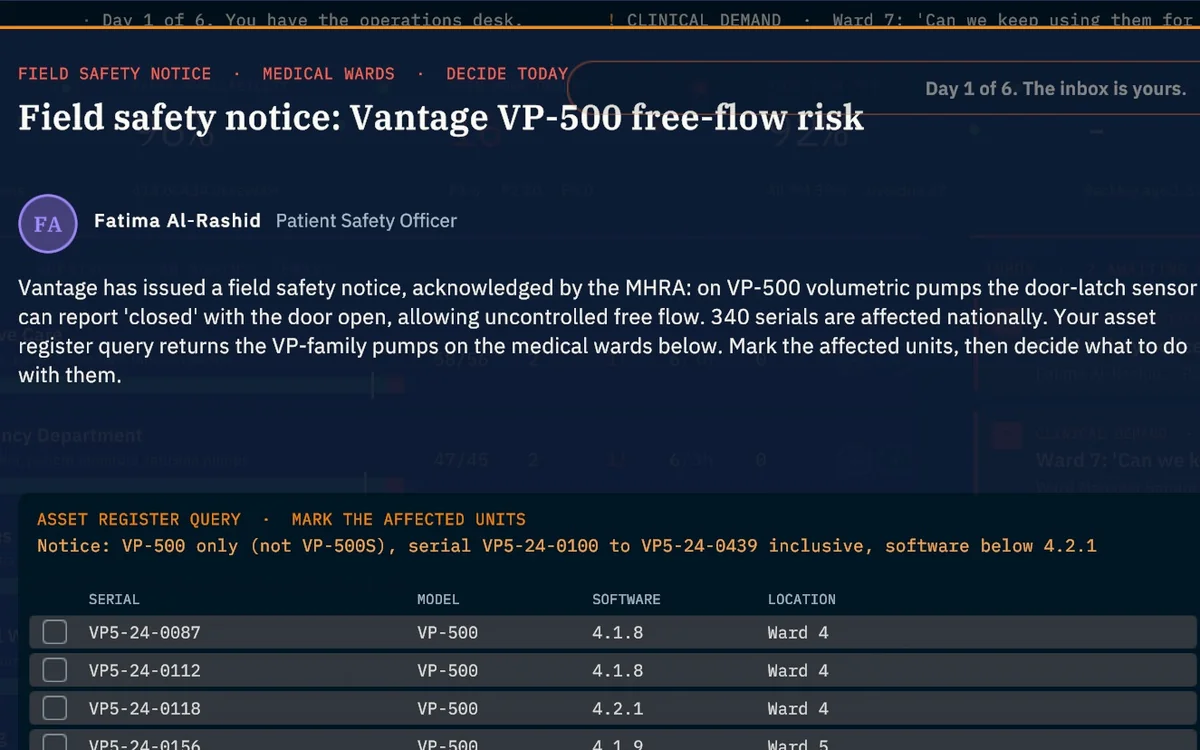
Mark only the affected units
A field safety notice names an affected range. Find every unit in it, and no other. Every condition of the notice must hold.
Rate the risk and escalate it
Some events belong on the risk register, with a rating and an owner. Rate honestly; do not cry wolf.
Technicians, loans, policy
Your technicians, loan pool, overtime and PM policy decide what gets done each day. Protect life-critical work first.
Work orders: bench or contract
Broken devices wait as work orders, by priority. Keep the bench for what only you can fix fast.
End the day and read the handover
The day's work is done, new failures happen and delayed consequences land. Read every handover.
Report to the board
The board asks a question; you answer with up to five figures and one ask. Answer the question asked, with one clear ask.
Hear the board's verdict
Director Brandt says whether the board approved. The page is judged against the question.
Debrief: the expert's notes
Your score, the trends and the expert's notes. Learn from every call that was not the best.
What it trains
Skills and competencies.
- Prioritise equipment work by clinical risk
- Keep a risk register current and escalate correctly
- Use technicians, loans, vendors and budget well
- Report to a board from the right figures
In the BMEssentia competency framework, this simulation builds 19 competencies across Patient & Electrical Safety, Maintenance & Performance Testing, Device Technology & Fault Finding, Clinical Environment & Infrastructure, Procurement & Technology Lifecycle, Regulation, Design & Quality, Incident Investigation & Learning, Leadership & Professional Practice.
- Patient & Electrical Safety
Alarm safety and configuration
Understand alarm priorities, limits, latency and alarm fatigue, and verify that alarms reach the people who must act on them.
- Patient & Electrical Safety
Decontamination and infection prevention
Make devices safe to handle and reuse: cleaning, disinfection, sterilisation, reprocessing validation and clean to dirty flow.
- Maintenance & Performance Testing
Risk-based maintenance planning
Set planned preventive maintenance intervals and priorities by device risk, failure history and manufacturer advice.
- Maintenance & Performance Testing
Service records and documentation
Keep complete, honest and timely CMMS records, job sheets and device tags so every action can be traced and trusted.
- Device Technology & Fault Finding
Device integration and interoperability
Connect devices to central stations, EPR and PACS safely using HL7, DICOM and IEC 80001-1, and validate the data end to end.
- Device Technology & Fault Finding
Medical device cybersecurity
Assess and reduce cyber risk in networked devices: inventory, segmentation, patching, SBOM and incident response.
- Clinical Environment & Infrastructure
Emergency response and resilience
Keep medical technology working through power, gas, IT and supply failures and major incidents.
- Procurement & Technology Lifecycle
Tender evaluation and whole-life cost
Evaluate bids fairly with weighted quality and price, whole-life cost and clear award justification.
- Procurement & Technology Lifecycle
Vendor and service contracts
Manage warranties, service contracts, uptime terms and supplier performance, and enforce them with evidence.
- Procurement & Technology Lifecycle
Asset management and replacement
Keep an accurate asset register and plan replacement, obsolescence and safe decommissioning over the whole life.
- Procurement & Technology Lifecycle
Capital projects and budgets
Set budgets with contingency, manage programme and scope change, and report cost honestly on capital projects.
- Regulation, Design & Quality
Risk management
Identify hazards, estimate and control risk with ISO 14971, and keep risk registers and residual risk honest.
- Regulation, Design & Quality
Quality systems and audit
Run document control, internal audit, CAPA and accreditation so the department can prove its work is controlled.
- Regulation, Design & Quality
Equipment governance
Apply rules for loans, off-label use, modifications, in-house devices, trials and third-party access to equipment.
- Incident Investigation & Learning
Vigilance, recalls and reporting
Report adverse incidents, act on field safety notices and recalls, and meet duty of candour obligations.
- Incident Investigation & Learning
Fleet data and trend analysis
Use downtime, failure and incident data within and across hospitals to find patterns before harm happens.
- Leadership & Professional Practice
Risk-based prioritisation
Order work, people and spares by clinical risk, secure the patient first and decide well under time pressure.
- Leadership & Professional Practice
Board reporting and business cases
Present engineering risk, performance and investment cases to directors and boards in clear, honest terms.
- Leadership & Professional Practice
Training, mentoring and reflective practice
Develop yourself and others: reflect on performance, train users, mentor juniors and transfer knowledge.
The takeaways
- Decide by consequence to the patient.
- Keep the risk register honest and current.
- Answer the board's question with the right figures and one ask.
The challenges
46 training cases.
- 01 First week as head of clinical engineering
Marcus has moved on.
- 02 CQC inspection in five days
Evidence, not a performance.
- 03 Infusion pump recall: 340 affected serials
A free-flow fault, a serial range, and every pump in the building to account for.
- 04 Winter surge: ventilator shortage
The beds will fill.
- 05 Power cut in theatres
Forty seconds without power, four open cases, and everything that rebooted.
- 06 Ransomware on the imaging network
Contain, continue, recover - and never reconnect a device you have not proved clean.
- 07 Vendor insolvency mid-contract
The dialysis contractor is gone.
- 08 Budget cut 15%
Less money, the same patients.
- 09 New wing opens early
Two new theatres, three weeks early.
- 10 Board report: justify the replacement programme
The board sees money.
- 11 The perfect storm: recall, cyber attack and a major incident
Every fix triggers another hazard.
- 12 MRI safety: a near miss and a failing magnet
A steel cylinder at the scan room door, and the helium is boiling off.
- 13 Oxygen supply under strain
Twenty-four patients on high flow and a pipeline built for ten litres a bed.
- 14 Dialysis water: counts, chlorine and a failing RO
The water is above action level, the carbon is breaking through, the patients are booked.
- 15 Heatwave: the neonatal unit cannot cool
Incubators can heat.
- 16 Basement flood: workshop, stores and loan pool
A burst main, a flooded workshop, and forty wet pumps the wards want back.
- 17 Sterile services: when the washers fail
A failed protein test, a failed Bowie-Dick and a theatre that still wants its trays.
- 18 Alarm fatigue: the alarm nobody answered
One missed telemetry alarm, 187 alarms per patient per day, and a programme to fix it.
- 19 Smart pump go-live: 410 nurses, one library
Dose error reduction only works if the library is right and the nurses use it.
- 20 Neonatal unit: incubators, probes and an outbreak
The smallest patients, the narrowest margins, and a fleet that may be the reservoir.
- 21 Defibrillator battery notice: find every pack
A battery that passes its self-test and fails at the shock.
- 22 Ventilator software notice: restart into standby
A rare firmware fault that stops ventilation.
- 23 Unsupported operating systems on clinical devices
End of support arrives.
- 24 Industrial action: the technicians strike
Two strike days.
- 25 Major incident: motorway collision
Twenty-six casualties tonight.
- 26 Respiratory virus wave: CPAP on the wards
Oxygen is a utility with limits.
- 27 Missing equipment: 14% of pumps unaccounted for
Sluices, cupboards, rentals and a register that no longer matches the wards.
- 28 Electrical safety audit: the insurer's findings
Overdue IEC 62353 tests, uncalibrated analysers and a FAIL still in use.
- 29 A patient death and an infusion pump
Secure the evidence, report on suspicion, tell the family, check the fleet.
- 30 Service contract renewals: imaging and beyond
Uptime that means something, first-line in-house, and remedies that bite.
- 31 CT outage on the stroke pathway
One scanner left, a stroke every few hours, and every minute counts.
- 32 Surgical fire in Theatre 5
Oxygen, alcohol and a spark.
- 33 Telemetry dropouts on cardiology
Nine patients vanish from the central station.
- 34 Cath lab down on the heart attack pathway
The only working lab fails mid-PCI.
- 35 Hospital merger: two of everything
Two registers, two PM standards, two defibrillators.
- 36 CMMS migration go-live
A new maintenance system went live at 06:00.
- 37 Holiday weekend on skeleton cover
Four days, one on-call, vendors on holiday hours.
- 38 Global supply shortage
Oxygen cells, probes, sensors and chips: making scarce parts go safely further.
- 39 Endoscope reprocessor failure
A missed disinfection cycle, scopes in use, and every patient to trace.
- 40 Patients' own devices in hospital
Insulin pumps, home ventilators, an LVAD and a device nobody can trace.
- 41 Bariatric and moving-and-handling equipment
Overdue LOLER examinations, a torn sling and beds near their safe working load.
- 42 Year-end capital: ten days to commit
Spend the underspend on the right risks, the right way, and accept it properly.
- 43 Ward decant: two wards into an old space
An empty ward is not a safe ward until every service in it is proven.
- 44 Four new graduates: competence before capacity
New technicians make you slower before they make you stronger.
- 45 Green theatres: cutting the gases safely
Lower carbon, same safety: every green change is still an engineering change.
- 46 Recommissioning theatres after estates works
Air, power, gas, dust, equipment: a theatre reopens on evidence, not on a date.
Standards