Medical City · Simulation 12 of 12
Master Clinical Engineering Challenge
Run the incident desk: every domain at once, against the clock.
What you do
Master Challenge: holding the whole board
The Master Challenge puts every part of clinical engineering on one desk at once: faults, notices, purchases, people and infrastructure, all on a running clock. It exists to train the coordinator's craft: keep patients safe first, delegate with confirmed communication, rank by harm, and explain every call.
In a real hospital crisis, problems do not queue politely. The engineer in command decides which ventilator, defibrillator or gas supply gets attention first, and those decisions decide who is harmed. The same habits, read to the end, protect the fallback, record honestly, keep the next crisis small.
Your role: the engineer in command of the incident desk.
40 challenges, each at Foundation, Practitioner and Expert level.
How it works
Step by step.
Take command of the board
You hold the hospital's engineering desk for the length of the crisis. Problems arrive by radio, phone, email and from the board, each with its own deadline. Patients first, then the kit, then the paperwork. Read every message to the end.
Make the priority call
At Practitioner and Expert, when three or more problems wait, up to four are shown and you set the order you will deal with them. Life-critical first, then severity, then the deadline.
Work each problem
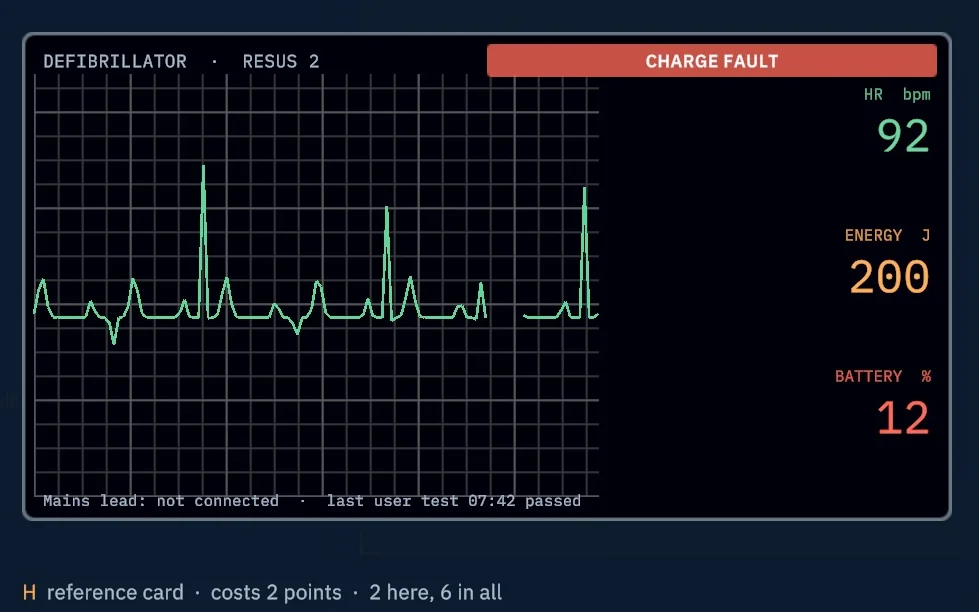
Each problem opens as a card: who sent it, what they know, sometimes a drawn device screen, and the kind of work it needs: a choice, an order, a selection, a share-out or a risk rating. Make it safe, then find the cause, then record it honestly.
Answer the Director's board
At Expert, when the clock stands down, the Director questions you as the hospital board will: why you made your key calls, and what should change. Lead with patient outcomes, then the decision and its reason, then the cost.
Read the debrief
The debrief scores the run: decisions carry most of the score, then patient safety, timeliness and priorities, and stewardship of trust and budget. Every crisis leaves a lesson. Write it down and change something.
What it trains
Skills and competencies.
- Prioritising many problems by harm and time
- Delegating with confirmed communication
- Reading device screens and notices to the end
- Defending decisions with their reasons
In the BMEssentia competency framework, this simulation builds 9 competencies across Device Technology & Fault Finding, Clinical Environment & Infrastructure, Regulation, Design & Quality, Incident Investigation & Learning, Leadership & Professional Practice.
- Device Technology & Fault Finding
Medical device cybersecurity
Assess and reduce cyber risk in networked devices: inventory, segmentation, patching, SBOM and incident response.
- Clinical Environment & Infrastructure
Medical gas systems
Understand medical gas pipelines, outlets, alarms, AGSS and isolation, and keep devices safe during gas work (HTM 02-01).
- Clinical Environment & Infrastructure
Emergency response and resilience
Keep medical technology working through power, gas, IT and supply failures and major incidents.
- Regulation, Design & Quality
Risk management
Identify hazards, estimate and control risk with ISO 14971, and keep risk registers and residual risk honest.
- Incident Investigation & Learning
Evidence preservation
Quarantine devices, secure logs and consumables, and keep chain of custody so evidence stays trustworthy.
- Incident Investigation & Learning
Root cause analysis
Build timelines and find root and contributing causes with 5 Whys, fishbone and barrier analysis in a just culture.
- Leadership & Professional Practice
Risk-based prioritisation
Order work, people and spares by clinical risk, secure the patient first and decide well under time pressure.
- Leadership & Professional Practice
Board reporting and business cases
Present engineering risk, performance and investment cases to directors and boards in clear, honest terms.
- Leadership & Professional Practice
Professional ethics and integrity
Act with honesty and independence: declare conflicts, refuse to falsify records and speak up when safety is at risk.
The takeaways
- Patients' fallbacks first, then the infrastructure, then the root cause.
- Coordinate: delegate with confirmed communication, do not run yourself.
- Rank by harm and time to harm, not by arrival.
- Never alter, hide or backdate a record; tell the truth and show the fix.
The challenges
40 training cases.
- 01 Major incident: the motorway pile-up
Twenty-three casualties, every device needed at once.
- 02 The night the power failed
02:10.
- 03 Cyber attack during a heatwave
Ransomware on the network, 38 C outside, imaging overheating.
- 04 The recall that hit every ward
186 syringe drivers, one silent alarm, every ward at once.
- 05 Inspection day goes wrong
The regulator is in theatres, and so is the failing equipment.
- 06 Opening day of the new wing
Five theatres, 412 new devices, a Minister at ten.
- 07 Pandemic surge, week one
Oxygen, ventilators and people, all running short together.
- 08 The Board's final question
Three incidents, one hidden cause, and your record on trial.
- 09 Flood night: the basement goes under
A burst main, live sockets and the hospital's spares in rising water.
- 10 The day the water stopped
A contaminated supply, nine hours of storage, and every device that drinks.
- 11 Ransomware on Christmas Eve
A skeleton crew, a flat network, and a note demanding payment.
- 12 Oxygen on the edge
Thirty-four patients on oxygen, frosted vaporisers and a delivery in doubt.
- 13 Fire in Theatre 3
A flash fire at the airway, a notice on the same ESU, and a scene to protect.
- 14 Snowbound
Two engineers of seven, a failing grid and patients' own ventilators in ED.
- 15 The neonatal outbreak
Bacteria in the humidifiers, a silent phototherapy fault and a ventilated transfer.
- 16 A polisher in the magnet
An MRI projectile, an arcing CT tube and one scanner carrying the stroke pathway.
- 17 Stuck between floors
A ventilated patient in a stalled lift, thirty minutes of oxygen and one lift left.
- 18 The chlorine cloud
Fourteen casualties, a decontamination area and equipment that must not cross the line.
- 19 Downtime
The record goes dark and every connected device loses the other half of its job.
- 20 Forty beds in a sports hall
Turn an empty hall into a ward that keeps oxygen-dependent patients safe.
- 21 Evacuating ICU
Smoke in the corridor, eleven ventilated patients and an oxygen valve everyone wants closed.
- 22 Three notices before breakfast
A consumable, a software fault and a connector, all urgent, all at once.
- 23 Merger day one
A second hospital, a spreadsheet register and devices that do not match.
- 24 The longest night
One on-call engineer, six calls, and only one that could not wait.
- 25 When the building moved
8 earthquake, swinging pendants, toppled cylinders and casualties on the way.
- 26 The hottest day
Both chillers trip at 38 °C, and imaging, theatres and servers start to cook.
- 27 Air from the oxygen outlet
Patients desaturating on 'oxygen' after a night of pipeline work.
- 28 186 patients, no data
The virtual ward's cloud goes down and the patients are all at home.
- 29 Moving day
ICU, two wards and theatres into a new tower, and every bed must be proven first.
- 30 Ventilators from the stockpile
Twenty emergency ventilators arrive; eight of them nobody knows.
- 31 Strike day, major incident
Two technicians on cover, a picket line, and a bus crash at 10:40.
- 32 Four times the dose
A service update reset the cath lab's fluoroscopy, and nobody noticed for two weeks.
- 33 The air stopped mid-transplant
An overloaded fan, an open abdomen, and two theatres about to start.
- 34 Forty-one patients and a kinked tube
An endoscope washer that said 'Dose OK' for three days without dosing.
- 35 Thirty percent less
The equipment programme is cut by a third.
- 36 Lightning on the east wing
Burnt monitors, dead telemetry, no nurse call, and a UPS left in bypass.
- 37 The cold chain broke at 01:30
A silent cold room, 600 vaccine doses and a monitoring system nobody tested.
- 38 Four percent too high
Cheap SpO2 probes, a grey-market distributor, and what else came in the same boxes.
- 39 The inspectors walk in
An unannounced inspection of how the hospital manages every device.
- 40 Everything at once
A storm, a recall, an intrusion, a collision and a generator that cannot refill.